
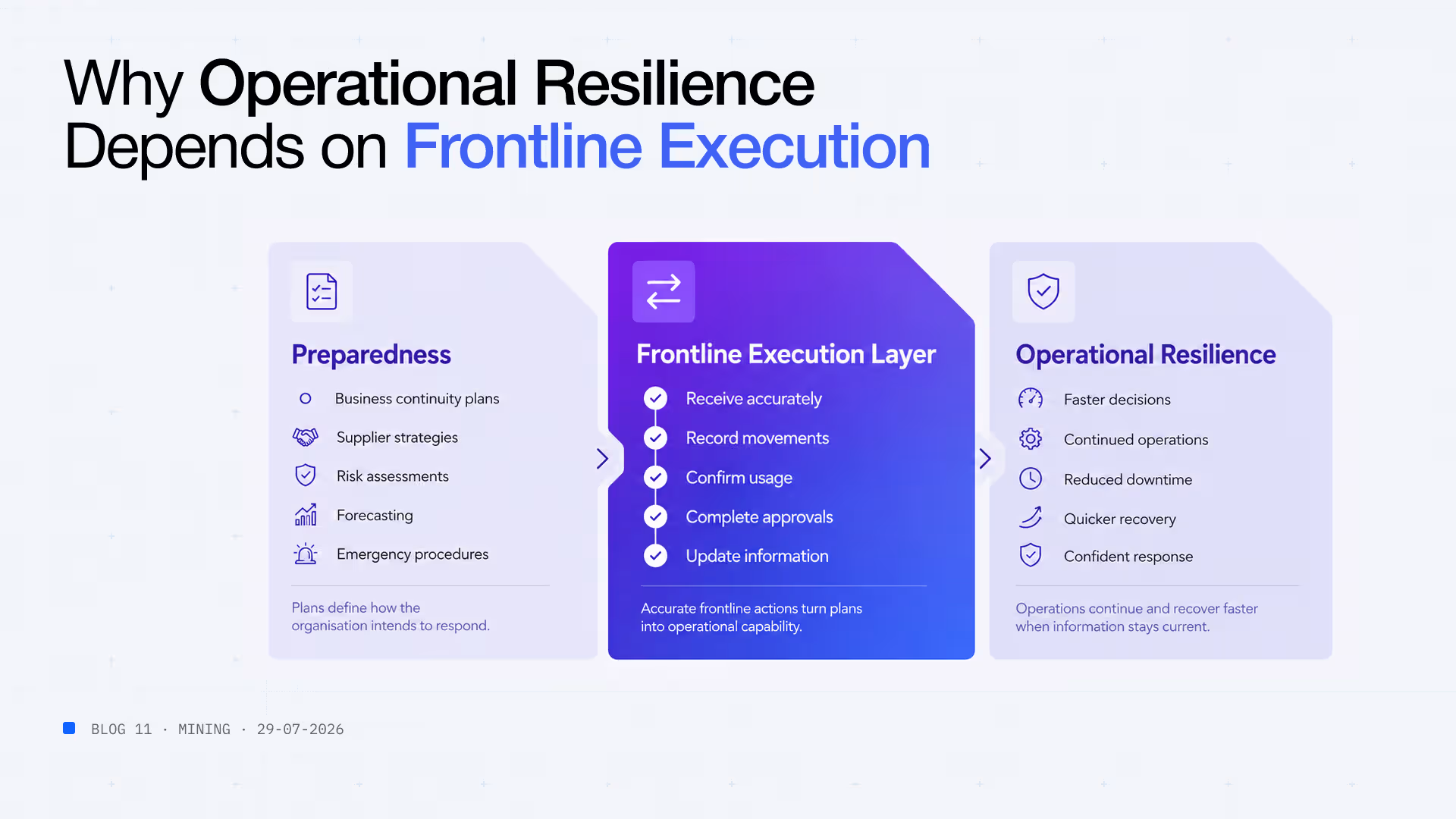
Modern industrial organizations invest heavily in planning.
They build business continuity strategies, strengthen supplier relationships, improve forecasting, and implement new technologies to reduce operational risk. These initiatives play an important role in preparing organizations for uncertainty.
Yet when disruptions occur, resilience is rarely determined by planning alone. It is determined by execution.
Every inventory receipt, every material transfer, every maintenance activity, and every operational transaction contributes to how effectively an organization responds under pressure. The strongest organizations are not simply those with well-documented contingency plans. They are the ones that consistently execute the right processes every day, creating a foundation that supports faster decisions when unexpected events occur.
Operational resilience begins long before disruption arrives.
Operational resilience is an organization's ability to continue delivering critical operations despite disruptions.
These disruptions can take many forms. Supplier delays, labour shortages, transportation challenges, equipment failures, cybersecurity incidents, and sudden changes in demand all test an organization's ability to adapt without compromising productivity.
Resilience does not eliminate disruption. Instead, it minimizes its operational impact by ensuring that people, processes, and information continue to support business operations.
This is why resilience has become a strategic priority across industrial sectors.
Organizations often associate resilience with planning.
Business continuity plans, emergency response procedures, and risk assessments are all valuable. However, these documents only become effective when operational teams can execute them consistently.
Consider a maintenance shutdown.
The plan may identify every required task and every necessary spare part. But if inventory locations are inaccurate, material movements are not recorded, or information is outdated, execution slows immediately.
The disruption itself may be unavoidable. The operational delay often is.
Resilience depends on the ability to execute daily processes accurately, even during periods of uncertainty.
Turn everyday frontline actions into reliable data. Discover how Scatterlink’s mobile execution layer automates barcode scanning, RFID ingest, and inventory tracking as work happens.
Operational resilience is often discussed in boardrooms. It is actually built on the shop floor.
Warehouse personnel receiving inventory correctly. Maintenance technicians recording inventory usage. Supervisors approving transactions. Procurement teams working with accurate inventory information. Every operational role contributes to the reliability of business information.
When frontline execution becomes inconsistent, resilience weakens. Small operational shortcuts gradually create uncertainty that affects every department relying on accurate information.
Operational failures rarely result from one major mistake, they develop through small inconsistencies repeated over time.
Examples include:
Individually, these situations may appear insignificant.
Collectively, they reduce confidence in operational information and increase the time required to respond when disruptions occur.
When disruptions occur, organizations need answers immediately.
These questions cannot be answered effectively if operational information is incomplete or outdated.
Real-time visibility enables organizations to assess operational conditions quickly, prioritize actions, and restore productivity faster.
Visibility is not simply about knowing what happened.
It enables organizations to determine what should happen next.
Connect field activity directly to your enterprise records. See how Scatterlink creates a real-time single source of truth across all your warehouses, yards, and sites.
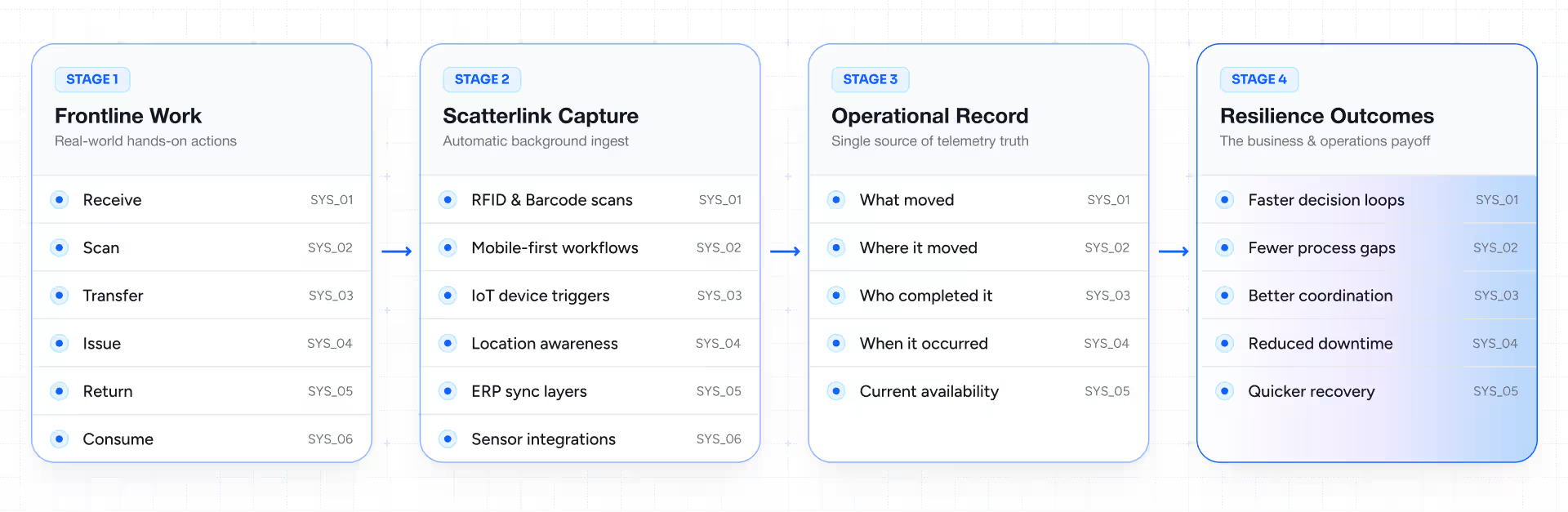
Technology contributes to resilience when it supports operational consistency.
Employees should not need extensive training to complete routine inventory transactions. They should not rely on manual spreadsheets or delayed updates to maintain operational records.
The most effective systems integrate naturally into existing workflows, reducing administrative effort while improving the quality of operational information.
When technology makes the correct process the easiest process, organizations improve both productivity and compliance without increasing operational complexity.
Scatterlink helps organizations strengthen operational resilience by improving the quality of information available to every decision-maker.
Our Inventory Intelligence Platform combines RFID, barcode technology, IoT devices, mobile workflows, and ERP integration to provide real-time visibility into inventory movement, location, and usage. Rather than creating additional work, Scatterlink simplifies everyday operational processes so transactions are captured naturally as work is completed.
This provides accurate, intelligent, and actionable information that supports frontline workers, supervisors, maintenance teams, procurement professionals, and executive leadership.
When every operational decision is supported by reliable information, organizations become better prepared for whatever disruption comes next.
Ready to shorten decision loops and reduce operational downtime?Book a live demo with a Scatterlink specialist to see frontline-driven resilience in action.
Operational resilience is often viewed as a strategic initiative. In reality, it is built through thousands of everyday operational decisions. Organizations become more resilient when inventory movements are recorded accurately, information is updated in real time, and operational teams follow consistent workflows.
These practices reduce uncertainty, improve collaboration, and enable faster responses when disruptions occur. Technology plays an important role in that process, but resilience is ultimately created by people executing the right processes with reliable information.
The organizations that invest in both will be better positioned to navigate uncertainty while maintaining operational performance.
Operational resilience is an organization's ability to continue critical business operations during disruptions while minimizing operational impact.
Frontline employees perform the operational activities that generate the information organizations rely on for decision-making. Consistent execution improves data accuracy and supports faster responses during disruptions.
Real-time operational visibility enables organizations to locate inventory, prioritize resources, reduce delays, and make informed decisions when responding to unexpected events.
Technology supports resilience by simplifying workflows, improving operational visibility, reducing manual errors, and providing accurate, real-time information for decision-making.
Scatterlink combines RFID, barcode scanning, IoT devices, mobile workflows, and ERP integration to provide accurate, intelligent, and actionable inventory information that helps organizations strengthen operational resilience.
RFID inventory management uses radio frequency identification (RFID) technology to automatically identify, locate, and track inventory throughout its lifecycle. Compared to manual inventory processes and barcode-only systems, RFID provides faster inventory counts, improved inventory accuracy, and real-time visibility across warehouses, stockyards, field locations, and industrial operations.
RFID asset tracking software helps organizations monitor inventory and equipment in real time by combining RFID tags, readers, mobile applications, and centralized inventory intelligence. It reduces manual data entry, shortens inventory search time, improves inventory accuracy, and provides complete visibility across multiple operational locations.
Mining operations manage inventory across warehouses, stockyards, sea cans, laydown yards, workshops, field locations, and underground environments. Purpose-built asset tracking software for mining, mining asset tracking platforms, and mining equipment tracking systems provide real-time visibility, offline mobile capability, and RFID-based tracking that traditional warehouse management systems are not designed to support.
%20(1).avif)
.avif)
%20(1).avif)