
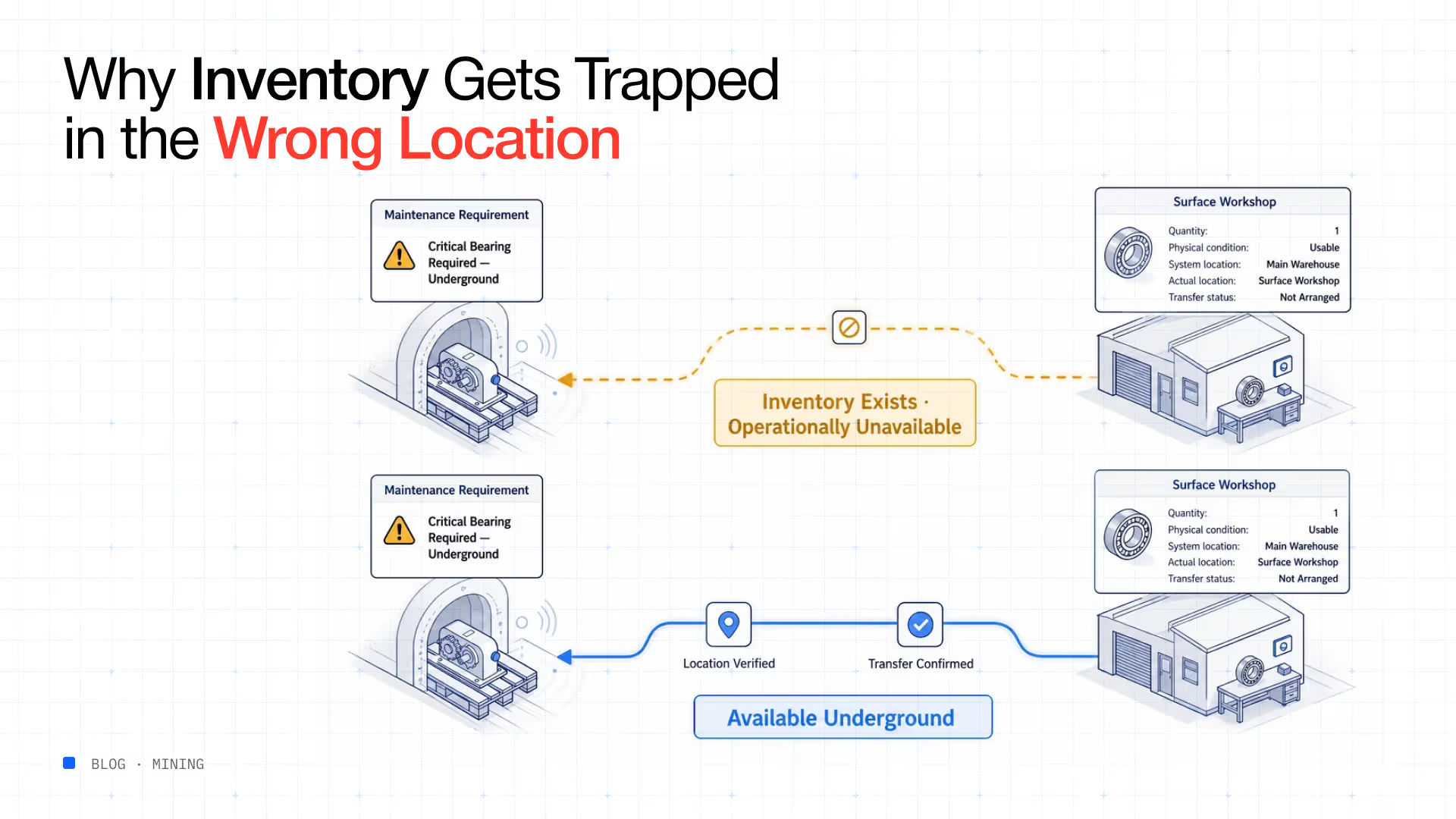
Inventory availability is not simply about whether a part exists somewhere within an organisation. For industrial operations, the location of that inventory can determine whether it is actually useful when maintenance or production teams need it. A critical spare sitting in the wrong warehouse may be technically available, but operationally unavailable if nobody can locate or access it in time.
This problem becomes more complex when inventory is distributed across multiple warehouses, workshops, surface locations and underground operations. Parts can move between locations for maintenance, replenishment, transfers or operational requirements, and every movement creates an opportunity for inventory records to fall out of sync with physical reality.
When organisations cannot maintain accurate visibility into inventory location, they can end up purchasing parts they already own, holding unnecessary stock at individual sites and experiencing stockouts despite having sufficient inventory elsewhere. Understanding why inventory becomes trapped is therefore an important part of improving inventory availability and inventory control.
Inventory is considered trapped when stock exists within an organisation but cannot be efficiently accessed, located, transferred or used where it is required. The inventory may be physically sitting in a warehouse, workshop or operational area, but its location or status prevents it from fulfilling a current requirement.
For example, a maintenance team may need a specific spare part at one site while the same component is sitting unused at another location. If the requesting team cannot see that stock, determine its condition or arrange a transfer quickly, it may purchase another part instead.
Trapped inventory is therefore not always physically inaccessible. It can also be information-inaccessible, meaning the organisation owns the inventory but does not have enough reliable information to make it usable.
Inventory can become trapped for several reasons, ranging from inaccurate location records to decentralised purchasing and inefficient transfer processes. In many cases, the problem develops gradually as inventory moves through the operation without each movement being captured accurately.
Common causes include:
These issues can create a gap between where inventory is recorded and where it actually exists. Over time, that gap makes inventory increasingly difficult to manage.
Location accuracy is a fundamental part of inventory visibility. If an inventory management system states that a component is stored in Warehouse A but the physical item has been moved to Warehouse B, anyone searching the system may waste time looking in the wrong location.
The problem becomes more serious when the incorrect location is not discovered quickly. Other transactions may continue to occur based on the inaccurate record, making it increasingly difficult to determine the actual inventory position.
For critical spare parts, a location error can have operational consequences. A part may technically be in stock, but if maintenance teams cannot find it when required, the organisation may need to arrange an emergency purchase or transfer.
Inventory transfers are one of the most common points at which location accuracy can deteriorate. A physical part can move from one site to another in minutes or hours, while the corresponding system transaction may be delayed or missed entirely.
When this happens, the original location may continue to show inventory that is no longer there. The receiving location may physically have the part but have no corresponding system record showing that it has arrived.
This creates a two-sided problem. One location has false inventory visibility while the other has physical inventory that may not be visible in the system. Both conditions can contribute to unnecessary purchases and longer inventory search times.
Industrial organisations often operate with inventory distributed across multiple locations. A central warehouse may supply several operational sites, while individual sites may also maintain their own spare parts and MRO inventory.
Without a consolidated view, each location may make inventory decisions based only on what it can see locally. This can lead to unnecessary replenishment because teams may not know that the required item already exists elsewhere.
Cross-site inventory visibility changes the decision-making process. Instead of asking whether a part is available at one location, teams can determine whether the organisation has the part anywhere in its network and whether it can be transferred within the required timeframe.
Maintenance activities can create temporary inventory locations that eventually become permanent. Spare parts may be issued to a work area, moved to a workshop or taken to equipment, but the inventory record may not reflect the final location after the maintenance activity is completed.
For example, unused components may be returned from a maintenance job but placed in a different storage area from where the system expects them. If the return transaction is not captured correctly, the system can continue showing the inventory at its previous location.
These small process gaps can accumulate over time. The result is an inventory network where parts physically exist but are increasingly difficult to locate.
Emergency purchasing can create a cycle of inventory accumulation. When a critical part cannot be located quickly, a team may purchase a replacement to avoid delaying maintenance or production.
The original inventory may later be found, leaving the organisation with two units instead of one. If this happens repeatedly, emergency purchases can gradually create excess inventory across multiple sites.
The problem is not necessarily the emergency purchase itself. The deeper issue is the lack of visibility that made the purchase necessary. Improving inventory location accuracy can reduce the likelihood that organisations purchase replacement stock simply because existing inventory cannot be found.
One of the most important distinctions in industrial inventory management is the difference between physical availability and operational availability. Physical availability means the item exists somewhere in the organisation. Operational availability means the item can be accessed, transferred and used within the timeframe required.
A spare part located several hours away may technically be available, but it may not be a practical solution for an urgent equipment failure. Similarly, a component recorded at a warehouse but physically sitting in an unregistered temporary location may be effectively unavailable.
This is why inventory location needs to be considered alongside criticality, response time and transfer capability.
Inventory trapped in the wrong location creates costs that extend beyond the value of the stock itself. Organisations may need to purchase duplicate parts, expedite deliveries, transfer materials between sites or spend additional labour hours searching for inventory.
There is also an opportunity cost. Capital remains tied up in stock that is not being effectively utilised, while another location may be purchasing the same item to meet its own requirement.
Over time, these costs can become significant, particularly for organisations managing high-value MRO and spare parts inventory across multiple industrial sites.
Trapped inventory can create a misleading inventory position. An organisation may appear to have sufficient stock when viewed at the total network level, while individual sites experience stockouts because the required inventory is located elsewhere.
This can result in unnecessary emergency procurement and maintenance delays. It can also make inventory performance difficult to measure because the organisation has both excess inventory and shortages at the same time.
A network-wide inventory view can help identify these imbalances. When teams can see where inventory is located and whether it can be accessed or transferred, they can make better decisions before ordering additional stock.
The first step is to compare system locations with physical locations. Regular cycle counts and location audits can identify discrepancies, but organisations should also analyse inventory movement data to determine where location errors are occurring.
Useful indicators include:
These indicators can help identify locations where inventory is consistently becoming disconnected from the system.
Organisations often focus on quantity accuracy while overlooking location accuracy. Knowing that 100 units exist does not provide much operational value if the system cannot reliably tell users where those units are.
Location accuracy should therefore be tracked as a separate inventory KPI. Teams can measure the percentage of inventory records where the recorded location matches the verified physical location.
For industrial operations with multiple warehouses and operational areas, this metric can reveal problems that a general inventory accuracy percentage may hide.
RFID can help organisations improve inventory visibility by using radio-frequency identification to capture tagged inventory and its movement through designated points. Instead of relying entirely on manual recording, RFID-enabled processes can provide additional visibility into when tagged inventory moves between locations.
This can be particularly useful where inventory moves frequently between warehouses, workshops and operational areas. Better movement visibility can help organisations identify where inventory has moved and reduce the gap between physical inventory and digital records.
For industrial operations looking to strengthen location visibility, explore Scatterlink’s RFID inventory management solution to understand how RFID can support inventory tracking from receipt through consumption.
Every inventory movement should create an accurate transaction. Receiving, issuing, transferring and consuming inventory all affect either the quantity, location or availability of stock.
When these transactions are delayed or skipped, inventory records become less reliable. This can make it difficult to distinguish between genuine stock shortages and inventory that simply exists somewhere else.
Strong transaction controls therefore form the foundation of reliable inventory location data. Learn more about Scatterlink and how connected inventory visibility can help industrial organisations maintain better control over inventory movements.
Recovering trapped inventory starts with identifying the gap between recorded and physical inventory locations. Organisations should compare inventory records against physical counts, recent transfer activity and known maintenance movements to determine where discrepancies have occurred. This creates a clearer picture of which items are genuinely missing and which are simply recorded against an outdated location.
Once the discrepancies are identified, inventory teams can correct location records and establish the appropriate physical storage location for each item. High-value and critical spare parts should generally receive priority because inaccurate location information for these items can create greater operational risk. The objective is not simply to update the system, but to restore confidence that inventory records accurately represent where usable stock can be found.
Temporary storage areas can become a significant source of trapped inventory. Parts may be placed in maintenance workshops, staging areas, project stores or equipment laydown areas while awaiting use, return or transfer. If these locations are not formally included in inventory controls, stock can remain there long after the original requirement has passed.
Organisations should identify temporary inventory locations and determine how long stock has remained there. Items that have been sitting in these areas for extended periods should be reviewed to determine whether they should be returned to controlled storage, transferred to another location or allocated to an upcoming requirement.
Creating visibility into temporary inventory prevents usable stock from effectively disappearing from the operational inventory network. It also reduces the likelihood that teams will purchase additional inventory simply because they cannot find parts that are already owned.
When inventory exists at the wrong location, transferring it can be more efficient than purchasing additional stock. A cross-site inventory transfer allows an organisation to use existing inventory while reducing unnecessary duplication across its network.
However, transfers should be based on reliable information. Teams need to know the quantity available, physical location, condition, criticality and expected transfer time before deciding whether an item can meet another site’s requirement.
A structured transfer process can also help organisations identify recurring imbalances. If one site consistently accumulates a particular spare while another repeatedly purchases it, the issue may indicate that inventory policies or replenishment settings need to be reviewed.
Not every trapped item requires immediate relocation. Inventory decisions should consider the operational importance of the part, its value, demand pattern and the consequences of being unavailable.
Critical spare parts should receive greater attention when their current location creates a risk to production or maintenance response times. Lower-priority items can be reviewed as part of routine inventory optimisation.
This approach prevents teams from spending equal effort on every location discrepancy. Instead, resources can be directed towards inventory where improving availability will have the greatest operational impact.
Inventory should ideally be positioned according to where and how frequently it is required. A location holding large quantities of a part that is rarely consumed may be a candidate for redistribution, particularly when another location has regular demand for the same item.
Comparing inventory levels with consumption by location can reveal these mismatches. Historical usage provides a useful starting point, while planned maintenance, equipment changes and upcoming projects should also be considered before making relocation decisions.
This type of analysis helps organisations move from simply knowing where inventory is stored to understanding whether it is stored in the most useful location.
Organisations can use specific KPIs to identify and monitor inventory location problems. These metrics help quantify the operational and financial impact of inventory that is difficult to locate, access or transfer.
Useful trapped inventory KPIs include:
This measures the percentage of inventory records where the recorded location matches the verified physical location. A declining location accuracy rate can indicate problems with transfers, returns or transaction processes.
Inventory search time measures how long employees take to locate required stock. Increasing search times can indicate that inventory locations are unclear, records are inaccurate or stock is being stored inconsistently.
This measures instances where a site experiences a stockout even though the required item was available elsewhere in the organisation. A high rate can indicate that inventory is not being effectively shared across locations.
This tracks purchases made when equivalent inventory already existed elsewhere. Repeated duplicate purchases can indicate that existing stock is effectively trapped by poor visibility or inefficient transfer processes.
This measures whether inventory transfers are recorded correctly in terms of item, quantity and location. Strong transfer accuracy helps maintain reliable inventory records across multiple sites.
Inventory in the wrong location can increase working capital requirements because organisations may purchase additional stock while existing inventory remains unused elsewhere. The result is a larger total inventory position without a corresponding improvement in availability.
This can be particularly costly when the trapped inventory consists of high-value spare parts. Multiple sites may maintain local buffers for the same component, creating significant capital duplication across the network.
Improving inventory location visibility can help organisations identify these opportunities before additional purchases are made. Explore Scatterlink’s RFID inventory management solution to strengthen visibility into inventory locations and movements.
Inventory that remains unused for long periods is exposed to a greater risk of becoming obsolete, damaged or incompatible with changing equipment requirements. When stock is distributed across multiple locations without effective visibility, organisations may not recognise that certain parts have become inactive.
Location-level inventory ageing can help identify where older stock is accumulating. Teams can then determine whether the inventory remains required, can be transferred to a location with active demand or should be reviewed for obsolescence.
This is particularly important for specialised industrial components that may have limited applications. The longer these items remain unused, the greater the possibility that their value will decline before the organisation recognises the issue.
Preventing trapped inventory requires controls throughout the inventory lifecycle rather than relying only on periodic stock counts. Every movement should be captured accurately, and every inventory location should be clearly defined and visible to the people responsible for managing stock.
Organisations should establish consistent processes for receiving, issuing, transferring, returning and consuming inventory. Temporary storage areas should also be incorporated into inventory controls rather than treated as locations outside the normal process.
Regular location audits and cycle counts can identify discrepancies before they become significant. Combining these processes with real-time movement visibility can further reduce the gap between physical inventory and digital inventory records.
A major cause of trapped inventory is fragmented information. When each warehouse or site maintains its own view of inventory, teams may have limited visibility into what is available elsewhere.
A consolidated inventory view allows teams to identify stock across the network before purchasing additional parts. It can also help them determine whether existing inventory can be transferred within the required operational timeframe.
For organisations managing distributed industrial inventory, this creates a shift from site-level inventory management to network-level inventory visibility. Learn more about Scatterlink and how inventory intelligence can support connected inventory management.
Industrial operations can face additional inventory location challenges when materials move between surface and underground environments. Inventory may be transferred through multiple operational areas before reaching its point of use, making manual tracking more difficult.
A part that is recorded as being in a surface warehouse may already have been transferred underground, while another component may have been returned to the surface but not recorded correctly. These gaps can make available inventory difficult to locate when maintenance teams need it.
Improving visibility across surface and underground operations helps organisations understand where inventory actually moves throughout its operational lifecycle. This can reduce unnecessary purchasing, improve search efficiency and support better inventory allocation.
The ultimate goal of inventory location management is not simply to know where a part is stored. Organisations need to understand how inventory moves from receipt through storage, transfer, issue and final consumption.
Connecting these stages provides a clearer picture of inventory utilisation. It can reveal where stock is accumulating, which locations are consuming particular items and where inventory is repeatedly being moved without reaching its intended point of use.
This information can support better replenishment decisions and help organisations identify process inefficiencies that contribute to trapped inventory. Explore Scatterlink’s inventory management capabilities to improve inventory visibility across the inventory lifecycle.
Inventory location should be considered whenever organisations make purchasing, replenishment or stock reduction decisions. Before ordering a part, teams should be able to determine whether the same item already exists elsewhere and whether it can meet the requirement.
Before reducing stock at a location, teams should also understand whether the inventory serves another operational requirement. Removing stock without considering network demand can simply move the problem from excess inventory to a future stockout.
A network-wide approach provides the context needed to make these decisions. It allows organisations to consider inventory availability, location, demand and operational requirements together.
Inventory gets trapped in the wrong location when physical movements and inventory information become disconnected. A part can exist somewhere within the organisation and still be unavailable to the team that needs it because its location is inaccurate, its transfer was not recorded or nobody knows that it exists.
The solution is not simply to increase stock levels. Organisations need reliable location information, controlled inventory transactions, cross-site visibility and a clear understanding of how inventory moves through the operational lifecycle.
When teams can see what inventory exists, where it is located and whether it can be accessed or transferred, they can make better decisions before purchasing additional stock. This reduces unnecessary duplication, improves inventory utilisation and helps ensure that critical parts are available where they are needed.
Inventory can become trapped because of inaccurate location records, unrecorded transfers, temporary storage, poor inventory transaction controls, decentralised inventory management and limited visibility across sites.
Trapped inventory is stock that an organisation owns but cannot efficiently access, locate, transfer or use where it is required. It may be physically available but operationally unavailable because its location or status is unclear.
Organisations can compare system records with physical counts, analyse recent inventory movements, review transfer transactions and investigate stockouts where inventory was available elsewhere. Location accuracy KPIs can also identify problem areas.
RFID can provide greater visibility into the movement of tagged inventory through designated locations. When integrated with inventory management processes, this can help organisations maintain more accurate information about where inventory is moving and where it is located.
Yes. A stockout can occur at one location even when the organisation has sufficient inventory elsewhere. If teams cannot see or access that inventory within the required timeframe, they may need to purchase additional stock.
Companies can reduce trapped inventory by improving location accuracy, controlling inventory transactions, monitoring temporary storage, using cross-site transfers and creating a consolidated view of inventory across locations.
Inventory location accuracy helps teams find stock when they need it. Without reliable location information, organisations can waste time searching for parts, purchase duplicate inventory and experience avoidable maintenance delays.
Trapped inventory can increase working capital, storage costs and inventory carrying costs while also encouraging duplicate purchasing. It can additionally increase the risk of inventory becoming obsolete because unused stock may remain unnoticed for long periods.
%20(1).avif)
.avif)
%20(1).avif)