
Warehouses have changed dramatically over the past decade.
Customer expectations continue to rise, supply chains have become increasingly complex and businesses are expected to move inventory faster than ever before. At the same time, organisations face ongoing labour shortages, rising operating costs and increasing pressure to maintain accurate inventory records.
Many warehouses struggle to keep pace.
Employees spend excessive time searching for inventory, warehouse layouts no longer support current order volumes and valuable storage space is occupied by slow-moving materials. Inventory records become increasingly unreliable, creating delays that affect purchasing, production and customer fulfilment.
These issues are rarely caused by a single operational problem.
Instead, they usually develop gradually as warehouse processes fail to evolve alongside business growth.
Warehouse optimization addresses this challenge by improving how inventory moves through the facility rather than simply increasing warehouse capacity.
An optimized warehouse enables employees to locate inventory faster, complete transactions more accurately and fulfil inventory requests more efficiently. Inventory becomes easier to manage, warehouse space is used more effectively and operational decisions become more reliable because they are supported by accurate inventory information.
Whether managing a small distribution facility or a multi-site warehouse network, continuous warehouse optimization has become essential for maintaining operational efficiency and long-term competitiveness.
Warehouse optimization is the continuous process of improving warehouse operations to increase productivity, maximise storage capacity, improve inventory accuracy and reduce operating costs.
Rather than focusing on one specific warehouse activity, optimization examines how inventory moves throughout the entire warehouse.
This includes:
The objective is not simply to make warehouse employees work faster.
Instead, warehouse optimization removes unnecessary movement, simplifies operational workflows and provides employees with better tools to complete their work accurately and efficiently.
Successful warehouse optimization creates measurable improvements in both operational performance and inventory visibility.
Warehouse organization forms the foundation of warehouse optimization.
Even the most advanced warehouse technologies cannot compensate for poorly organised storage locations, inconsistent labelling or inefficient inventory placement.
When inventory is organised effectively, employees spend less time searching and more time performing productive warehouse activities.
Inventory movements become easier to manage, picking routes become shorter and inventory accuracy improves because storage locations remain consistent.
Poor organisation produces the opposite effect.
Employees walk longer distances, inventory is misplaced more frequently and warehouse congestion increases during busy operational periods.
Over time, these inefficiencies increase labour costs while reducing customer service levels.
Warehouse organization should therefore be viewed as an ongoing operational discipline rather than a one-time project.
As inventory profiles, customer demand and warehouse volumes change, storage strategies should evolve alongside them.
Many warehouse inefficiencies develop gradually.
Because employees adapt to existing processes, organisations often fail to recognise optimization opportunities until operational performance begins declining.
Several indicators suggest a warehouse may benefit from optimization.
Inventory searches remain one of the clearest signs of warehouse inefficiency.
When warehouse personnel frequently walk between multiple storage locations before locating inventory, valuable labour hours are being lost every day.
This often indicates inaccurate inventory records, inconsistent storage practices or poor warehouse organisation.
Many warehouses believe they have run out of storage space when the real problem is poor space utilisation.
Slow-moving inventory occupies premium storage locations while vertical storage capacity remains underutilised.
Optimising storage layouts frequently creates significant additional capacity without expanding warehouse facilities.
If warehouse teams require longer to fulfil the same number of inventory requests, operational workflows should be reviewed.
Long travel distances, poor inventory placement and inefficient picking routes all contribute to declining warehouse productivity.
Frequent inventory discrepancies, duplicate purchasing and unexpected stockouts often indicate that warehouse processes are no longer supporting accurate inventory management.
Improving inventory organization and transaction accuracy usually produces significant improvements across multiple operational areas.
Warehouse layout directly influences almost every warehouse activity.
The distance employees travel, how inventory flows through the facility and how efficiently orders are fulfilled all depend on warehouse design.
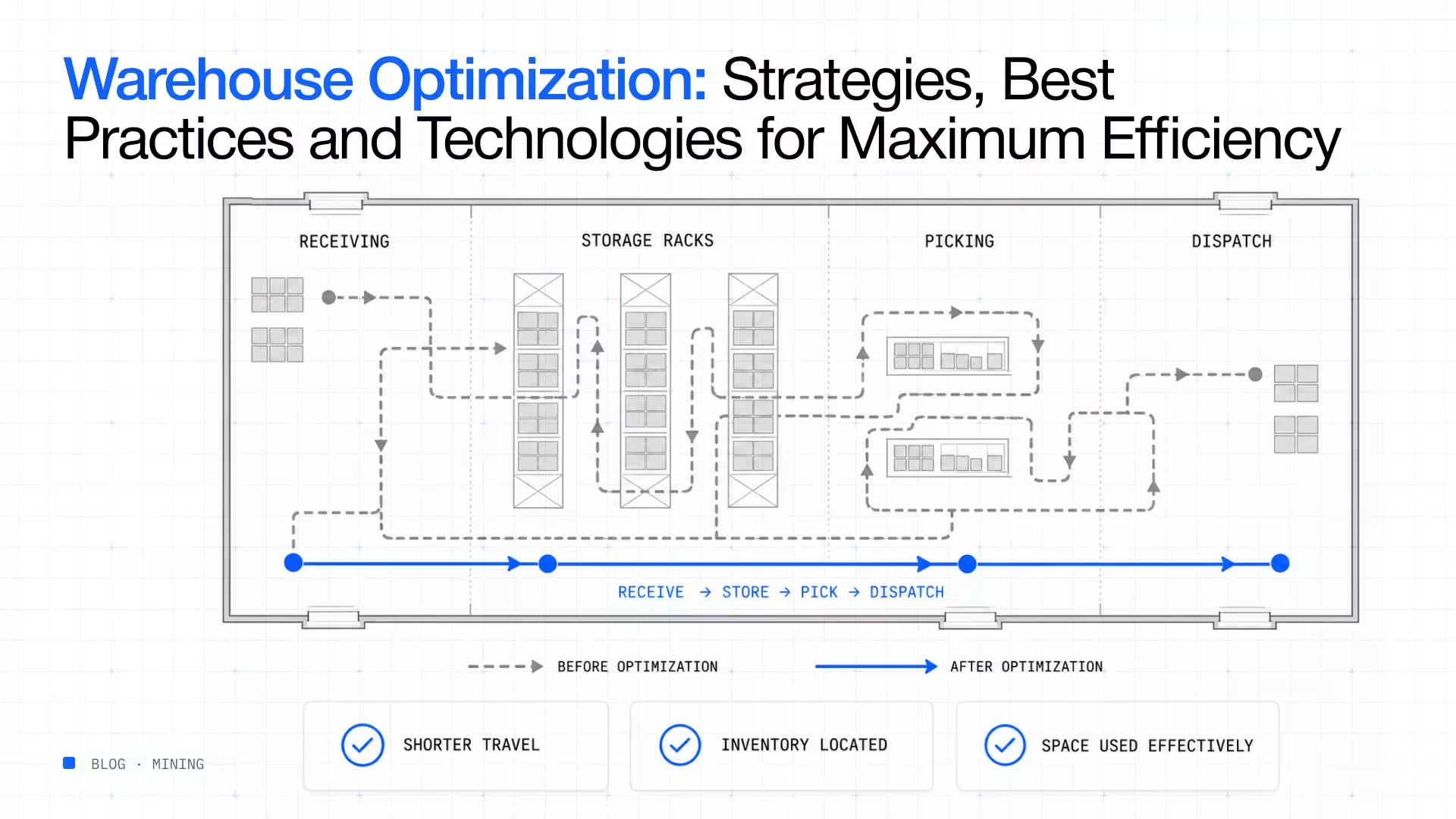
An effective warehouse layout should minimise unnecessary movement while supporting logical inventory flow.
Receiving areas should connect naturally to storage locations. Fast-moving inventory should remain easily accessible. Picking routes should reduce employee travel rather than requiring repeated movement across the warehouse.
Warehouse layouts should also support future growth.
Designing warehouse operations only around current inventory volumes often results in expensive redesigns as business requirements evolve.
Instead, layouts should remain flexible enough to accommodate changing inventory profiles and operational priorities.
Not every inventory item deserves the same warehouse location.
ABC analysis allows organisations to classify inventory based on usage frequency or operational importance.
"A" items represent frequently used inventory that should remain closest to receiving, picking or dispatch areas.
"B" items typically experience moderate inventory movement and occupy secondary storage locations.
"C" items move infrequently and can be stored in less accessible areas without significantly affecting warehouse productivity.
This simple strategy dramatically reduces warehouse travel while improving labour efficiency.
Employees naturally spend more time handling high-demand inventory.
Positioning those items strategically reduces unnecessary movement throughout the warehouse while accelerating order fulfilment.
Scatterlink helps organisations improve warehouse optimization by providing real-time inventory visibility across warehouses, workshops, laydown yards and remote operational locations. With RFID, barcode scanning, offline mobile inventory applications and ERP integration, warehouse teams spend less time searching for inventory and more time moving operations forward.
One of the most common misconceptions in warehouse management is that operational challenges require larger facilities.
In reality, many warehouses have significant unused storage potential.
Vertical storage often remains underutilised.
Wide aisles consume unnecessary floor space.
Slow-moving inventory occupies high-value storage locations.
Duplicate inventory is stored across multiple warehouse zones without clear operational justification.
Warehouse optimization begins by understanding how storage space is currently being used before investing in facility expansion.
By reorganising storage locations, removing obsolete inventory and improving inventory placement strategies, organisations frequently recover substantial storage capacity while improving warehouse efficiency.
Warehouse optimisation becomes significantly more difficult when inventory locations are inconsistent.
Employees should never have to interpret handwritten shelf labels, rely on personal knowledge or search multiple locations before finding the correct inventory item.
Every storage location should follow a standardised naming convention that is easy to understand and easy to maintain.
Clear aisle numbers, rack identifiers, shelf labels and bin locations reduce confusion while making inventory searches faster and more accurate.
Consistent labelling also improves employee onboarding.
New warehouse personnel can become productive much faster when storage locations follow a logical structure rather than relying on tribal knowledge.
When barcode labels or RFID tags are integrated into warehouse location management, inventory verification becomes even faster while reducing manual errors.
Walking is one of the biggest hidden costs inside a warehouse.
Studies consistently show that warehouse personnel spend a significant portion of their shift travelling between storage locations rather than physically handling inventory.
Reducing travel time has a direct impact on warehouse productivity.
Organisations can achieve this by:
Small improvements in travel distance, repeated hundreds of times each day, translate into substantial productivity gains over the course of a year.
Warehouse optimisation starts long before inventory is picked.
Receiving and putaway activities determine how efficiently inventory will move through the warehouse for the rest of its lifecycle.
Inventory should be inspected, labelled and assigned to storage locations as quickly as possible after receipt.
Delays during receiving create congestion, increase handling requirements and postpone inventory availability for production or customer fulfilment.
Efficient putaway strategies also reduce future warehouse travel by placing inventory in locations that align with expected demand and operational priorities.
Rather than assigning storage locations randomly, businesses should consider inventory velocity, physical dimensions, handling requirements and replenishment frequency.
Many organisations still depend on annual physical inventory counts.
While these counts remain important, they often identify inventory problems months after discrepancies first occur.
Cycle counting provides a more effective approach.
Instead of shutting down warehouse operations once a year, selected inventory locations are counted regularly throughout the year.
This allows inventory discrepancies to be identified and investigated much earlier.
Regular cycle counting improves inventory accuracy while reducing the operational disruption associated with large physical stocktakes.
It also helps maintain confidence in warehouse inventory records throughout the year.
Warehouse optimisation depends on accurate information.
If inventory records do not reflect physical inventory movement, even well-designed warehouse processes begin to fail.
Employees waste time searching for inventory.
Procurement teams reorder parts that already exist.
Production schedules are delayed because required materials cannot be located.
Real-time inventory tracking reduces these problems by updating inventory records as transactions occur rather than hours later.
When inventory is received, transferred, picked or consumed, the system immediately reflects the new inventory status.
This creates greater confidence in inventory information while supporting faster operational decisions.
Scatterlink provides real-time inventory visibility by combining barcode scanning, RFID, offline mobile inventory applications and ERP integration. Every inventory movement is captured at the point of work, helping warehouse teams maintain accurate inventory records while reducing search time and operational delays.
Warehouse optimisation increasingly depends on digital technologies working together.
Rather than replacing warehouse personnel, these technologies reduce repetitive manual tasks while improving operational visibility.
A Warehouse Management System helps coordinate warehouse activities such as receiving, putaway, picking and shipping.
It provides operational control while supporting more efficient warehouse workflows.
Barcode technology remains one of the simplest and most effective ways to improve warehouse accuracy.
Scanning inventory during receiving, picking and transfers reduces manual entry while helping verify inventory identity.
RFID extends warehouse visibility beyond traditional barcode scanning.
Multiple inventory items can be identified simultaneously without requiring direct line-of-sight scanning.
This improves transaction speed while supporting larger-scale inventory operations.
Mobile inventory applications allow warehouse personnel to complete transactions directly from handheld devices.
Receiving inventory, confirming picks, completing transfers and performing cycle counts no longer require employees to return repeatedly to desktop workstations.
This improves both productivity and inventory accuracy.
Modern warehouses increasingly rely on Inventory Intelligence to move beyond transaction processing.
Rather than simply recording inventory movement, Inventory Intelligence analyses operational activity to identify inefficiencies, inventory risks and opportunities for improvement.
It transforms warehouse data into actionable operational insights.
Technology alone does not optimise warehouse operations.
Several common mistakes continue preventing organisations from achieving meaningful improvements.
Poor inventory records undermine every warehouse improvement initiative.
Before redesigning warehouse layouts or implementing new technologies, businesses should first improve inventory accuracy.
Warehouse optimisation is not simply about fitting more inventory into the building.
Increasing storage density without considering inventory flow often creates congestion and reduces operational efficiency.
The objective should always be improving movement rather than maximising storage alone.
Warehouse employees interact with inventory every day.
Their experience often reveals operational inefficiencies that are not immediately visible in reports or dashboards.
Successful warehouse optimisation includes employee feedback when reviewing warehouse processes.
Business requirements constantly evolve.
Inventory profiles change.
Customer demand shifts.
Warehouse volumes increase.
Optimisation should therefore become an ongoing improvement process rather than a single implementation project.
Warehouse operations continue becoming more intelligent and increasingly connected.
Artificial intelligence is helping organisations optimise inventory placement and warehouse workflows based on historical movement patterns.
RFID adoption continues expanding as businesses seek faster inventory verification and greater inventory visibility.
Autonomous mobile robots are reducing employee travel while supporting repetitive transport activities.
Predictive analytics is allowing warehouse managers to anticipate congestion, labour shortages and replenishment requirements before operational performance declines.
Despite these technological advances, one principle remains unchanged:
The quality of warehouse decisions depends on the quality of warehouse visibility.
Scatterlink's Inventory Intelligence Platform combines RFID, barcode scanning, mobile inventory management and ERP integration to help organisations optimise warehouse operations through accurate, real-time inventory visibility from receipt through consumption.
Warehouse optimisation is not achieved through a single technology or process improvement.
It results from continuously refining warehouse layouts, inventory organisation, storage strategies, operational workflows and inventory visibility.
Organisations that optimise their warehouses experience more than faster operations.
They improve inventory accuracy, reduce operating costs, increase workforce productivity and strengthen customer service by ensuring inventory is available when and where it is needed.
As supply chains continue evolving, warehouses must move beyond manual processes and limited inventory visibility.
Real-time inventory information, supported by technologies such as barcode scanning, RFID and mobile inventory management, enables organisations to operate more efficiently while making better operational decisions.
Warehouse optimisation is the process of improving warehouse layouts, inventory management, storage strategies, workflows and technologies to increase operational efficiency, improve inventory accuracy and reduce operating costs.
Warehouse optimisation helps organisations reduce labour costs, improve warehouse productivity, maximise storage utilisation, increase inventory accuracy and fulfil inventory requests more efficiently.
Some of the most effective strategies include improving warehouse layout, using ABC inventory analysis, reducing picker travel, optimising receiving and putaway, implementing cycle counting and adopting technologies such as barcode scanning, RFID and mobile inventory management.
Real-time inventory visibility allows warehouse teams to locate inventory faster, reduce inventory discrepancies, improve picking accuracy and make better operational decisions using trusted inventory data.
Scatterlink strengthens warehouse optimisation through real-time inventory visibility, RFID, barcode scanning, offline mobile inventory management and ERP integration, enabling organisations to manage inventory accurately from receipt through consumption while improving overall warehouse efficiency.
%20(1).avif)
.avif)
%20(1).avif)