
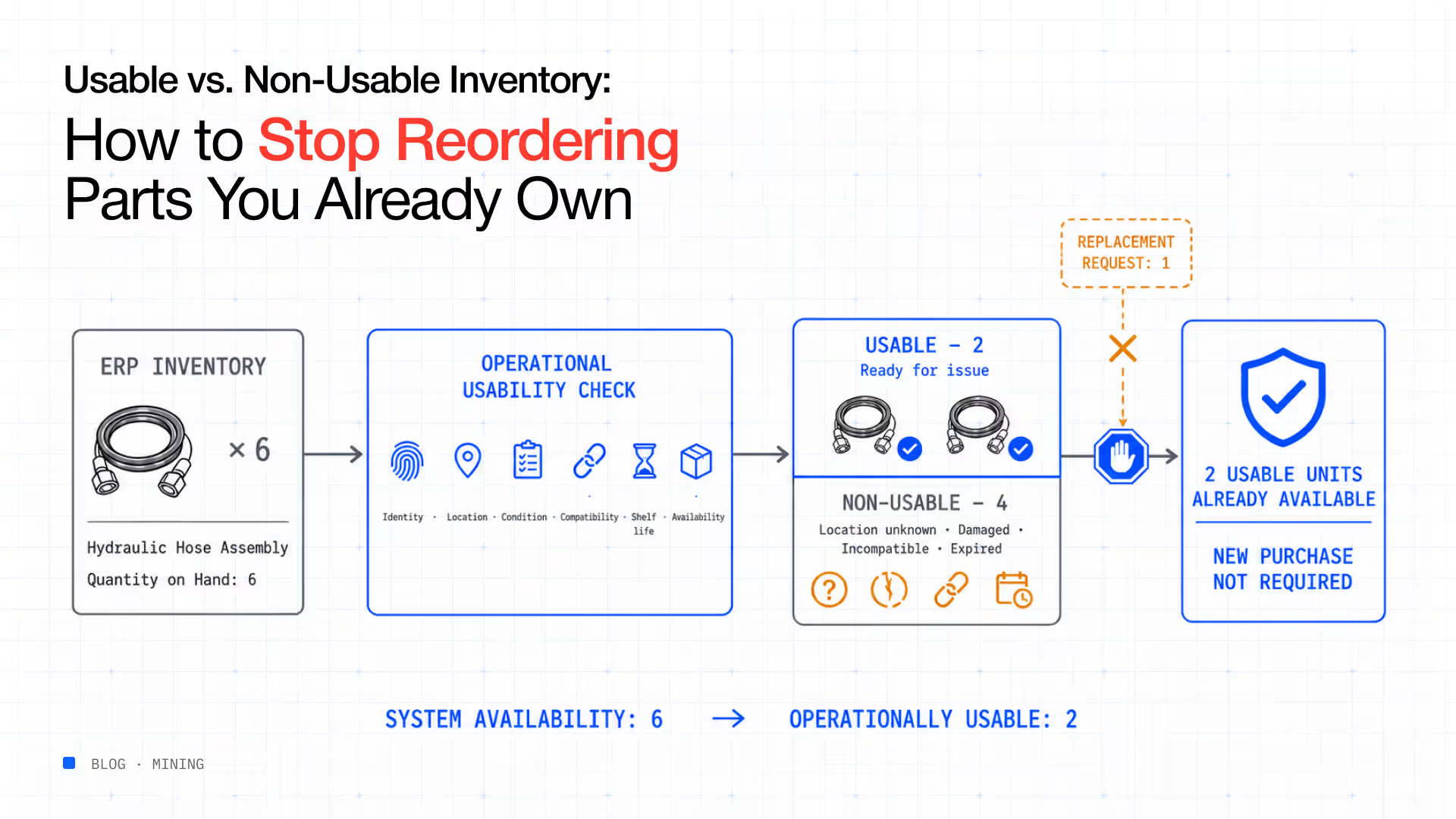
Many mining organizations believe they have an inventory shortage when, in reality, they have an inventory visibility problem. Warehouses appear well stocked, procurement continues purchasing replacement components, and inventory values increase every year. Yet maintenance teams still struggle to locate the spare parts they need when equipment fails. The issue is not always the quantity of inventory on hand. It is whether that inventory is actually usable. Understanding the difference between usable and non-usable inventory is essential for improving inventory performance, reducing unnecessary purchasing, and maximizing return on inventory investment.
Every industrial operation accumulates inventory that no longer contributes to production. Some materials become obsolete after equipment upgrades, while others remain unused because they were purchased for completed projects or emergency shutdowns. Damaged components, expired consumables, duplicate spare parts, and inventory with incomplete documentation may still appear as available stock within the ERP, yet they cannot support maintenance activities. These items inflate inventory values while providing little or no operational benefit.
Organizations that distinguish usable inventory from non-usable inventory gain a much clearer understanding of their true inventory position. Instead of measuring success by total inventory value, they begin measuring how much inventory is actually available to keep operations running.
Usable inventory refers to materials that are immediately available to support operational requirements. These items are correctly identified, physically accessible, in good condition, and suitable for use without additional inspection, repair, or approval.
For an inventory item to be considered usable, several conditions should be met. The inventory should be stored in a known location, accurately recorded within the inventory system, and available for issue when maintenance or production teams require it. The item should also meet operational specifications, remain within any applicable shelf-life requirements, and be free from damage or contamination.
Examples of usable inventory include:
Usable inventory contributes directly to operational readiness because maintenance teams can rely on its availability without additional verification.
When organizations understand exactly how much usable inventory they possess, they can make better procurement decisions, improve maintenance planning, and reduce unnecessary inventory investment.
Non-usable inventory includes any material that cannot currently support operational activities despite appearing within inventory records or occupying physical storage space.
This category extends well beyond obsolete inventory.
Components may be damaged during storage or transportation. Rubber products, adhesives, lubricants, and chemical materials may exceed their shelf life before being consumed. Spare parts purchased for decommissioned equipment may remain on warehouse shelves for years. Duplicate inventory may exist under multiple stock codes without anyone realizing identical components are already available elsewhere.
Some inventory becomes non-usable simply because no one knows where it is.
Items stored inside sea cans, temporary shutdown facilities, contractor compounds, or remote workshops may remain physically available but operationally invisible because their locations were never updated within inventory systems. From a maintenance perspective, inventory that cannot be located quickly may as well not exist.
Common examples of non-usable inventory include:
Although these materials continue appearing in inventory reports, they contribute little toward improving equipment availability or operational performance.
Instead, they consume warehouse space, increase carrying costs, complicate stocktakes, and create misleading inventory information that affects procurement and maintenance decisions.
Most organizations recognize obsolete inventory as a financial burden, but few realize how many hidden costs accumulate long before inventory is officially written off. Every non-usable item occupies warehouse space, appears in inventory reports, and requires handling during stocktakes, yet contributes nothing to operational performance. Instead of supporting maintenance, it gradually reduces the efficiency of warehouse operations while increasing inventory carrying costs.
The financial impact begins with procurement.
When maintenance teams cannot identify usable inventory quickly, procurement assumes replacement inventory is required. Purchase orders are raised, suppliers are contacted, and new stock arrives even though similar inventory may already exist elsewhere within the operation. This duplicate purchasing increases working capital while creating even more inventory that must be stored and managed.
Warehouse operations are affected as well.
Large volumes of non-usable inventory make it harder for warehouse personnel to locate active stock. Time that should be spent issuing inventory to maintenance crews is instead spent moving obsolete materials, searching through duplicate records, or manually verifying whether a component can still be used. As inventory databases grow, these inefficiencies become increasingly difficult to manage.
Finance also experiences the impact.
Inventory that has little operational value continues appearing as an asset on the balance sheet until formal reviews identify it for disposal or write-off. This creates an inflated picture of inventory value while making it difficult for leadership to understand how much inventory is actually supporting production.
Ultimately, non-usable inventory does not simply occupy warehouse shelves. It consumes capital, labour, storage capacity, and management attention that could be directed toward higher-value operational activities.
The difference between usable and non-usable inventory cannot be determined through inventory quantity alone. Organizations must also understand the condition, location, availability, and operational relevance of every inventory item.
This is where real-time inventory visibility becomes critical.
Many organizations already own the inventory required for an upcoming maintenance activity, but they cannot locate it because inventory records have not been updated. Components may remain inside sea cans following a shutdown, be stored in a contractor compound, transferred to another workshop, or temporarily held underground without any corresponding update to the ERP.
From an operational perspective, inventory that cannot be found quickly behaves exactly like inventory that does not exist.
Real-time inventory visibility changes this by providing a complete view of inventory movement from receipt through consumption.
Maintenance planners can verify whether spare parts are immediately available before scheduling work. Procurement can confirm that inventory has been searched across every operational location before approving new purchases. Warehouse personnel spend less time performing manual searches because inventory locations remain continuously updated.
Instead of making purchasing decisions based on incomplete information, organizations gain confidence that existing inventory is fully utilized before additional stock is ordered.
This improves inventory utilization while reducing duplicate purchases and unnecessary inventory growth.
Know exactly which inventory is ready to support operations. Discover how Scatterlink helps mining organizations improve inventory visibility and maximize the value of every spare part.
Scatterlink's Inventory Intelligence Platform helps organizations move beyond simply tracking inventory quantities by providing complete visibility into inventory location, movement, and availability. Rather than relying solely on ERP inventory records, Scatterlink captures every inventory transaction as it happens, ensuring organizations always understand which inventory is operationally available.
Using RFID technology, barcode scanning, offline mobile inventory applications, GPS-enabled location tracking, IoT devices, and seamless ERP integration, Scatterlink enables inventory to remain visible across warehouses, workshops, sea cans, laydown yards, contractor facilities, and both surface and underground operations.
This allows warehouse teams to locate inventory faster, maintenance planners to verify spare parts before work begins, and procurement teams to avoid unnecessary purchases by confirming existing inventory across every operational location.
Combined with clean item master data and standardized inventory information, organizations gain a trusted inventory foundation that improves decision-making while reducing excess inventory investment.
Instead of measuring inventory by how much is owned, Scatterlink helps organizations understand how much inventory is actually usable.
Not all inventory contributes equally to operational performance. While usable inventory supports maintenance, production, and equipment reliability, non-usable inventory quietly consumes warehouse space, working capital, and management effort without delivering operational value.
Mining organizations that fail to distinguish between these two categories often continue purchasing inventory they already own, simply because they cannot confidently identify what is available for immediate use.
By combining strong inventory governance with real-time inventory visibility, organizations can maximize the value of existing inventory, reduce duplicate purchases, improve maintenance planning, and strengthen inventory performance across every operational site.
The objective is not to own more inventory. It is to ensure that the inventory already owned is visible, accessible, and ready to keep operations moving.
Usable inventory refers to materials that are immediately available for operational use. These items are correctly identified, in good condition, stored in known locations, and can be issued without additional inspection or approval.
Non-usable inventory includes obsolete, damaged, expired, duplicate, or inaccessible inventory that cannot currently support operational activities despite appearing in inventory records.
Non-usable inventory increases warehouse storage costs, inflates inventory values, contributes to duplicate purchasing, slows warehouse operations, and reduces overall inventory efficiency while providing little operational benefit.
%20(1).avif)
.avif)
%20(1).avif)