
Inventory doesn't stop moving simply because employees leave the warehouse. Materials are received at loading docks, transferred between warehouses, issued to maintenance teams, consumed on production lines, delivered to remote project sites and returned after work is completed. Every one of these movements affects inventory accuracy, yet many organizations still depend on fixed workstations or manual paperwork to record them.
This creates an unavoidable delay between physical inventory movement and digital inventory records.
During that delay, planners make purchasing decisions using outdated information, maintenance teams struggle to locate critical parts, warehouse personnel answer constant inventory enquiries and finance teams lose confidence in inventory reporting. While these issues may appear unrelated, they often stem from the same problem: inventory transactions are not being captured where the work actually occurs.
Mobile inventory management systems solve this challenge.
Rather than requiring employees to return to a desktop computer before updating inventory, mobile technology allows every transaction to be recorded immediately using handheld devices, tablets or rugged mobile computers. Inventory information becomes available in real time, allowing the entire organisation to work from more accurate and reliable data.
The benefits extend far beyond convenience.
Mobile inventory management improves inventory visibility, strengthens inventory accuracy, increases warehouse productivity and enables faster operational decision-making. When integrated with barcode scanning, RFID technology and ERP systems, it creates a connected inventory ecosystem that supports every stage of the inventory lifecycle.
Whether an organisation manages a single warehouse or multiple operational sites across different regions, mobile inventory management has become an essential capability for modern inventory operations.
A mobile inventory management system is software that enables employees to perform inventory transactions directly from mobile devices instead of relying on desktop computers or manual paperwork.
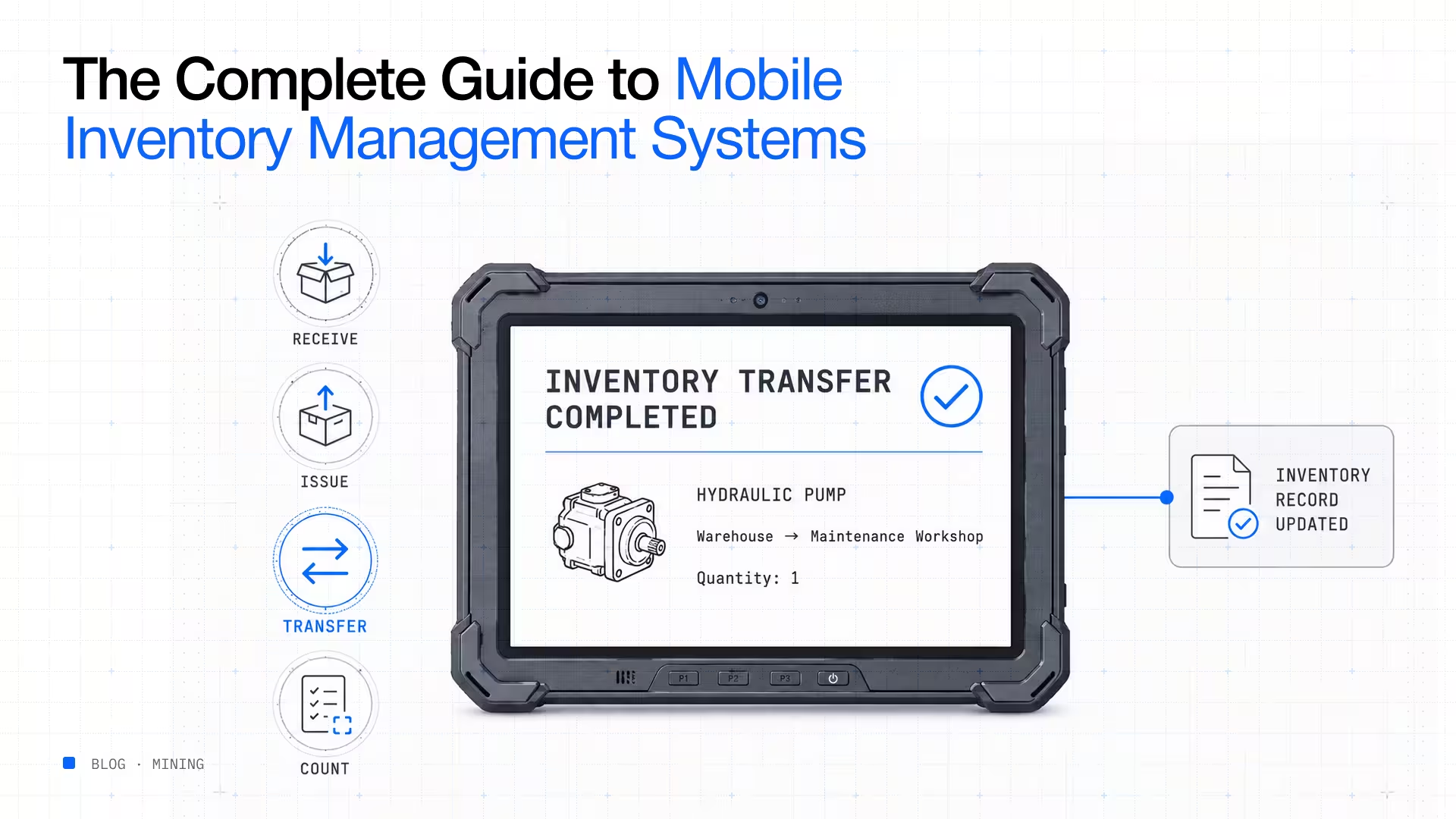
Using smartphones, rugged handheld terminals, tablets or specialised industrial devices, warehouse personnel, maintenance teams and field workers can receive inventory, issue materials, perform transfers, conduct cycle counts and update inventory records from wherever inventory is physically located.
Instead of recording inventory movements hours later, transactions occur immediately.
This significantly reduces the time between physical inventory activity and system updates, improving inventory accuracy while giving planners, procurement teams and operational managers access to more reliable inventory information.
Modern mobile inventory management systems often support:
Rather than functioning as standalone software, most enterprise-grade mobile inventory management systems integrate directly with ERP platforms, ensuring inventory information remains consistent across business operations.
Many organizations still rely on inventory processes developed years ago.
Warehouse employees complete paperwork during receiving, maintenance teams manually record inventory consumption after repairs are completed and inventory transfers are updated only after employees return to their workstations. While these processes may appear manageable, they introduce delays that gradually reduce inventory accuracy.
Consider a simple warehouse transfer.
Inventory is physically moved from one location to another early in the morning, but the transfer transaction is not entered into the ERP until later that afternoon. Throughout the day, every inventory lookup continues showing inventory in the previous location. Employees searching for the item waste valuable time, while planners unknowingly make decisions using outdated information.
Multiply this scenario across hundreds of daily inventory movements.
The result is an inventory system that continually lags behind operational reality.
Manual inventory processes also increase the likelihood of human error.
Handwritten notes become difficult to read, spreadsheets contain duplicate entries and employees occasionally forget to record transactions altogether. These seemingly minor issues accumulate over time, creating discrepancies that eventually require expensive reconciliation exercises.
Mobile inventory management addresses these weaknesses by capturing inventory transactions at the moment work occurs.
Instead of waiting for employees to update inventory later, information flows directly into inventory systems as operational activities take place.
Perhaps the greatest benefit of mobile inventory management is immediate inventory visibility.
Inventory movements are recorded as they happen, allowing every department to work from current inventory information rather than historical transactions. Procurement teams gain confidence in available inventory, maintenance planners know whether critical spare parts are available and warehouse teams spend less time investigating inventory discrepancies.
This improves operational decision-making across the business.
Inventory accuracy depends on how quickly transactions are recorded.
The longer organizations wait before updating inventory records, the greater the likelihood of discrepancies developing between physical inventory and system records.
Mobile inventory management significantly reduces this delay.
Because employees complete transactions directly from mobile devices, inventory records remain closely aligned with physical inventory movement, improving confidence in inventory information throughout the organisation.
Warehouse productivity improves when employees no longer need to return repeatedly to office workstations.
Receiving inventory, issuing materials, confirming transfers and performing cycle counts can all be completed from the warehouse floor. Employees spend more time moving inventory and less time moving between inventory and computers.
The result is faster operational workflows without increasing labour requirements.
Scatterlink enables warehouse teams, maintenance crews and field personnel to capture inventory transactions wherever work happens. With offline mobile capability, barcode scanning, RFID integration and ERP connectivity, organizations gain real-time inventory visibility without disrupting existing workflows.
Mobile inventory management simplifies everyday work.
Employees no longer maintain handwritten notes before entering transactions later. Inventory lookups become faster, stock movements require fewer administrative steps and warehouse personnel spend more time performing productive operational activities.
This not only improves productivity but also creates a better employee experience by reducing repetitive manual tasks.
Not every mobile inventory management solution delivers the same level of operational value.
Organizations evaluating new platforms should look beyond basic inventory transaction capabilities and focus on features that support long-term operational efficiency.
Many industrial operations continue working in locations where reliable internet connectivity cannot be guaranteed.
Warehouses with poor wireless coverage, remote maintenance facilities, mining operations and field service environments all require systems capable of operating without continuous network access.
Offline functionality allows employees to continue receiving inventory, issuing materials and completing transactions without interruption. Once connectivity is restored, information automatically synchronises with enterprise systems.
Without offline capability, inventory management effectively stops whenever network access becomes unavailable.
Barcode scanning remains one of the fastest and most accurate methods for capturing inventory transactions.
Employees can identify inventory instantly while reducing manual data entry errors. Barcode support also accelerates receiving, inventory counts and warehouse picking activities, improving overall operational efficiency.
As organizations increase inventory automation, RFID becomes increasingly valuable.
Rather than scanning individual inventory items, RFID allows multiple tagged assets or materials to be identified simultaneously, reducing transaction times while improving inventory visibility.
Modern mobile inventory management platforms should support both barcode and RFID technologies, allowing organizations to adopt whichever identification method best suits each operational process.
A mobile inventory management system should never operate in isolation.
Most organisations already rely on ERP systems to manage purchasing, finance, supplier information and inventory records. If mobile transactions remain disconnected from the ERP, employees are forced to enter the same information twice, increasing administrative effort while creating opportunities for inconsistencies.
Seamless ERP integration eliminates this problem.
Inventory transactions completed on a mobile device automatically update enterprise records, allowing procurement, finance, warehouse operations and maintenance teams to work from the same trusted inventory data.
For organisations managing inventory across multiple warehouses, contractor compounds, yards or remote operational sites, location visibility is becoming increasingly important.
GPS-enabled inventory management allows organisations to identify where inventory is currently located, reducing unnecessary inventory searches while improving asset utilisation across distributed operations.
This capability is particularly valuable for industries where inventory frequently moves beyond traditional warehouse environments.
Inventory directly affects financial reporting and operational performance.
A mobile inventory management system should therefore include role-based access controls, approval workflows and secure authentication to ensure employees can only perform transactions appropriate to their responsibilities.
Strong security not only protects inventory data but also improves audit readiness by maintaining complete transaction histories.
Although the core principles remain consistent, mobile inventory management delivers different benefits depending on the industry.
Mining organisations often manage inventory across surface warehouses, underground operations, workshops, laydown yards and remote storage facilities.
Mobile inventory applications allow maintenance crews to issue and return critical spare parts directly from the worksite while continuing to operate even when internet connectivity is unavailable.
Manufacturers use mobile inventory systems to support production by ensuring raw materials, components and finished goods remain accurately tracked throughout production processes.
Real-time inventory visibility reduces production delays caused by unavailable materials while improving inventory planning.
Oil and gas operations frequently involve geographically dispersed facilities with demanding operational environments.
Mobile inventory systems improve inventory control across drilling sites, maintenance facilities and regional warehouses while reducing reliance on paper-based inventory documentation.
Construction projects continuously move inventory between warehouses, project sites and temporary storage areas.
Mobile inventory management allows field teams to receive, issue and transfer inventory directly from project locations, reducing delays while improving inventory accountability.
Utility organisations maintain inventory across numerous depots and field locations.
Mobile inventory applications enable technicians to access inventory information, complete transactions and update records during field work without returning to central offices.
Regardless of industry, the common objective remains the same: capture inventory activity where work occurs rather than after the fact.
Selecting a mobile inventory solution should involve more than comparing feature lists.
Decision makers should first evaluate how inventory currently moves throughout the organisation and identify where operational bottlenecks occur.
Important questions include:
Technology should simplify operational processes rather than requiring organisations to redesign workflows around software limitations.
Many mobile inventory projects fail to achieve expected results because organisations focus solely on technology implementation.
One common mistake is digitising inefficient manual processes instead of improving them. If poor inventory procedures remain unchanged, mobile devices simply accelerate existing inefficiencies.
Another mistake is overlooking user adoption.
Employees should understand how mobile inventory systems make their work easier rather than viewing them as additional administrative requirements. Practical training and intuitive interfaces significantly improve implementation success.
Finally, some organisations underestimate integration.
A mobile inventory solution disconnected from ERP systems, warehouse operations or inventory reporting creates another information silo rather than improving enterprise-wide visibility.
Capturing inventory transactions on mobile devices represents a major improvement over manual processes.
However, mobile inventory alone does not create complete inventory visibility.
Organisations also need to understand where inventory is moving, how inventory is being utilised and how operational decisions affect inventory performance across the business.
This requires more than transaction processing.
It requires Inventory Intelligence.
Inventory Intelligence combines mobile transactions with RFID, barcode scanning, ERP integration, operational analytics and real-time inventory tracking to create a continuously updated operational picture of inventory movement.
Instead of simply recording inventory activity, organisations gain meaningful insight into inventory availability, utilisation and operational performance.
Scatterlink combines offline mobile inventory management with RFID, barcode technology, ERP integration and Inventory Intelligence to provide complete visibility from inventory receipt through consumption. This allows organisations to make faster decisions using trusted, real-time inventory data.
Successful mobile inventory implementations begin with operational objectives rather than technology specifications.
Identify the inventory processes that currently consume the greatest amount of time or create the highest operational risk. These often include receiving, inventory transfers, maintenance issues and cycle counting.
Roll out mobile capabilities in phases.
Beginning with high-impact workflows allows employees to become comfortable with the technology while demonstrating measurable operational improvements early in the implementation.
Maintain clean inventory data before deployment.
Duplicate stock codes, inconsistent descriptions and inaccurate inventory records reduce the effectiveness of any inventory management system regardless of its capabilities.
Finally, continuously measure operational performance.
Monitor inventory accuracy, transaction completion times, inventory search duration, warehouse productivity and inventory visibility improvements to ensure the implementation delivers measurable business value.
Mobile inventory management continues to evolve alongside advances in artificial intelligence, IoT, RFID and cloud computing.
Rather than functioning simply as digital transaction tools, modern mobile inventory platforms increasingly provide predictive insights, automated alerts and intelligent inventory recommendations.
Real-time inventory visibility will become the standard rather than the exception.
Employees will receive immediate guidance on inventory availability, replenishment priorities and operational risks while inventory systems continuously analyse movement patterns in the background.
Organisations that invest in connected inventory ecosystems today will be significantly better positioned to support future automation initiatives.
Scatterlink helps organisations move beyond basic mobile inventory management by delivering an Inventory Intelligence Platform that connects mobile applications, ERP systems, RFID, barcode technology and real-time inventory visibility into one unified operational solution.
Mobile inventory management has become an essential capability for organisations seeking greater inventory accuracy, operational efficiency and real-time decision-making.
By allowing employees to capture inventory transactions wherever work occurs, mobile systems eliminate many of the delays and inaccuracies associated with traditional inventory processes. Inventory information becomes more reliable, warehouse operations become more efficient and decision makers gain greater confidence in enterprise inventory data.
The greatest value, however, comes when mobile inventory management is integrated into a broader inventory visibility strategy. Organisations that combine mobile technology with RFID, ERP integration and Inventory Intelligence gain far more than faster transactions. They create connected inventory operations capable of supporting smarter decisions across procurement, maintenance, warehouse management and executive leadership.
A mobile inventory management system enables employees to perform inventory transactions using smartphones, tablets or rugged handheld devices instead of desktop computers, allowing inventory updates to occur wherever work takes place.
Benefits include improved inventory accuracy, real-time inventory visibility, faster warehouse operations, reduced manual data entry, better workforce productivity and improved decision-making.
Yes. Enterprise-grade solutions support offline operation, allowing inventory transactions to continue during network outages before automatically synchronising once connectivity returns.
Most modern platforms integrate directly with ERP systems, ensuring inventory transactions automatically update enterprise inventory records without duplicate data entry.
Scatterlink combines offline mobile inventory applications with RFID, barcode scanning, ERP integration and Inventory Intelligence to provide real-time inventory visibility across warehouses, workshops, remote sites and operational facilities, enabling organisations to manage inventory confidently from receipt through consumption.
%20(1).avif)
.avif)
%20(1).avif)