
A spare part can sit unused for months and still be essential to keeping an operation running. When the associated equipment fails, the value of having that part immediately available can be far greater than its purchase price. This is why safety stock for spare parts requires a different approach from simply keeping extra inventory on hand.
Safety stock acts as a buffer against uncertainty. It protects operations when demand is higher than expected or when replenishment takes longer than planned. For industrial organisations, particularly those managing MRO and critical spare parts, determining the right safety stock level means balancing stockout risk against the cost of holding inventory that may not be used for an extended period.
Safety stock is additional inventory held above expected demand to provide protection against uncertainty in demand and replenishment. It is designed to reduce the likelihood of a stockout when actual consumption or supplier lead time differs from expectations. The basic principle is straightforward, but determining the right quantity depends heavily on the characteristics of each spare part.
For spare parts, safety stock is particularly important because demand is often intermittent. A component may have little or no consumption for long periods and then suddenly be required because of an unexpected equipment failure. Standard inventory formulas based only on average consumption can therefore underestimate the amount of protection required for production-critical parts.
The purpose of safety stock is not to prevent inventory from ever reaching a low level. Its purpose is to provide a controlled buffer when actual operating conditions differ from the expected demand or replenishment plan. Without an appropriate buffer, an unexpected equipment failure or supplier delay can quickly turn a manageable inventory situation into a production problem.
For critical spare parts, the consequences of a stockout can be significant. Maintenance teams may have to wait for procurement, arrange emergency freight or search other locations for a replacement. In a production-critical environment, the resulting downtime can cost considerably more than the carrying cost of maintaining an additional quantity of the part.
Regular inventory is generally held to meet expected demand, while safety stock is held specifically to protect against uncertainty. The expected inventory requirement may be calculated from forecast demand or historical consumption, whereas the safety stock provides an additional buffer when actual demand or supply conditions deviate from that expectation.
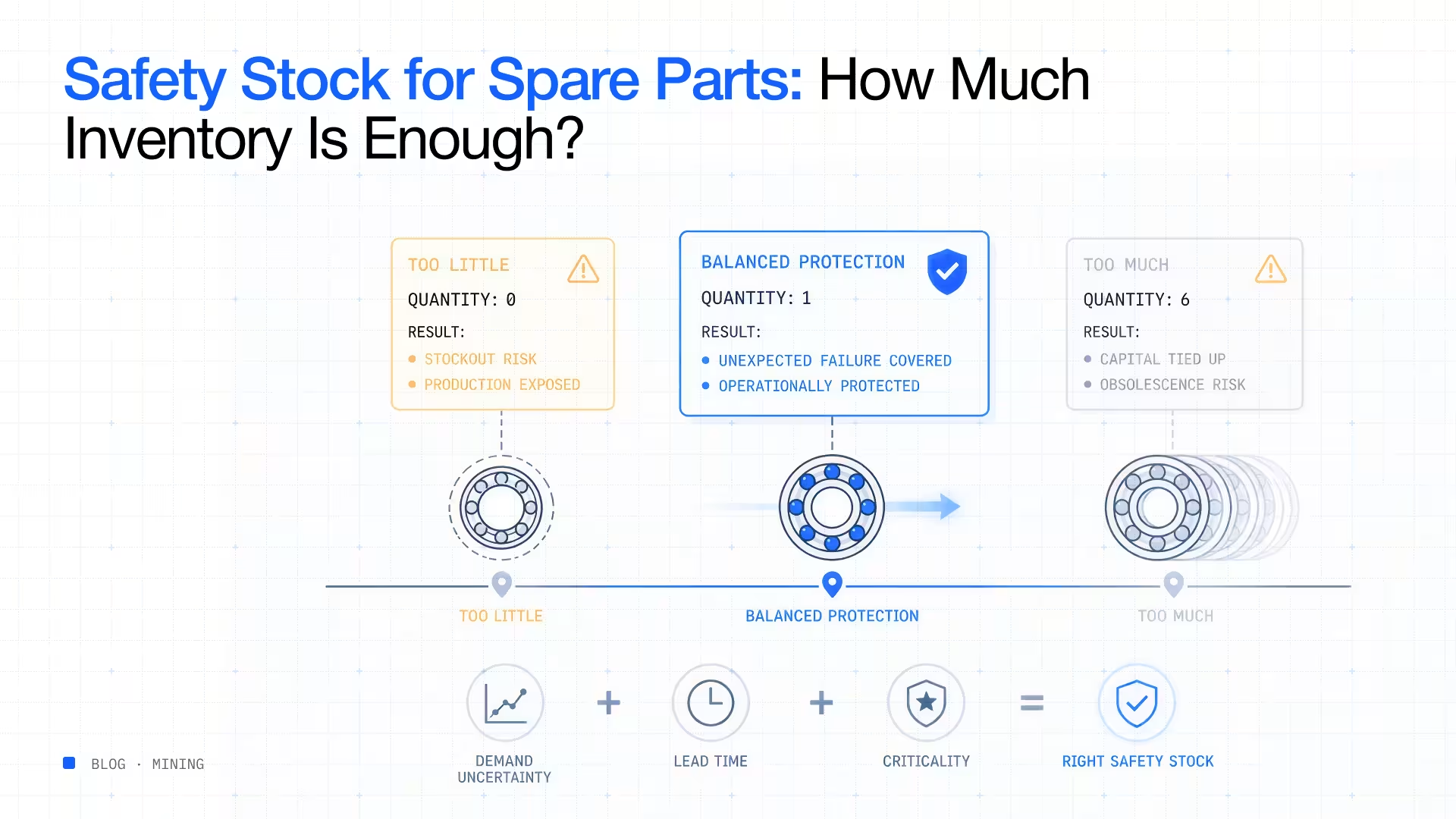
This distinction matters because adding inventory without understanding the reason for holding it can create unnecessary stock. If every spare part receives an arbitrary buffer, the organisation may increase carrying costs without meaningfully improving availability. Safety stock should instead be linked to identifiable risks such as demand variability, supplier lead time variability and operational criticality.
There is no single safety stock quantity that is appropriate for every spare part. The right level depends on how frequently the part is required, how unpredictable that demand is, how long replenishment takes and what happens if the part is unavailable. Organisations also need to consider whether an equivalent component can be sourced elsewhere or transferred from another location.
The main factors include:
These factors should be evaluated at the item level wherever practical. A high-use consumable and a production-critical spare should not automatically receive the same safety stock policy.
Demand variability refers to how much actual consumption differs from the expected or average level. For conventional inventory, demand may be relatively predictable, but spare parts can behave very differently. One month may show no consumption while several units are required during an unexpected maintenance event.
This intermittent demand makes safety stock particularly important for critical components. However, it also makes simplistic calculations less reliable. A long period of zero consumption should not automatically result in a zero safety stock level if the item supports equipment where failure has significant consequences.
For this reason, spare parts inventory management should consider both demand history and operational criticality. A part with unpredictable but high-impact demand may require protection even when its historical consumption is low.
Lead time is the time between initiating replenishment and having usable inventory available. The longer the lead time, the greater the exposure to demand occurring before replacement stock arrives. If supplier lead time is also inconsistent, the organisation faces additional uncertainty that may need to be covered by safety stock.
For example, a locally available component with a two-day lead time may require relatively little protection against replenishment delays. A specialised component with a six-month lead time presents a very different risk. If the part is also critical to production, maintaining an appropriate safety stock level may be justified even when annual consumption is very low.
Lead time data should ideally reflect actual supplier performance rather than only the standard value stored in a purchasing system. Historical delivery performance can reveal whether replenishment consistently arrives within the expected period or whether delays are common enough to influence inventory planning.
Criticality is one of the most important factors when determining how much safety stock to hold. The potential consequence of a stockout should influence the level of protection assigned to an item. A spare part that supports a non-critical piece of equipment can often tolerate a different stockout risk from a component whose absence could stop production.
Criticality assessment can consider production impact, safety implications, equipment dependency, replacement lead time and the availability of alternatives. This helps organisations avoid the common mistake of treating low consumption as a reason to reduce stock automatically.
For example, a bearing used only once every three years might appear unnecessary from a pure consumption perspective. If it is required for a critical piece of equipment and takes several months to source, maintaining a replacement may be commercially and operationally sensible.
Insufficient safety stock increases the likelihood that unexpected demand or supplier delays will result in a stockout. For industrial operations, this can create a chain of consequences that extends beyond the missing part itself. Maintenance may be delayed, equipment may remain unavailable and production schedules may be disrupted while teams wait for replenishment.
Low safety stock can also increase dependence on emergency procurement. Teams may need to pay for expedited freight, source components from alternative suppliers or transfer parts urgently from another location. These actions can significantly increase the total cost of maintaining equipment.
The risk is particularly high when inventory records are inaccurate. A system may show that a spare is available when the physical part cannot be located, creating a false sense of protection. Accurate inventory visibility is therefore an essential part of effective safety stock management.
Increasing safety stock is not a risk-free way to improve availability. Excessive safety stock ties up working capital, consumes warehouse capacity and increases inventory carrying costs. It can also contribute to slow-moving and obsolete inventory when demand remains lower than expected.
This is particularly relevant for specialised spare parts. Some components can remain in storage for years, and changes in equipment specifications or maintenance strategies can eventually make them unnecessary. Holding excessive quantities therefore creates both a financial cost and a potential obsolescence risk.
The objective should be to find the level at which the additional inventory provides meaningful protection against stockouts without creating unnecessary excess. This requires a balance between service requirements, uncertainty and inventory carrying costs.
MRO inventory includes the materials, components and supplies required to maintain equipment and support ongoing operations. Within this category, some items are routine consumables while others are critical spare parts with infrequent but high-impact demand. Applying the same safety stock rules across the entire MRO inventory can therefore produce poor results.
Critical spares should be evaluated according to the consequences of non-availability as well as demand. Low-use parts with long lead times may require greater protection, while frequently available components may require less safety stock even if they have higher consumption. A risk-based approach provides a more accurate balance between operational availability and inventory cost.
Safety stock calculations depend on knowing what inventory is actually available. If organisations cannot accurately see stock across warehouses, workshops and operational locations, they may hold unnecessary safety stock in one location while another site experiences a shortage. This can result in both excess inventory and stockouts within the same organisation.
A connected inventory view allows teams to understand current quantities, locations, movements and availability before placing replenishment orders. This is particularly valuable across surface and underground operations, where inventory may be physically distributed and access to a part can be as important as the quantity held. Explore Scatterlink's RFID inventory management solution to improve visibility across inventory locations and movements.
Safety stock should not be treated as a permanent number. Changes in demand, supplier performance, equipment criticality, maintenance schedules and operating conditions can all change the level of protection an item requires.
Regular reviews can identify where safety stock has become excessive or insufficient. They can also reveal parts where demand has changed significantly or supplier lead times have become less predictable. Learn more about Scatterlink and how real-time inventory visibility can support better inventory decisions.
There is no single safety stock formula that works for every spare part because demand patterns and supply risks vary significantly between items. A basic calculation can use demand variability and lead time, while more advanced approaches can incorporate service levels, supplier reliability and the criticality of the equipment supported by the part. The objective is to calculate enough protection to manage uncertainty without turning the safety stock buffer into unnecessary excess inventory.
A simplified approach is:
Safety Stock = Maximum Expected Demand During Lead Time − Average Expected Demand During Lead Time
This method can provide a useful starting point when historical demand and lead time data are available. However, it may not be suitable for every industrial spare part, particularly where demand is highly intermittent or where the consequences of a stockout are significant.
Where demand varies significantly, organisations can use statistical measures such as standard deviation to estimate the additional inventory required to protect against fluctuations. A commonly used approach considers demand variability, lead time and a desired service level.
A simplified statistical model can be represented as:
Safety Stock = Z × Standard Deviation of Demand During Lead Time
Here, the Z value represents the desired service level. A higher service level generally requires more safety stock because the organisation is attempting to protect against a larger range of possible demand outcomes.
For example, an organisation that wants a very high probability of having a part available when required will generally need a larger buffer than one that can tolerate a higher stockout risk. The appropriate service level should therefore be based on the operational consequences of non-availability rather than simply choosing the highest possible target.
Critical spare parts require a risk-based approach because their importance may have little relationship with their historical consumption. A component that is rarely used can still require immediate availability if its failure would stop a production line, delay a mining operation or create a significant maintenance disruption.
When setting safety stock for critical spares, organisations should consider the consequence of failure, equipment criticality, supplier lead time, alternative sourcing options and the time required to restore equipment. A part with a six-month procurement lead time and no viable alternative may justify a different safety stock level from an equivalent part that can be sourced locally within days.
Criticality can therefore be used as an additional decision layer rather than as a replacement for demand data. The strongest approach combines historical consumption with operational risk so that inventory protection reflects what could happen if the part is unavailable.
Service level represents the desired probability of meeting demand without experiencing a stockout during a specified period. Increasing the desired service level generally requires more safety stock because the organisation needs a larger buffer against unexpected demand and supply variation.
However, maximising service levels across every inventory item is rarely an efficient strategy. The carrying cost of additional inventory can become significant, particularly when applied across thousands of MRO and spare parts. Instead, service levels can be differentiated according to inventory criticality, replacement difficulty and operational consequences.
A production-critical spare may justify a very high availability target, while a non-critical component with short lead time may be managed with a lower target. This segmentation helps organisations direct inventory investment towards the parts where availability matters most.
No. Safety stock requirements can vary between locations depending on local demand, supplier access, replenishment lead times and the availability of alternative inventory nearby. Applying identical safety stock quantities across every site can result in unnecessary inventory at some locations while leaving others under-protected.
This becomes especially important for industrial organisations operating across multiple warehouses, workshops, surface locations and underground operations. A central inventory view allows teams to consider stock held across the network before determining how much additional safety stock each location actually needs.
For example, if one site has three units of a critical spare and another site has none, the organisation may be able to transfer existing stock rather than purchase another quantity. This can reduce total inventory while maintaining operational availability. Explore Scatterlink's RFID inventory management solution.
Average demand can provide a useful baseline, but it does not account for unusual demand spikes. Spare parts are particularly vulnerable to this problem because consumption can be intermittent and failure-driven.
An item may have an average annual consumption of only two units but still require protection because both units could be needed within a short period following equipment failures. Safety stock calculations should therefore consider demand variability and operational risk rather than relying exclusively on averages.
Using a single supplier lead time can create a false sense of security. If an item normally arrives within 30 days but frequently takes 45 or 60 days, calculating safety stock around the shortest expected lead time can leave the organisation exposed.
Actual supplier performance should be monitored to identify variations in delivery times. Where lead time is unpredictable, that uncertainty should be reflected in the inventory protection strategy.
Not every spare part deserves the same level of protection. Applying a universal safety stock percentage can create excessive inventory for low-risk items while failing to adequately protect critical components.
Inventory segmentation can help organisations distinguish between critical, essential and non-critical items. Safety stock can then be aligned with the operational consequences associated with each category.
A common mistake is calculating safety stock independently at every site without considering inventory across the wider organisation. This can lead to multiple locations holding large quantities of the same part even when total organisational demand does not justify it.
A network-wide inventory view can help identify opportunities to transfer existing stock and reduce duplicate safety buffers. This is particularly useful when sites operate independently but share common equipment or spare parts.
A safety stock calculation is only useful if the inventory data behind it is accurate. If the system shows five units available but those units cannot be located, have already been issued or are not actually usable, the organisation may believe it has sufficient protection when it does not.
Accurate receiving, issuing, transferring and consumption records are therefore essential. Inventory visibility needs to reflect the physical reality of stock, not simply the quantities stored in an ERP or inventory database.
Optimising safety stock does not necessarily mean reducing inventory. It means making sure that inventory protection is concentrated where it provides the greatest operational value. Organisations can achieve this by segmenting spare parts according to criticality, demand variability, supplier lead time and replacement difficulty.
Inventory reviews should identify parts where safety stock is consistently unused and parts where stockouts continue to occur despite existing buffers. If an item repeatedly remains untouched for years, its safety stock level may need to be reassessed. If another item repeatedly falls below its minimum level, its demand or replenishment assumptions may need to be updated.
Inventory transfers can also reduce unnecessary safety stock. When inventory can be moved between locations quickly, organisations may not need to maintain the same level of protection independently at every site. This allows the wider inventory network to function as a shared pool rather than a collection of isolated stockrooms.
Safety stock should evolve as operating conditions change. Changes in production levels, equipment utilisation, supplier performance, maintenance strategies and inventory consumption can all alter the appropriate level of protection.
Regular inventory analysis can identify these changes before they create either excessive carrying costs or stockout risk. Tracking consumption, inventory movements, lead times and stock availability gives teams the information needed to determine whether existing safety stock remains appropriate.
This is where real-time inventory visibility becomes particularly valuable. When teams can see inventory movements from receipt through issue and consumption, they can make replenishment decisions using more current information rather than relying entirely on periodic manual counts. Learn more about Scatterlink
Effective safety stock management requires more than a formula. The calculation provides a baseline, but inventory teams still need to understand what the numbers mean in the context of actual operations. A low-use spare may need significant protection because of its criticality, while a high-use component may require less safety stock because it is readily available and replenished quickly.
Inventory intelligence helps bring these factors together by connecting inventory data with movement, location and operational context. This gives teams a stronger basis for deciding which parts require protection, where that protection should be held and when existing stock can be used instead of purchasing more.
For industrial operations, the goal is to move from simply asking "How much stock should we hold?" to asking "How much stock do we need, where should it be, and what operational risk does it protect against?" Learn more about Scatterlink's inventory intelligence approach.
A regular review can help organisations determine whether safety stock levels remain appropriate. Each critical spare part can be assessed against a consistent set of factors rather than relying on a generic inventory rule.
A practical review should consider:
Reviewing these factors together creates a more balanced safety stock strategy. It prevents organisations from reducing inventory simply because consumption is low and prevents them from accumulating unnecessary stock simply because an item is considered important.
Safety stock for spare parts is ultimately about managing uncertainty. The right quantity depends on demand variability, supplier lead time, equipment criticality and the consequences of not having the part when it is required. Holding too little can expose operations to stockouts and emergency procurement, while holding too much can increase carrying costs and create slow-moving or obsolete inventory.
The strongest approach is therefore not to apply one safety stock formula across the entire inventory catalogue. Industrial organisations should segment spare parts according to operational risk, analyse actual consumption and supplier performance, and regularly review whether existing inventory protection still reflects current requirements.
Visibility across the inventory network is equally important. When teams know what is available, where it is located and how inventory is moving, they can make better decisions about replenishment, transfers and safety stock. This helps organisations protect critical operations without simply increasing the amount of inventory they hold.
Safety stock is additional inventory held to protect against unexpected demand, supplier delays and other uncertainties. For spare parts, it can help ensure that critical components are available when equipment failures occur even when demand is difficult to predict.
A basic approach considers maximum expected demand during the replenishment period compared with average expected demand. More advanced calculations can incorporate demand variability, lead time variability and the desired service level.
There is no universal quantity. The appropriate level depends on equipment criticality, demand variability, supplier lead time, availability of alternatives and the consequences of a stockout. Critical parts with long replacement times may require greater protection even when historical consumption is low.
No. Safety stock should be based on the level of uncertainty and operational risk associated with each item. Applying the same buffer to every spare part can create unnecessary excess inventory.
Yes. Safety stock increases the amount of inventory held and therefore contributes to carrying, storage and handling costs. However, insufficient safety stock can create much greater costs when stockouts cause emergency procurement, maintenance delays or production disruption.
Safety stock should be reviewed when demand, supplier lead times, equipment requirements or operational conditions change. Regular scheduled reviews can also identify inventory levels that have become excessive or insufficient.
Inventory visibility shows teams what stock is available, where it is located and how it is moving across the organisation. This can prevent unnecessary replenishment and help teams use inventory held at another location before purchasing additional safety stock.
RFID can improve the visibility of tagged inventory by capturing item movements and helping organisations maintain more accurate information about inventory location and status. When integrated with inventory management processes, this visibility can support better replenishment and safety stock decisions.
%20(1).avif)
.avif)
%20(1).avif)