
Selecting the right RFID technology is one of the most important decisions organizations make when implementing an inventory or asset tracking system. Whether you're managing spare parts across a mining operation, monitoring equipment in an oil and gas facility, or tracking inventory in a large industrial warehouse, the type of RFID tag you choose directly impacts visibility, accuracy, implementation costs, and long-term return on investment.
One of the most common questions organizations ask during the planning stage is whether passive or active RFID tags are the better option. While both technologies use radio frequency identification to identify and track assets, they are designed for very different operational requirements. Factors such as read range, infrastructure, asset value, environmental conditions, and maintenance requirements all influence which technology delivers the best results.
There is no universal answer. The right choice depends on what you need to track, where those assets are located, and how they move throughout your operation. Understanding the strengths and limitations of both technologies helps organizations build an RFID solution that supports operational efficiency without introducing unnecessary complexity.
This guide explains the differences between passive and active RFID tags, where each technology performs best, and how industrial organizations can select the right solution for their operations.
Radio Frequency Identification (RFID) is a technology that uses radio waves to identify and track tagged objects automatically. Unlike traditional barcode systems, RFID does not always require direct line-of-sight scanning, allowing multiple tagged items to be identified quickly and accurately.
A typical RFID system consists of three primary components:
The biggest distinction between RFID systems lies in the type of tag being used. Passive and active RFID tags perform the same basic function, but they operate in fundamentally different ways.
Choosing between them requires understanding how each technology works in real-world industrial environments.
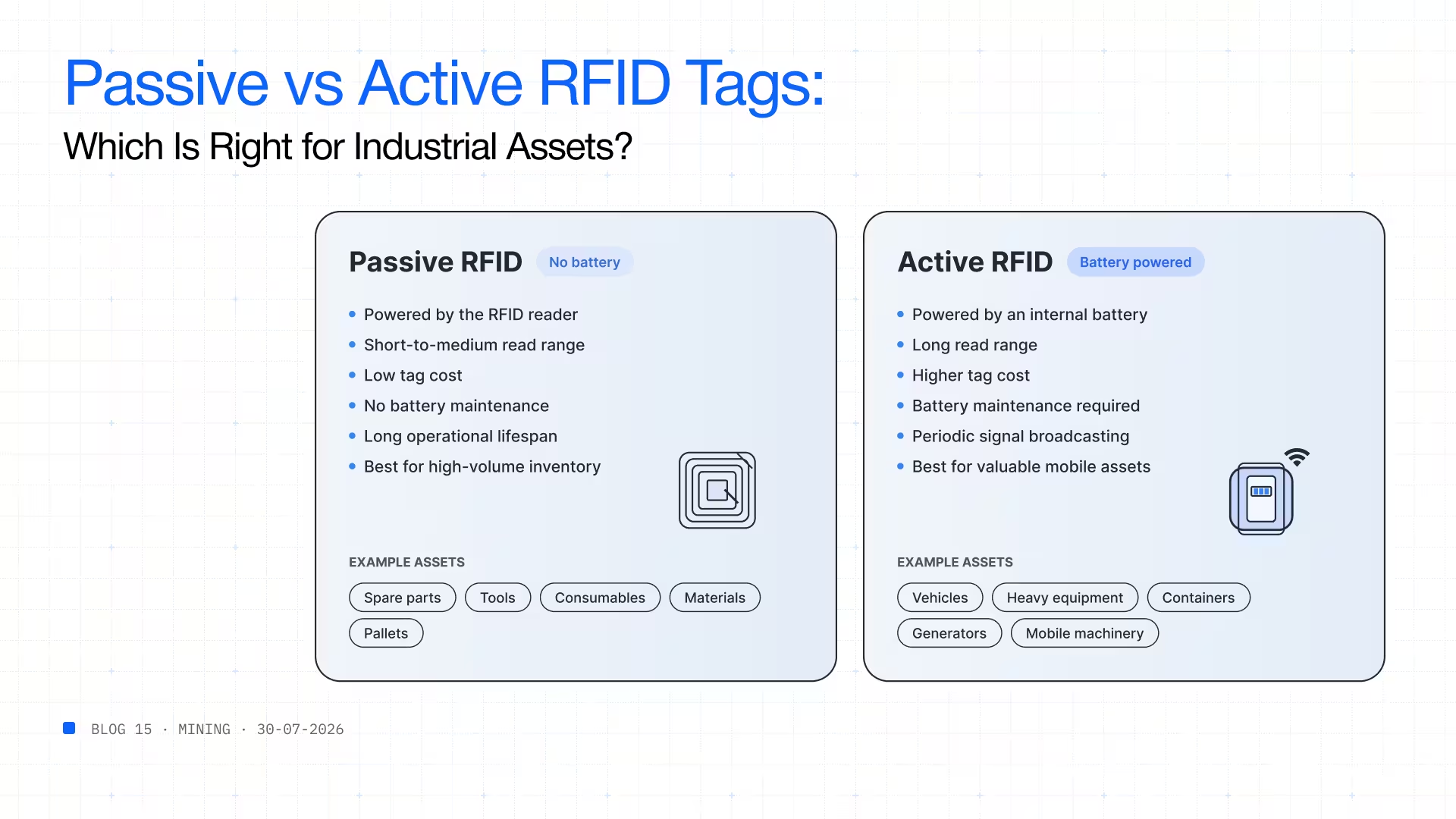
Passive RFID tags do not contain an internal power source. Instead, they are activated by the radio signal transmitted from an RFID reader. When a reader sends out a radio frequency signal, the tag draws energy from that signal, transmits its unique identification number, and then becomes inactive once it moves outside the reader's range.
Because passive tags contain fewer electronic components, they are significantly smaller, lighter, and less expensive than active RFID tags. They also require virtually no maintenance since there is no battery to replace.
These characteristics make passive RFID one of the most widely adopted technologies for inventory management across industrial operations.
Passive RFID tags offer several benefits for organizations managing high volumes of inventory.
For organizations tracking consumables, spare parts, tools, materials, and warehouse inventory, passive RFID often provides the best balance between performance and cost.
However, passive RFID also has limitations that should be considered before implementation.
Because passive tags rely entirely on reader-generated energy, they typically offer shorter read ranges than active RFID tags.
Performance may also vary depending on:
Fortunately, industrial-grade passive RFID tags are specifically designed to overcome many of these challenges, making them suitable for harsh environments such as mining, manufacturing, construction, and oil and gas operations.
Looking to streamline your asset tracking? Explore how our RFID Inventory Management Solutions help you track both high-volume inventory and critical assets effortlessly.
Unlike passive tags, active RFID tags contain an internal battery that continuously powers the device.
Because the tag generates its own signal, it can communicate with RFID readers over much greater distances. Depending on the technology and operating environment, active RFID systems may achieve read ranges exceeding several hundred feet.
This extended range makes active RFID particularly valuable for tracking high-value assets that move across large operational areas.
Examples include:
Rather than waiting for a nearby reader to activate them, active tags periodically broadcast their location or identification, allowing organizations to monitor asset movement continuously.
This capability supports real-time asset visibility across expansive industrial sites.
Active RFID provides capabilities that passive RFID cannot easily achieve.
Its longer read range significantly reduces the number of readers required across large facilities. Continuous broadcasting also enables organizations to monitor asset movement without requiring assets to pass directly beside a reader.
Active RFID is particularly beneficial when organizations need to:
For operations where equipment availability directly impacts production, these advantages can justify the higher implementation cost.
The greatest trade-off with active RFID is cost.
Because every tag contains a battery and additional electronics, active tags are significantly more expensive than passive alternatives. Organizations deploying thousands of tags may find implementation costs increase substantially.
Battery maintenance must also be considered.
Although battery life can range from three to ten years depending on the device, batteries eventually require replacement. This introduces ongoing maintenance that passive RFID systems do not require.
For businesses tracking thousands of low-cost inventory items, active RFID often becomes unnecessarily expensive compared to passive RFID.
Understanding these differences is the first step toward selecting the technology that aligns with your operational objectives rather than simply choosing the most advanced option.
Industrial environments place unique demands on RFID systems. Unlike retail or office environments, mining sites, oil and gas facilities, manufacturing plants, and construction projects expose equipment and inventory to dust, vibration, moisture, extreme temperatures, and constant movement. Selecting an RFID tag based solely on cost or read range often leads to disappointing results.
Instead, organizations should begin by evaluating their operational objectives. If the goal is to track thousands of spare parts, maintenance consumables, tools, or warehouse inventory, passive RFID is typically the most practical and cost-effective choice. If the objective is to monitor the location of high-value mobile assets across large operational areas, active RFID may deliver greater value despite its higher initial investment.
Several factors should influence the decision.
Not every item requires continuous monitoring. Tracking a $50 spare part with a high-cost active RFID tag rarely makes financial sense. On the other hand, locating a haul truck, generator, mobile compressor, or specialized drilling equipment within seconds can significantly reduce operational delays and improve equipment utilization.
A good rule is to align the cost of the RFID technology with the value and criticality of the asset.
Industrial sites vary considerably in terms of infrastructure and environmental conditions.
Ask questions such as:
These factors directly affect RFID performance and help determine the most appropriate tag type and reader configuration.
Many organizations begin with a pilot project before expanding RFID across multiple facilities. Choosing a scalable solution ensures the technology can support future operational growth without requiring significant redesign.
For example, a mining company may initially implement passive RFID for warehouse inventory and later expand to active RFID for tracking high-value mobile equipment. Planning for this evolution from the beginning creates a more sustainable long-term strategy.
Discover how intelligent tracking technologies transform end-to-end operational visibility on the Scatterlink Homepage.
Many RFID implementations struggle not because of the technology itself, but because the wrong solution was selected for the business problem.
Some of the most common mistakes include:
Successful RFID projects begin with operational requirements rather than technology preferences. Organizations that first understand their workflows, inventory movement, and visibility challenges are more likely to choose the right solution and achieve measurable business outcomes.
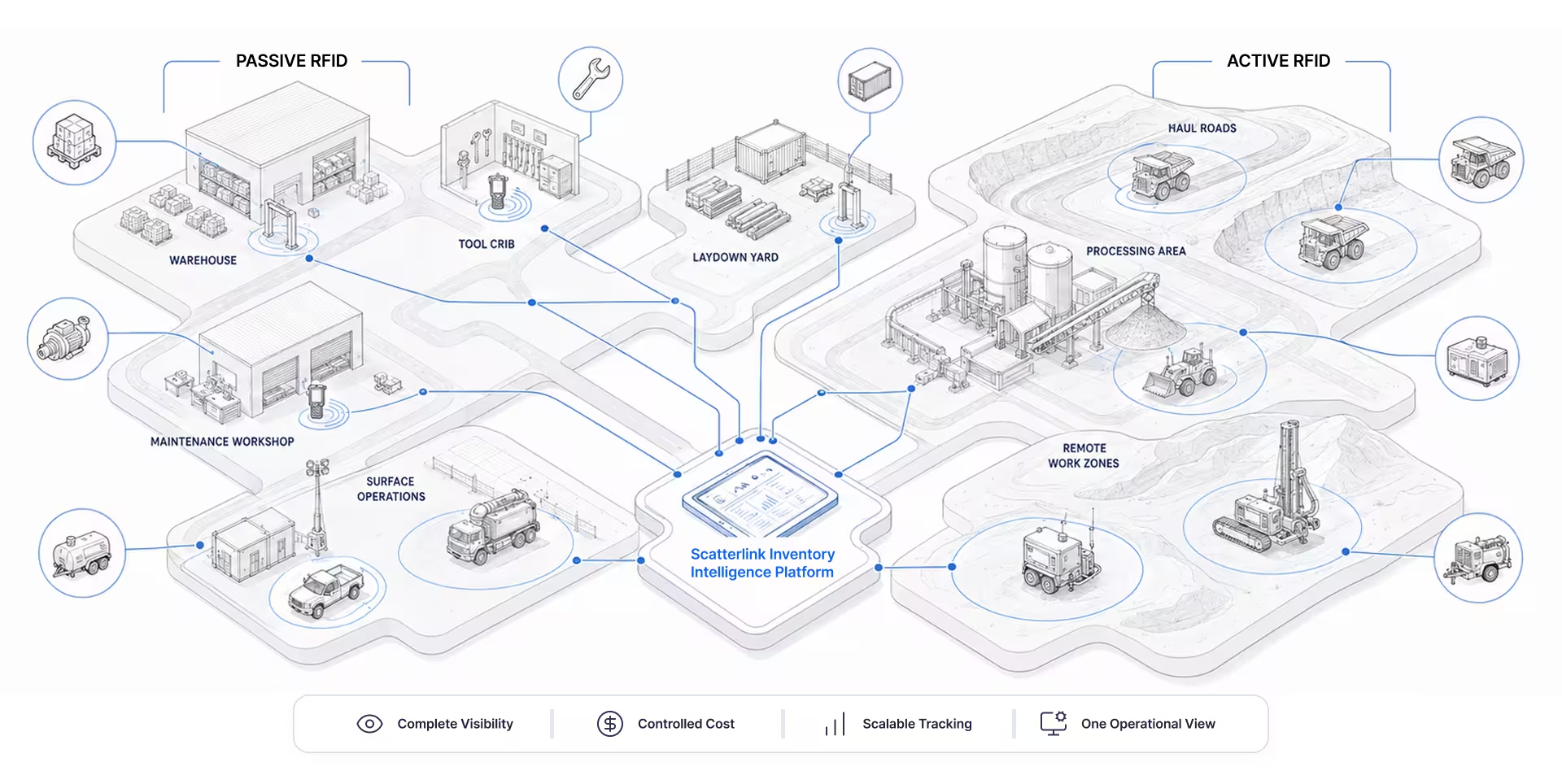
The decision isn't always passive or active RFID. In many industrial environments, the most effective solution combines both technologies.
For example, a mining operation might use passive RFID to manage thousands of inventory items stored in warehouses and laydown yards while using active RFID to monitor the movement of expensive mobile equipment across the site. This hybrid approach provides comprehensive visibility without unnecessarily increasing implementation costs.
Combining multiple RFID technologies allows organizations to match the tracking method to the operational need. High-volume inventory can be managed efficiently with passive tags, while high-value or frequently moving assets benefit from the extended range and continuous monitoring provided by active RFID.
Rather than viewing the technologies as competitors, many organizations achieve the best results by using them together within a unified inventory intelligence strategy.
Choosing between passive and active RFID is only one part of building an effective inventory management solution. Long-term success depends on how well the technology integrates into everyday operations and how easily employees can use it.
Scatterlink's Inventory Intelligence Platform helps industrial organizations implement RFID solutions that align with their operational requirements rather than forcing them into a one-size-fits-all approach. Whether using passive RFID, active RFID, or a combination of both, Scatterlink provides real-time visibility into inventory movement, location, and usage across warehouses, stockyards, surface operations, and underground environments.
By combining RFID technology with intuitive mobile applications, IoT devices, barcode scanning, and seamless ERP integration, Scatterlink delivers accurate, intelligent, and actionable information without creating additional administrative work for frontline teams. Transactions are captured naturally as work happens, improving inventory accuracy while making critical information immediately available to maintenance teams, procurement professionals, warehouse personnel, supervisors, and executive leadership.
Not sure whether your warehouse assets need active or passive tracking? Connect with our tracking specialists to build a customized RFID tag strategy today.
Choosing between passive and active RFID tags is not about selecting the most advanced technology. It is about selecting the technology that best supports your operational goals.
Passive RFID remains the preferred choice for organizations managing large volumes of inventory because it provides an affordable, scalable, and maintenance-free solution for tracking spare parts, tools, and materials. Active RFID offers greater visibility across large operational areas, making it ideal for monitoring high-value equipment and mobile assets where location accuracy and long-range tracking are critical.
Many industrial organizations ultimately benefit from combining both technologies, using each where it delivers the greatest operational value. When supported by the right inventory intelligence platform, RFID becomes more than a tracking technology. It becomes the foundation for faster decisions, improved inventory accuracy, reduced search time, and greater operational efficiency.
Passive RFID tags do not contain a battery and are powered by signals from an RFID reader. Active RFID tags have an internal battery that allows them to transmit signals over much longer distances.
Passive RFID tags are generally better suited for inventory management because they are cost-effective, require no battery maintenance, and can be deployed across thousands of inventory items.
Active RFID is best for tracking high-value assets, vehicles, heavy equipment, shipping containers, and mobile resources that require long-range or continuous location tracking.
Absolutely. Many organizations implement a hybrid RFID strategy, using passive RFID for inventory and active RFID for high-value mobile assets to balance cost, scalability, and operational visibility.
Not always. Many industrial organizations use RFID and barcode technology together, depending on the application, asset type, and operational requirements.
RFID inventory management uses radio frequency identification (RFID) technology to automatically identify, locate, and track inventory throughout its lifecycle. Compared to manual inventory processes and barcode-only systems, RFID provides faster inventory counts, improved inventory accuracy, and real-time visibility across warehouses, stockyards, field locations, and industrial operations.
RFID asset tracking software helps organizations monitor inventory and equipment in real time by combining RFID tags, readers, mobile applications, and centralized inventory intelligence. It reduces manual data entry, shortens inventory search time, improves inventory accuracy, and provides complete visibility across multiple operational locations.
Mining operations manage inventory across warehouses, stockyards, sea cans, laydown yards, workshops, field locations, and underground environments. Purpose-built asset tracking software for mining, mining asset tracking platforms, and mining equipment tracking systems provide real-time visibility, offline mobile capability, and RFID-based tracking that traditional warehouse management systems are not designed to support.
%20(1).avif)
.avif)
%20(1).avif)