
As industrial organizations grow, inventory rarely remains in a single warehouse. Materials, spare parts, equipment, and consumables are distributed across multiple facilities, regional warehouses, stockyards, maintenance workshops, mine sites, construction projects, and remote operational locations. While this expansion supports business growth, it also introduces significant inventory management challenges.
Without complete visibility across every location, organizations struggle to answer fundamental operational questions. Where is a particular item? Which location has available stock? Should inventory be transferred internally or purchased again? Is another warehouse already carrying surplus inventory that could satisfy current demand?
This is why multi-location inventory management has become a strategic priority for asset-intensive industries. Effective multi-location inventory management provides a centralized view of inventory across every operational site, enabling organizations to make faster decisions, improve inventory utilization, and reduce unnecessary inventory investment.
Rather than treating each warehouse or project as an independent inventory operation, leading organizations manage inventory as a connected enterprise-wide resource. The result is greater inventory visibility, improved inventory accuracy, and stronger operational performance.
In this guide, we'll explore the common challenges of multi-location inventory management, explain why centralized inventory visibility matters, and examine the technologies helping industrial organizations manage inventory more effectively across multiple locations.
Business growth almost always increases inventory complexity.
Mining companies operate multiple mines, processing plants, warehouses, and maintenance facilities. Construction companies manage inventory across active projects and temporary storage locations. Manufacturers support production from multiple plants, while oil and gas organizations maintain inventory across refineries, terminals, drilling sites, and regional distribution centers.
As the number of operational locations grows, so does the volume of inventory movement.
Materials are transferred between sites. Equipment is reassigned based on operational priorities. Spare parts are relocated to support maintenance activities. Procurement teams purchase inventory for different facilities while operations continue around the clock.
Without effective multi-location inventory management, maintaining visibility across these interconnected operations quickly becomes difficult.
Although every organization operates differently, businesses managing inventory across multiple sites often experience similar operational challenges.
Many organizations maintain accurate inventory records within individual warehouses but struggle to gain visibility across the entire business.
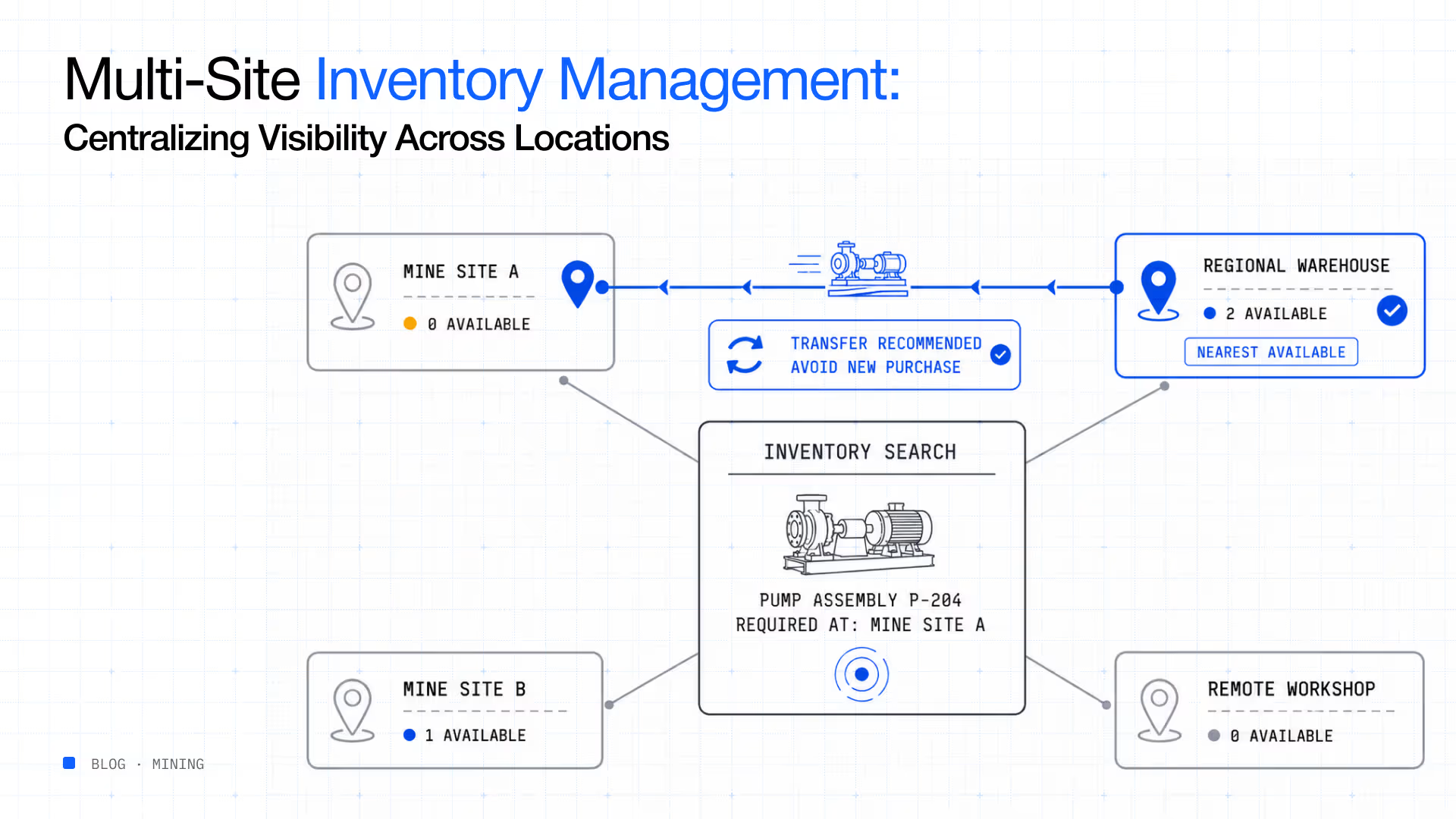
A maintenance planner may know inventory is unavailable at one location without realizing the same item is available at another facility. Procurement teams place new purchase orders because they cannot easily identify surplus inventory elsewhere.
This fragmented visibility leads to unnecessary procurement, slower decision-making, and reduced inventory utilization.
Duplicate purchasing is one of the most expensive consequences of poor multi-location inventory management.
When inventory visibility is limited, different locations frequently purchase identical inventory independently. Meanwhile, existing stock remains unused at another warehouse or operational site.
Over time, duplicate purchases increase inventory investment, tie up working capital, and create unnecessary surplus inventory throughout the organization.
Inventory movement between locations is common across industrial operations.
Critical spare parts may move between mine sites, construction projects, warehouses, or maintenance facilities. Equipment is reassigned based on operational priorities, while consumables are distributed to support changing production requirements.
If these transfers are not captured accurately, inventory records quickly become unreliable.
Employees lose confidence in inventory systems, maintenance planning slows, and warehouse personnel spend increasing amounts of time verifying inventory manually.
Some organizations operate multiple inventory systems across different facilities.
Individual warehouses may use separate spreadsheets, localized inventory software, paper-based processes, or disconnected ERP modules. Although each location manages its own inventory effectively, obtaining a consolidated enterprise-wide view becomes extremely difficult.
This lack of standardization limits the effectiveness of multi-location inventory management and makes enterprise-level inventory planning significantly more challenging.
Your inventory shouldn't operate in silos simply because your business doesn't. Discover how Scatterlink provides centralized inventory visibility across every operational location.
The primary objective of multi-location inventory management is not simply tracking inventory across more locations.
It is enabling every department to work from the same accurate inventory information.
When inventory visibility is centralized, procurement teams can identify available stock before placing new purchase orders. Maintenance planners can locate spare parts across the organization before scheduling repairs. Warehouse teams coordinate inventory transfers more efficiently, while operations managers gain greater confidence in production planning.
Instead of asking, "Do we have this item?" organizations begin asking, "Where is the closest available inventory?"
That shift significantly improves operational efficiency while reducing unnecessary inventory investment.
Many organizations already own the inventory they need.
The challenge is knowing where it is.
Without centralized visibility, inventory often remains underutilized because employees cannot easily identify available stock across multiple facilities. One warehouse may experience shortages while another carries excess inventory of the same item.
Effective multi-location inventory management improves inventory utilization by making inventory visible across the enterprise rather than within individual locations.
This reduces duplicate purchases, lowers carrying costs, and enables organizations to maximize the value of existing inventory before investing in additional stock.
Inventory transfers are a normal part of industrial operations. Spare parts are moved between warehouses to support urgent maintenance, equipment is reassigned to different sites, and surplus inventory is redistributed as operational priorities change.
The challenge arises when these transfers are not recorded consistently.
An item may physically leave one warehouse but remain listed there in the ERP. At the receiving location, the inventory may not be recorded immediately. During this gap, both locations are working with incomplete information, making it difficult to trust inventory records or make informed procurement decisions.
Effective multi-location inventory management requires every inventory movement to be captured in real time. Standardized transfer workflows ensure inventory records remain synchronized across every location, giving warehouse teams, procurement professionals, and operations managers confidence in the information they rely on every day.
Not every inventory transaction happens inside a warehouse.
Maintenance teams issue spare parts in the field, construction supervisors receive materials directly at project sites, and mining personnel transfer inventory between surface and underground operations. Waiting until employees return to a desktop computer to update inventory records often leads to delays and missing transactions.
Mobile inventory applications solve this challenge by allowing employees to complete inventory transactions wherever work takes place.
Users can receive inventory, transfer materials, issue spare parts, perform cycle counts, and search inventory directly from mobile devices. For remote locations with unreliable connectivity, offline-first capability allows transactions to continue without interruption, with data synchronizing automatically once a connection is available.
This flexibility makes multi-location inventory management practical across geographically distributed operations where inventory is constantly moving.
Managing inventory across multiple locations becomes significantly easier when inventory updates automatically.
RFID technology enables organizations to capture inventory movement quickly and accurately without relying solely on manual scanning. Combined with mobile applications, barcode technology, IoT devices, and ERP integration, RFID helps maintain accurate inventory records across every operational site.
With real-time inventory visibility, organizations can instantly determine:
Instead of relying on assumptions or multiple phone calls between warehouses, every department has access to the same accurate inventory information.
This level of visibility allows multi-location inventory management to become proactive rather than reactive.
Managing multiple locations shouldn't mean managing multiple versions of the truth. Discover how Scatterlink gives every site access to the same accurate inventory information in real time.
Centralizing inventory information does more than improve visibility. It creates opportunities for better decision-making across the organization.
When inventory data from every warehouse, stockyard, maintenance facility, and remote site is consolidated into a single platform, organizations can identify patterns that would otherwise remain hidden.
For example, inventory intelligence can reveal:
These insights allow organizations to optimize inventory levels, improve procurement planning, and allocate inventory more effectively across the business.
Instead of managing inventory location by location, multi-location inventory management becomes an enterprise-wide strategy that improves both operational performance and financial efficiency.
Scatterlink's Inventory Intelligence Platform is designed for organizations managing inventory across multiple operational locations.
By combining RFID technology, barcode scanning, IoT devices, mobile inventory applications, GPS-enabled location tracking, and seamless ERP integration, Scatterlink provides a centralized view of inventory across warehouses, stockyards, maintenance facilities, project sites, and remote operations.
Whether inventory is transferred between mine sites, construction projects, regional warehouses, or field locations, every movement is captured and reflected within a single inventory platform. Teams no longer need to rely on separate spreadsheets or local inventory records to determine inventory availability.
Scatterlink's offline-first mobile capability allows inventory transactions to continue even in remote environments with limited connectivity, ensuring inventory information remains accurate regardless of where work takes place.
Because the platform is designed around existing operational workflows, employees require minimal training to begin using it. Warehouse teams, maintenance personnel, procurement professionals, operations managers, and executive leadership all gain access to accurate, intelligent, and actionable inventory information that supports faster, more confident decision-making.
Looking to improve multi-location inventory management? Discover how Scatterlink helps industrial organizations centralize inventory visibility, reduce duplicate purchases, and manage inventory more efficiently across every operational location.
As industrial organizations expand, managing inventory across multiple locations becomes increasingly complex. Without centralized visibility, inventory is easily underutilized, duplicate purchases become more common, and operational teams spend valuable time searching for information instead of making decisions.
Effective multi-location inventory management eliminates these challenges by providing a single, accurate view of inventory across every warehouse, job site, maintenance facility, and remote operation. With standardized inventory processes, real-time visibility, and connected technologies such as RFID, mobile applications, and ERP integration, organizations can improve inventory accuracy while maximizing the value of the inventory they already own.
The result is more than better inventory control. It is faster maintenance planning, smarter procurement decisions, improved inventory utilization, and stronger operational performance across the entire enterprise.
For organizations operating across multiple sites, multi-location inventory management is no longer simply an operational improvement. It is a competitive advantage.
Multi-location inventory management is the process of tracking, managing, and optimizing inventory across multiple warehouses, facilities, project sites, stockyards, and operational locations from a centralized platform.
It improves inventory visibility, reduces duplicate purchases, supports better inventory transfers, increases inventory utilization, and helps organizations make faster operational decisions using accurate inventory information.
Common challenges include fragmented inventory visibility, inconsistent inventory transfers, duplicate purchasing, disconnected inventory systems, delayed inventory updates, and maintaining inventory accuracy across multiple sites.
Real-time visibility allows organizations to identify inventory availability across every location instantly, improving maintenance planning, procurement decisions, inventory transfers, and overall inventory utilization.
RFID, barcode scanning, mobile inventory applications, IoT devices, offline synchronization, GPS-enabled location tracking, ERP integration, and centralized inventory intelligence platforms all strengthen multi-location inventory management.
%20(1).avif)
.avif)
%20(1).avif)