
Maintenance, Repair, and Operations (MRO) inventory is the backbone of every mining operation. While it may not directly contribute to production output, it enables the equipment, infrastructure, and facilities that keep production running safely and efficiently. Every bearing, hydraulic hose, electrical component, cutting edge, filter, gasket, and sensor plays a critical role in maintaining equipment reliability. Effective MRO inventory management ensures these critical items are available when required without tying up excessive working capital in slow-moving stock.
Unfortunately, managing MRO inventory has become increasingly difficult for modern mining operations. Equipment fleets continue to grow, inventory is spread across multiple locations, and maintenance teams demand immediate access to critical spare parts. Without accurate inventory visibility, organizations struggle to balance inventory availability with inventory investment. The result is excess stock, emergency purchasing, duplicate inventory, and maintenance delays that directly affect equipment availability and operational performance.
A structured MRO inventory strategy allows mining organizations to move beyond reactive inventory management by ensuring every inventory decision is supported by accurate, real-time information.
Unlike production inventory, which directly contributes to the extraction and processing of minerals, MRO inventory exists to support the equipment and infrastructure that make production possible. It includes thousands of individual items ranging from low-cost consumables to highly specialized spare parts that may only be used once every few years.
This creates a unique inventory management challenge.
Some MRO items are consumed daily, while others remain in storage for extended periods waiting for an unexpected equipment failure. Certain components are inexpensive but operationally critical, whereas others represent a significant financial investment despite being used infrequently. Determining the appropriate inventory level for each item requires balancing operational risk against inventory carrying costs.
The challenge becomes even greater because MRO inventory is rarely stored in a single location. Critical spare parts are distributed across warehouses, workshops, mobile maintenance units, shutdown storage areas, sea cans, contractor compounds, and both surface and underground facilities. As inventory moves between these locations, maintaining accurate inventory records becomes increasingly difficult.
Without structured MRO inventory management, organizations frequently experience stockouts of critical components while simultaneously holding excessive quantities of slower-moving inventory. This imbalance increases working capital without improving equipment availability.
Successful MRO inventory management is therefore not about holding more inventory. It is about ensuring the right inventory is available in the right location at the right time.
Many mining organizations manage MRO inventory reactively. Inventory is replenished after a stockout occurs, emergency purchase orders are raised during equipment failures, and inventory reviews happen only after operational issues become visible.
While this approach may appear manageable on a day-to-day basis, it quietly introduces significant costs across the business.
Emergency procurement often carries premium pricing because suppliers must respond immediately. Expedited freight increases transportation expenses. Maintenance teams lose productive hours waiting for replacement components to arrive. Production schedules are adjusted while equipment remains unavailable.
These direct costs are only part of the problem.
Reactive inventory management also creates hidden inefficiencies that accumulate over time. Procurement teams frequently purchase duplicate inventory because existing stock cannot be located. Maintenance planners schedule work based on incomplete inventory information. Warehouse personnel spend valuable time conducting manual searches rather than supporting operational activities.
Perhaps the most significant consequence is the gradual loss of confidence in inventory data. When warehouse records no longer reflect physical inventory accurately, every department begins verifying inventory manually before making decisions. What should be a straightforward inventory process becomes an administrative exercise involving multiple phone calls, emails, spreadsheets, and physical inspections.
Instead of supporting maintenance efficiency, inventory management becomes another source of operational delay.
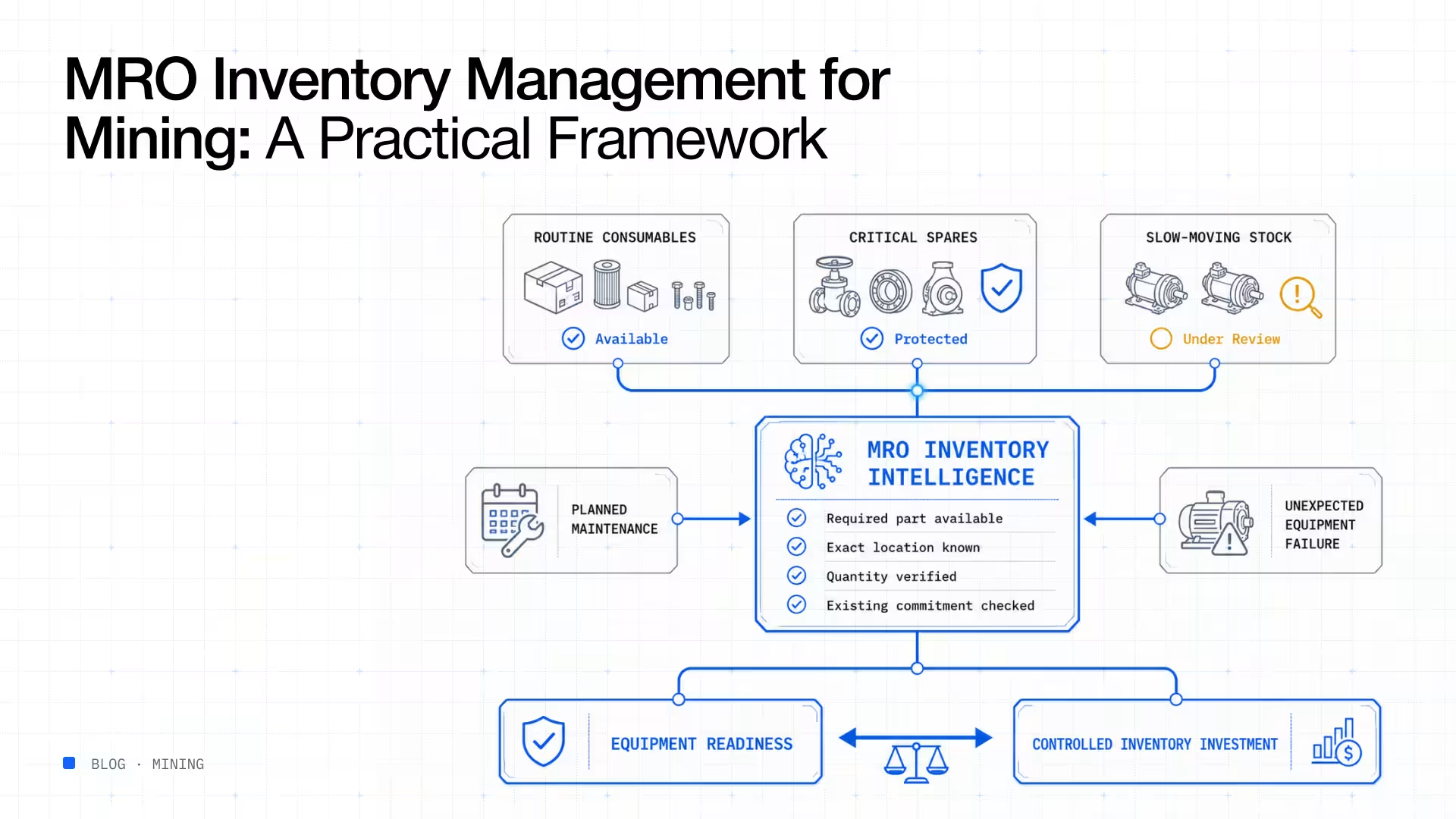
Improving MRO inventory management does not require organisations to completely redesign their warehouse operations or replace existing ERP systems. What it does require is a structured framework that treats inventory as a strategic operational asset rather than simply a collection of spare parts. The most successful mining organisations combine inventory governance, real-time visibility, maintenance planning, and continuous data improvement into a single inventory management approach.
The first step is identifying which inventory items are genuinely critical to production. Not every spare part carries the same operational risk. A low-cost gasket used daily should not be managed in the same way as a specialised gearbox that could stop an entire processing plant if unavailable. Criticality analysis allows organisations to prioritise inventory investment where it has the greatest operational value.
The second step is maintaining accurate inventory records. Every inventory movement should be captured from receipt through consumption so that maintenance planners, warehouse teams, procurement professionals, and finance departments are working from the same trusted information. Without accurate inventory data, even the most sophisticated inventory planning models eventually fail.
The third step involves standardising inventory across the business. Duplicate item descriptions, inconsistent supplier information, and multiple stock codes for identical parts make inventory management unnecessarily complex. A clean item master combined with standardised classifications allows organisations to identify interchangeable inventory, reduce duplicate purchases, and improve procurement decisions.
Finally, organisations should continuously review inventory performance rather than relying solely on annual stocktakes. Inventory accuracy, stock availability, inventory turnover, emergency purchases, and maintenance delays should all be monitored regularly to identify improvement opportunities before they become operational problems.
When these principles work together, MRO inventory management evolves from a reactive support function into a strategic capability that improves equipment reliability while controlling inventory costs.
No MRO inventory strategy can succeed without accurate inventory visibility.
Mining organisations often know how much inventory they have purchased, but they cannot always determine where it is currently located. Critical spare parts move constantly between warehouses, workshops, sea cans, shutdown areas, maintenance crews, and underground operations. If these movements are not captured immediately, inventory records gradually lose accuracy.
This uncertainty creates operational friction across every department.
Maintenance planners hesitate to schedule work because inventory availability cannot be confirmed. Warehouse personnel spend valuable time searching for inventory that should already be on the shelf. Procurement raises emergency purchase orders because existing stock cannot be located quickly enough. Finance questions inventory valuations because physical stock no longer matches system records.
Real-time inventory visibility eliminates these challenges by providing continuous visibility into inventory movement across every operational location.
Instead of asking whether inventory should be available, maintenance teams know exactly where it is stored. Procurement can verify existing inventory before purchasing additional stock. Warehouse personnel spend less time performing manual searches because inventory locations remain continuously updated.
This level of visibility not only improves operational efficiency but also strengthens decision-making throughout the business. Leaders gain confidence that inventory reports accurately reflect reality, allowing them to optimise stock levels without increasing operational risk.
Inventory visibility therefore becomes the foundation upon which every successful MRO inventory strategy is built.
Improve your MRO inventory strategy with complete visibility across warehouses, workshops, sea cans, and maintenance facilities. Discover how Scatterlink helps mining organisations manage inventory with confidence.
Scatterlink's Inventory Intelligence Platform helps mining organisations transform MRO inventory management by connecting inventory visibility with day-to-day maintenance operations. Rather than relying solely on ERP transactions, Scatterlink captures inventory movement as it happens, ensuring every spare part remains visible throughout its entire lifecycle.
Using RFID technology, barcode scanning, offline mobile applications, IoT devices, GPS-enabled location tracking, and seamless ERP integration, Scatterlink provides real-time visibility across central warehouses, maintenance workshops, laydown yards, contractor facilities, sea cans, and both surface and underground operations.
This enables maintenance teams to locate critical spare parts in seconds rather than hours. Procurement teams gain confidence that existing inventory has been checked before new purchases are approved. Warehouse personnel spend less time searching for inventory and more time supporting operational activities. Finance benefits from improved inventory accuracy and stronger inventory governance across the organisation.
By combining inventory intelligence with accurate operational data, Scatterlink helps organisations reduce downtime, optimise inventory investment, and improve equipment availability without disrupting existing ERP systems.
Effective MRO inventory management is about far more than maintaining warehouse stock. It is about ensuring every maintenance activity is supported by accurate inventory information, reliable spare parts availability, and complete visibility across every storage location.
Mining organisations that continue relying on reactive inventory practices often experience duplicate purchases, emergency procurement, excess inventory, and unnecessary maintenance delays. These challenges increase operating costs while reducing confidence in inventory data.
By implementing a structured MRO inventory framework supported by real-time inventory visibility, organisations can improve maintenance planning, optimise working capital, strengthen procurement decisions, and increase equipment availability across the entire operation.
As mining operations become increasingly digital, successful MRO inventory management will depend not only on what inventory organisations own, but on how intelligently they manage it.
MRO inventory management is the process of managing Maintenance, Repair, and Operations inventory required to maintain equipment, infrastructure, and operational assets. It focuses on ensuring critical spare parts are available while minimising unnecessary inventory investment.
Mining equipment depends on readily available spare parts to minimise downtime. Effective MRO inventory management improves equipment reliability, supports preventive maintenance, reduces emergency purchasing, and helps maintain continuous production.
Real-time inventory visibility allows maintenance teams to locate spare parts quickly, verify inventory availability before maintenance begins, reduce duplicate purchases, and improve inventory accuracy across multiple storage locations.
%20(1).avif)
.avif)
%20(1).avif)