
Maintaining the right amount of inventory is a constant challenge for industrial operations. Too little stock can leave maintenance teams waiting for critical parts, while too much inventory ties up working capital, consumes storage capacity and increases the risk of excess or obsolete stock. Min-max inventory levels provide a structured way to balance these competing risks.
The concept is straightforward: establish a minimum inventory level that triggers replenishment and a maximum level that defines how much stock should normally be held. The difficult part is setting those levels correctly. For MRO and spare parts inventory, demand is often irregular, supplier lead times can be long and some low-use components may still be critical to production.
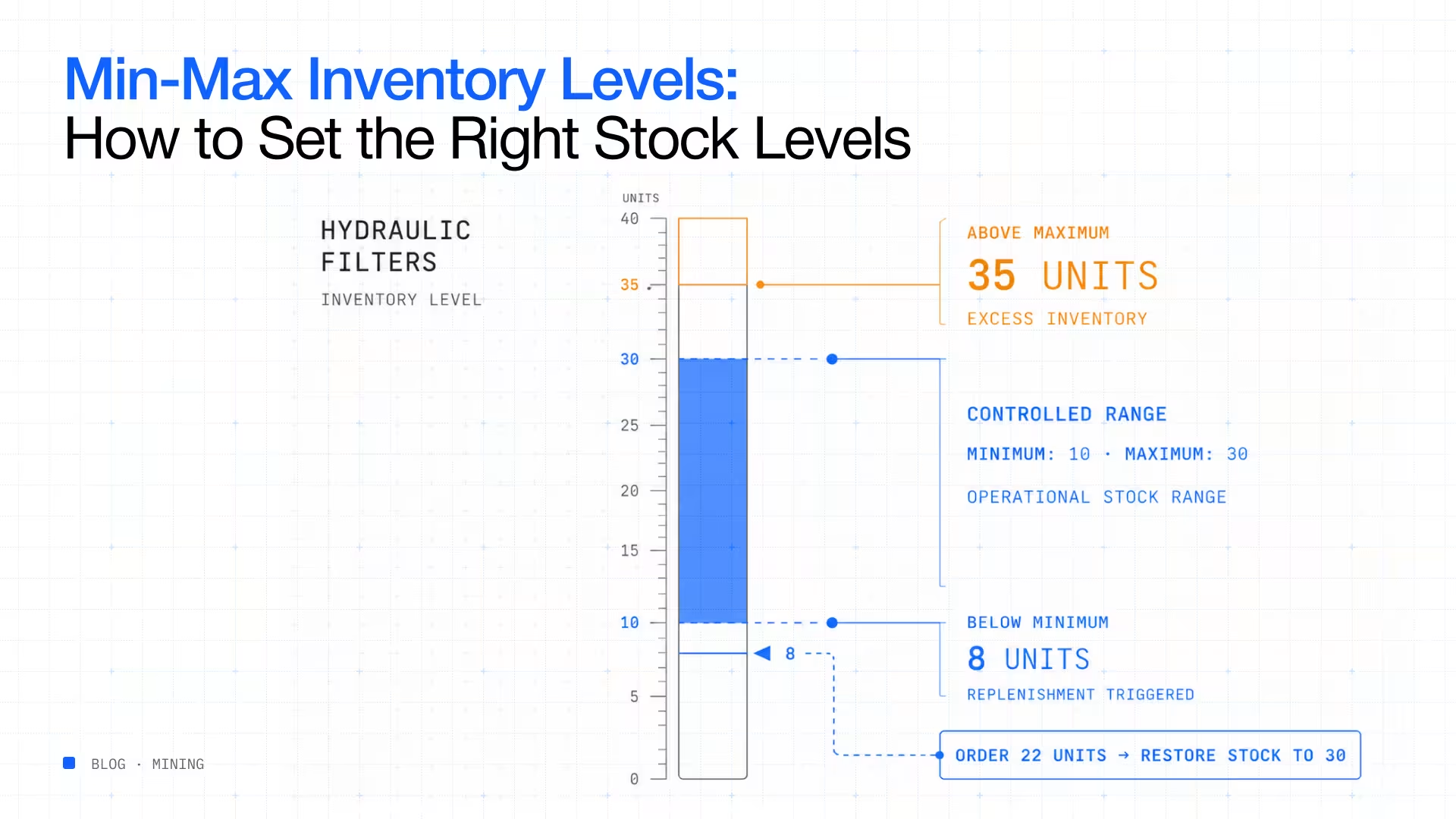
Min-max inventory levels are inventory control parameters used to determine when stock should be replenished and how much inventory should generally be maintained. The minimum level represents the point at which additional stock should be ordered, while the maximum level represents the target quantity to replenish towards.
For example, if a warehouse has a minimum level of 10 units and a maximum level of 30 units, reaching or falling below 10 units can trigger a replenishment action. The order quantity would typically bring available inventory back towards the maximum level, depending on current stock, outstanding orders and other inventory requirements.
Min-max inventory control is particularly useful for organisations managing large numbers of spare parts and consumables because it creates consistent replenishment rules. However, the parameters should reflect actual demand, lead times and operational criticality rather than being assigned as generic values across every inventory item.
The purpose of min-max inventory management is to prevent inventory levels from moving too far in either direction. If minimum levels are set too low, the organisation can experience stockouts before replenishment arrives. If maximum levels are set too high, the organisation may hold unnecessary inventory that remains unused for extended periods.
This balance becomes particularly important for industrial operations where inventory availability can directly affect maintenance and production. A critical spare part may have very low historical consumption but still require a sufficient stock level because a failure could cause significant downtime. Min-max settings need to account for this operational context.
Effective min-max inventory levels can help organisations:
A min-max system uses two primary thresholds to control replenishment. The minimum level acts as a trigger, while the maximum level establishes the desired upper inventory position. When stock reaches the minimum threshold, the organisation reviews whether replenishment is required and determines the appropriate quantity.
However, the calculation should not simply compare physical stock against two fixed numbers. Organisations should also consider inventory already on order, reserved stock, expected demand and stock held at other locations. Otherwise, the system may recommend unnecessary purchases or fail to recognise that available inventory already exists elsewhere.
For example, suppose a site has 12 units physically available and a minimum level of 10 units. At first glance, there may appear to be no immediate replenishment requirement. But if six units are already reserved for planned maintenance, the genuinely available quantity is much lower. A reliable min-max process needs to account for these operational realities.
The minimum inventory level is the point at which an organisation should consider replenishment to protect against running out of stock. It should provide enough inventory coverage to account for expected demand during the replenishment period and an appropriate level of uncertainty.
Minimum stock should not be based solely on average consumption. Supplier lead time, demand variability, criticality and the availability of alternative parts can all influence the level required. A component with a long and unpredictable lead time may need a higher minimum level than an item that can be sourced locally within a few days.
Minimum stock and reorder point are related but should not always be treated as identical concepts. The reorder point generally represents the inventory position at which a replenishment order should be initiated, while minimum stock can refer to the lower inventory threshold an organisation wants to avoid reaching.
For practical inventory control, the distinction matters because replenishment needs to begin early enough for new stock to arrive before existing inventory is exhausted. If an organisation waits until physical stock reaches a critical minimum before initiating procurement, a long supplier lead time can create a stockout before the replacement arrives.
The maximum inventory level represents the upper quantity an organisation aims to hold under normal replenishment conditions. It helps prevent procurement teams from continuously ordering more stock than the operation can reasonably consume.
Setting a maximum level requires an understanding of expected demand, replenishment frequency, supplier lead times, storage constraints and the cost of holding inventory. A maximum level that is too high can create excess stock, while a maximum that is too low may lead to frequent purchasing and increased administrative workload.
For MRO and spare parts inventory, maximum levels should also reflect criticality. A high-value critical spare may require a different inventory strategy from a commonly available consumable, even if both have similar historical consumption.
There is no single formula that works for every industrial inventory category. A basic approach starts with expected demand during the replenishment period and then adds an appropriate buffer for demand and supply uncertainty.
A simplified framework can be expressed as:
Minimum Level = Expected Demand During Lead Time + Safety Stock
The maximum level can then be established based on expected demand over the replenishment cycle plus an appropriate buffer:
Maximum Level = Expected Demand Over Replenishment Cycle + Safety Stock
These formulas provide a starting point rather than a universal answer. Industrial organisations should adjust their calculations according to item criticality, demand variability, supplier reliability, storage constraints and operational requirements.
Historical consumption provides a useful starting point for understanding how much inventory an item typically requires. Organisations can examine consumption frequency, average usage and changes in demand over time to establish a baseline.
However, historical data should not be used in isolation. A spare part that has only been consumed twice in three years may still require protection if it supports critical equipment. Demand history needs to be interpreted alongside operational requirements.
Supplier lead time directly affects how much inventory protection may be required. The longer it takes to replenish an item, the greater the risk that available stock will be exhausted before the next delivery arrives.
Lead time should also reflect actual supplier performance rather than only the standard lead time recorded in a purchasing system. If a supplier routinely takes longer than the stated lead time, using the shorter figure when setting minimum levels can create an unrealistic replenishment strategy.
Average demand does not tell the full story. Two parts may have the same average annual consumption while having completely different demand patterns. One may be consumed consistently, while another may remain unused for months before several units are suddenly required.
Demand variability should therefore influence the amount of protection built into inventory levels. Higher uncertainty generally requires greater consideration of safety stock and replenishment timing.
Criticality is especially important when setting min-max levels for industrial spare parts. A low-consumption component may still require a minimum quantity if its absence could stop production or significantly delay maintenance.
This is why critical spare parts should not automatically receive lower inventory levels simply because they have low turnover. The cost of holding an additional unit needs to be compared with the operational consequences of not having that unit when equipment fails.
Min-max inventory levels are only effective when the underlying inventory information is accurate. If system quantities do not reflect physical stock, replenishment triggers can be based on incorrect information. Teams may order parts that are already available or fail to replenish inventory that appears sufficient in the system but cannot actually be located.
This becomes more challenging when inventory is distributed across multiple warehouses, surface operations and underground locations. A centralised view of inventory can help teams understand total availability before making replenishment decisions. Explore Scatterlink's RFID inventory management solution to improve visibility into inventory movements and availability across complex industrial environments.
Min-max levels should not be treated as permanent settings. Changes in equipment, production requirements, maintenance strategies, supplier performance and consumption patterns can all make existing inventory parameters unsuitable.
Regular reviews can identify items where demand has increased, declined or become more variable. They can also highlight parts where supplier lead times have changed or where existing stock levels no longer reflect operational requirements. Learn more about Scatterlink and how better inventory visibility can support more informed inventory decisions.
Setting min-max inventory levels should begin with reliable inventory and consumption data rather than arbitrary numbers. The minimum should provide enough protection to cover expected demand during replenishment, while the maximum should prevent unnecessary accumulation. A practical approach is to establish the inputs first, calculate a baseline, and then adjust the levels according to criticality, variability and operational requirements.
Start by analysing historical consumption for each inventory item. Look at average usage, consumption frequency, demand peaks and changes in usage over time rather than relying on a single historical figure. For industrial spare parts, it is also important to distinguish genuine demand from one-off events such as major shutdowns or abnormal equipment failures.
Consumption data should be sufficiently detailed to support item-level decisions. If the organisation uses broad averages across unrelated parts, the resulting min-max levels may be too high for some items and too low for others. Accurate transaction data from receiving, issuing, transferring and consuming inventory provides a stronger foundation for setting replenishment parameters.
Next, establish how long each item takes to replenish. Lead time should reflect the actual time between placing an order and having usable inventory available, rather than relying solely on a standard supplier figure.
This is particularly important for specialised industrial spare parts. A component with a six-week supplier lead time requires a very different minimum level from an item that can be sourced within two days. Where supplier lead times fluctuate, the additional uncertainty should also be considered when determining safety stock.
Once average demand and lead time are known, calculate the expected consumption during the replenishment period. A basic approach is:
Demand During Lead Time = Average Daily Demand × Lead Time in Days
For example, if an item is consumed at an average rate of two units per day and supplier lead time is 15 days, expected demand during lead time is 30 units. This gives the organisation a starting point for determining the minimum inventory requirement.
However, this calculation assumes that demand remains relatively predictable. Where demand varies significantly, relying only on average consumption can leave the operation exposed to stockouts. Safety stock should therefore be considered where demand or supply uncertainty is material.
Safety stock provides an additional buffer against unexpected demand and supplier delays. In a basic min-max model, the minimum or reorder point can be established by combining expected demand during lead time with an appropriate safety stock level.
Minimum Level / Reorder Point = Demand During Lead Time + Safety Stock
The right safety stock level depends on the item's demand variability, supplier reliability, desired service level and operational criticality. A critical spare part supporting production may justify more protection than a readily available, low-impact component. The objective is not to maximise safety stock, but to provide an appropriate buffer against the risks that could interrupt operations.
Once the minimum level has been established, the maximum level determines how much stock should normally be held after replenishment. A simple approach is to add the intended replenishment quantity to the minimum level.
Maximum Level = Minimum Level + Replenishment Quantity
The replenishment quantity can depend on supplier minimum order quantities, purchasing frequency, storage capacity, expected demand and other commercial considerations. For example, if the minimum level is 30 units and the organisation normally replenishes 50 units at a time, the maximum level could be set at 80 units.
The maximum should not simply be set as a large buffer to avoid frequent purchasing. Excessively high maximum levels can create overstock, tie up working capital and increase the risk of slow-moving or obsolete inventory. The level should reflect how much stock the operation can reasonably expect to use before the next replenishment cycle.
Critical spare parts require a different approach because their operational importance may not correlate with their consumption rate. A component that is used only once every two years could still require protection if its failure would stop production and replacement takes several months.
For these items, organisations should consider equipment criticality, failure consequences, supplier lead time, availability of alternatives and the possibility of emergency procurement. This may justify maintaining a higher minimum level than historical consumption alone would suggest. Min-max settings should therefore be risk-based rather than applied uniformly across every spare part.
One of the most common mistakes is applying a standard inventory rule across an entire catalogue. Industrial inventories contain consumables, routine maintenance parts, specialised components and production-critical spares, each with different demand and supply characteristics.
A better approach is to segment inventory according to factors such as criticality, consumption, value and lead time. High-criticality items can receive stronger availability protection, while low-risk items can be managed with tighter stock limits. This makes min-max inventory management more responsive without unnecessarily increasing stock across the entire inventory catalogue.
Min-max levels should also account for where inventory is held. If every location independently establishes minimum and maximum levels without visibility into the wider network, the organisation can accumulate more inventory than it actually needs.
For example, three mining sites may each maintain a minimum quantity of the same specialised bearing even though the combined inventory could support the entire operation. A network-wide inventory view can reveal these opportunities and help organisations decide whether inventory should be transferred before additional stock is purchased.
This is particularly important when managing inventory across surface and underground operations. A part may technically exist within the organisation but still be unavailable to the location that needs it. Explore Scatterlink's RFID inventory management solution to improve visibility into inventory locations, movements and availability.
Min-max settings become unreliable when they are based on historical demand that no longer reflects current operating conditions. Equipment changes, production levels and maintenance strategies can all alter future consumption.
Inventory parameters should therefore be reviewed when demand patterns change. A part that once required a high maximum level may need a lower level after equipment usage declines, while an increase in production may require additional inventory protection.
Using an average supplier lead time without considering actual variability can create stockout risk. If an item normally arrives within four weeks but occasionally takes eight weeks, a minimum level based only on the four-week figure may not provide sufficient protection.
Supplier performance should therefore be monitored alongside inventory consumption. Where lead times become longer or less predictable, min-max settings may need to be recalculated.
Min-max calculations are only as reliable as the inventory data behind them. If the system says that 20 units are available but five have already been issued and another five cannot be located, the replenishment calculation is being made against inaccurate information.
Accurate inventory transactions are therefore essential. Receiving, issuing, transferring and consuming inventory should update inventory records consistently so that replenishment decisions reflect actual availability.
Min-max inventory levels should be treated as dynamic controls rather than permanent values. Changes in demand, supplier lead times, equipment requirements, maintenance schedules and inventory criticality can all affect the appropriate stock range.
A regular review can identify items where minimum levels are too low, maximum levels are creating excess inventory or safety stock no longer reflects operational risk. Learn more about Scatterlink's inventory intelligence approach and how better inventory visibility can support more informed inventory decisions.
The right min-max inventory levels are not simply the numbers that prevent a warehouse from reaching zero. They are the levels that balance availability, operational risk, replenishment time and the cost of holding inventory. For industrial operations, that balance needs to account for the very different behaviours of consumables, MRO materials and critical spare parts.
A reliable approach starts with accurate consumption and lead-time data, then incorporates safety stock, criticality, supplier variability and multi-location inventory requirements. Min-max settings should also be reviewed regularly because the conditions that determined the original levels can change over time.
When inventory data is accurate and visible across the operation, teams can make better decisions about when to replenish, how much to hold and where existing stock can be used. See how Scatterlink supports real-time inventory visibility across the inventory lifecycle.
Min-max inventory levels are two stock thresholds used to control replenishment. The minimum level indicates when inventory should trigger a replenishment action, while the maximum level represents the target quantity to restore inventory towards.
A basic calculation is Minimum Level = Demand During Lead Time + Safety Stock. Demand during lead time can be calculated using average daily demand multiplied by supplier lead time, while safety stock provides additional protection against demand and supply variability.
A simple approach is Maximum Level = Minimum Level + Replenishment Quantity. The replenishment quantity should reflect factors such as demand, supplier minimum order quantities, storage capacity, purchasing frequency and inventory carrying costs.
The reorder point is the inventory position at which replenishment should be initiated, while minimum stock can refer to the lower quantity an organisation aims to maintain. In many basic min-max systems, the minimum level and reorder point are treated as the same value.
Not necessarily, but critical spare parts may require greater inventory protection when their absence could cause significant operational disruption. Equipment criticality, failure consequences, supplier lead time and replacement availability should be considered alongside historical consumption.
Min-max levels should be reviewed whenever there are significant changes in demand, supplier lead times, equipment requirements, maintenance strategies or inventory performance. A regular scheduled review can also identify outdated settings before they contribute to stockouts or excess inventory.
%20(1).avif)
.avif)
%20(1).avif)