

Inventory turnover is one of the most widely used inventory management metrics for measuring how efficiently stock is being consumed over a given period. A higher turnover generally indicates that inventory is being used or replenished frequently, while a lower turnover can indicate that stock is sitting unused for longer periods. But for MRO and spare parts inventory, the number requires considerably more context.
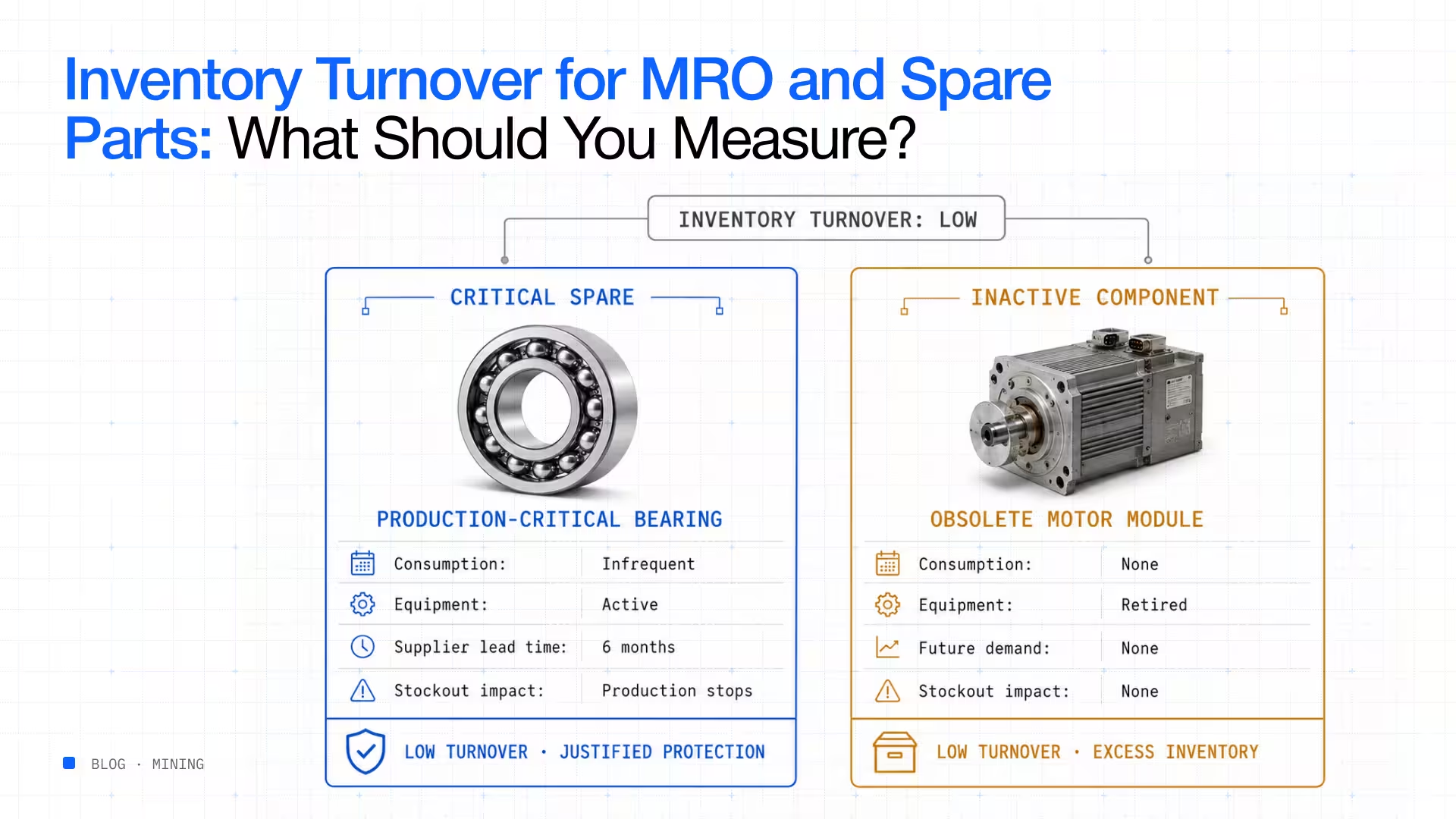
Industrial organisations often hold parts that may not move for months or even years but remain essential to maintaining equipment. A critical spare with low annual consumption can have a low inventory turnover ratio while still providing significant operational value. Measuring inventory turnover for spare parts therefore requires organisations to look beyond a simple ratio and consider inventory criticality, demand patterns, lead times and the consequences of stockouts.
Inventory turnover measures how frequently an organisation sells or consumes its inventory during a specific period. In industrial inventory management, the metric can be adapted to measure how frequently MRO materials and spare parts are consumed or issued rather than sold.
Inventory Turnover Ratio = Cost of Inventory Consumed During the Period ÷ Average Inventory Value
For example, if an operation consumes $1 million worth of inventory during a year and its average inventory value is $250,000, its inventory turnover ratio would be 4. This indicates that the organisation consumed inventory equivalent to four times its average inventory value during the period.
The calculation is straightforward, but interpreting the result is more complicated. A turnover ratio that looks low in a conventional retail environment may be entirely appropriate for an industrial spare parts operation where inventory exists primarily to protect against equipment failure.
MRO inventory can represent a significant investment because industrial organisations need to maintain parts and materials that support maintenance, repair and operational continuity. Inventory turnover helps teams understand whether that investment is being actively utilised or whether significant amounts of capital remain tied up in stock.
A consistently low turnover ratio may indicate excess inventory, weak demand, inaccurate replenishment settings or obsolete stock. However, it can also indicate that the organisation is deliberately holding critical spare parts with unpredictable demand. The metric therefore works best as a starting point for investigation rather than as a standalone target.
Inventory turnover can help organisations identify:
The basic inventory turnover formula can be adapted for MRO and spare parts by using the value of inventory consumed during the measurement period and the average inventory value held during that period.
Inventory Turnover = Annual Inventory Consumption Value ÷ Average Inventory Value
Average inventory can be calculated using opening and closing inventory values:
Average Inventory = (Opening Inventory + Closing Inventory) ÷ 2
For example, if an organisation begins the year with $5 million in spare parts inventory and ends the year with $7 million, its average inventory value is $6 million. If $12 million of inventory was consumed during the year, the inventory turnover ratio would be 2.
This calculation provides a useful high-level view, but it can hide significant differences between individual inventory categories. One site may have a high turnover rate for commonly used consumables, while another holds low-turnover critical spares. Aggregating the two can make the overall result appear healthier or worse than the underlying inventory actually is.
There is no universal inventory turnover ratio that represents good performance for every industrial operation. The appropriate ratio depends on the type of inventory, consumption pattern, equipment criticality, supplier lead time and operational requirements.
High-turnover inventory is generally consumed frequently and may require regular replenishment. Low-turnover inventory may be used infrequently but can still be essential if it protects against significant equipment failure. Comparing both categories against the same turnover target can lead to poor inventory decisions.
Instead of asking whether turnover is simply high or low, inventory teams should ask why turnover is at that level. If turnover is low because the organisation is holding unnecessary stock, corrective action may be appropriate. If turnover is low because the organisation holds critical spares with unpredictable demand, reducing stock simply to improve the ratio could increase operational risk.
Inventory turnover and inventory days provide two different ways of looking at inventory utilisation. Turnover measures how many times inventory is consumed over a given period, while inventory days estimate how long current inventory could theoretically support consumption at a given rate.
Inventory days can be calculated using:
Inventory Days = Number of Days in Period ÷ Inventory Turnover Ratio
For example, if inventory turnover is 4 times per year, inventory days would be approximately 91 days. This can make the result easier for operational teams to interpret because it translates a ratio into an estimated period of inventory coverage.
However, inventory days can be misleading for spare parts when demand is highly intermittent. A critical component with very low consumption may appear to have an extremely high number of inventory days, even though maintaining that stock is intentional. This is another reason why MRO inventory metrics should be interpreted alongside operational context.
Low inventory turnover often attracts attention because it can indicate that capital is tied up in stock that is not being consumed. For conventional inventory categories, this may be a strong signal that stock levels need to be reviewed. For industrial spare parts, however, low turnover can sometimes be a deliberate and rational inventory strategy.
Critical spares are often held precisely because demand is uncertain. The organisation does not expect frequent consumption, but it needs the part available if a failure occurs. If the component has a long procurement lead time, retaining the part can be more cost-effective than waiting for an emergency order.
This means that inventory turnover should never be used alone to determine whether a spare part should be reduced or removed. Criticality, replacement time and operational consequences must also be considered.
Low turnover becomes more concerning when it is combined with other indicators of excess or inactive inventory. An item that has not moved for several years, has no known future demand and supports retired equipment is very different from a critical spare that is intentionally held for an unpredictable failure.
Inventory teams should investigate low-turnover items by reviewing:
The last consumption date shows when the inventory was most recently issued or used. A long period without movement can indicate that demand has declined, but it should be investigated rather than automatically classified as obsolete.
Inventory age helps identify how long stock has remained within the operation. Older inventory may have a higher risk of becoming obsolete, particularly where equipment specifications or operational requirements have changed.
Criticality indicates how important the part is to maintaining operations. A low-turnover critical spare may need to remain in stock despite limited consumption, while a low-criticality component may be a stronger candidate for reduction.
Long supplier lead times can justify holding additional inventory even when turnover is low. If replacement takes several months, the organisation may need to maintain sufficient stock to protect against unexpected equipment requirements.
Historical consumption does not necessarily represent future requirements. Planned maintenance, equipment lifecycle changes and upcoming shutdowns can all influence whether low-turnover inventory remains necessary.
Measuring turnover only at the organisation-wide level can hide important inventory problems. A single turnover figure across multiple warehouses, sites and inventory categories may not show which items are creating excess stock or where availability problems exist.
For more useful analysis, turnover can be measured by inventory category, location, item class, equipment group or criticality level. This allows teams to identify where inventory is moving efficiently and where additional investigation is required.
For example, an operation may have an acceptable overall turnover ratio while one remote site holds millions of dollars in slow-moving spare parts. Without location-level analysis, that excess inventory may remain hidden within the broader organisational figure.
Accurate inventory turnover depends on accurate information about both consumption and inventory value. If inventory transactions are delayed, stock movements are recorded incorrectly or inventory locations are not updated consistently, the resulting turnover calculation may not reflect actual operational activity.
This becomes particularly challenging across distributed industrial environments. Inventory may move between warehouses, workshops, surface locations and underground operations before it is ultimately consumed. Explore Scatterlink’s RFID inventory management solution to improve visibility into inventory movements from receipt through to consumption.
A more connected view can help organisations understand not just how much inventory is being consumed, but where it is being consumed and how inventory is moving between locations. This creates a stronger foundation for interpreting turnover and identifying inventory that requires further review.
Inventory turnover is valuable, but it should be considered alongside other inventory KPIs. Stock accuracy, service levels, stockout frequency, inventory carrying cost, inventory age and obsolete inventory can provide additional context.
An organisation could improve turnover by dramatically reducing inventory, but if that reduction causes critical spare stockouts and equipment downtime, the result is not necessarily better inventory management. The goal should be to optimise inventory performance rather than maximise a single metric.
Learn more about Scatterlink and how inventory intelligence can help industrial operations connect inventory data with operational decision-making.
%20(1).avif)
.avif)
%20(1).avif)