
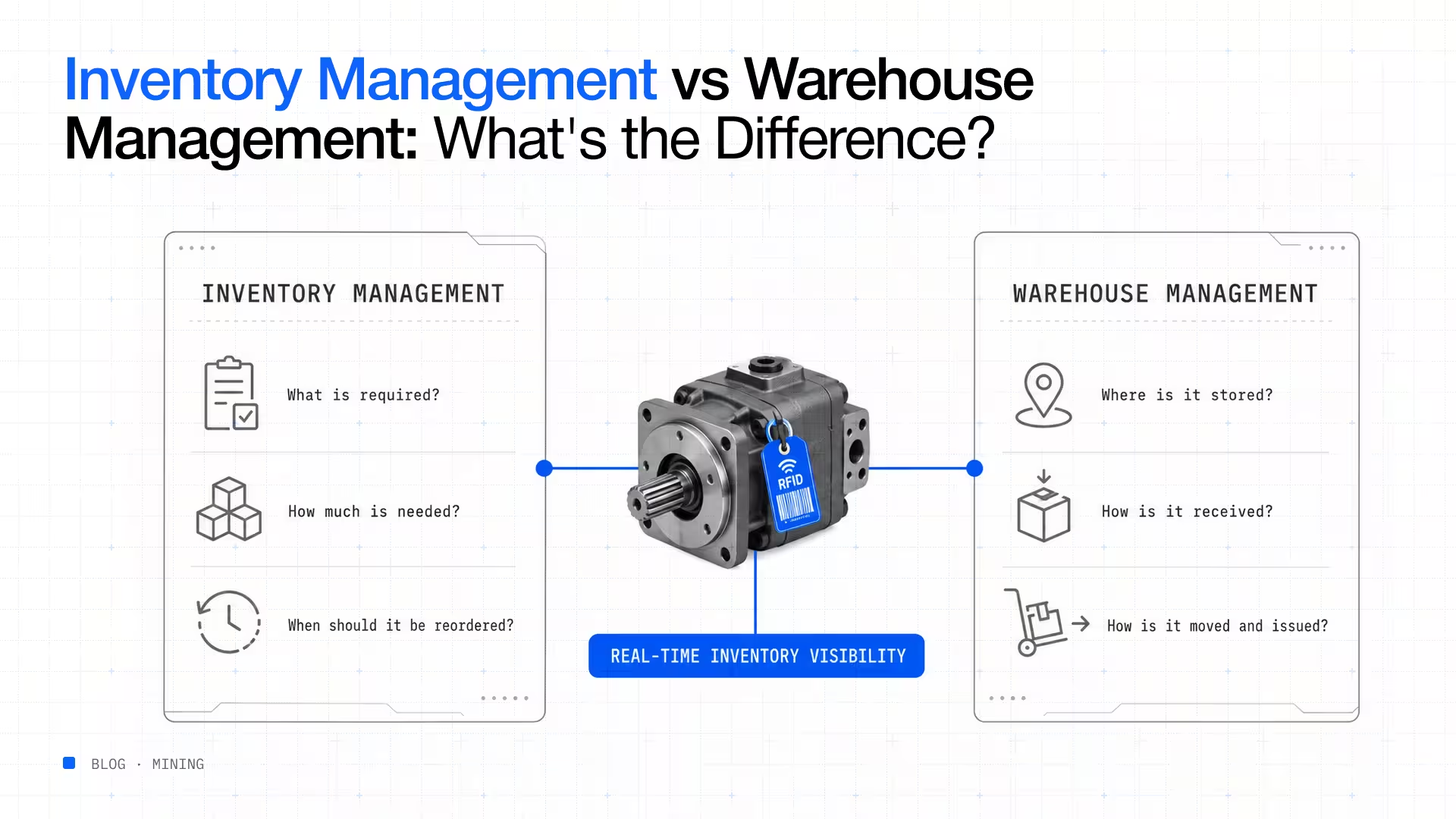
Inventory management controls what stock you have, how much to hold, and when to order. Warehouse management controls where that stock is stored and how it moves physically through the facility.
While both disciplines overlap in tracking materials, they solve entirely different operational challenges. Inventory management focuses on stock optimization, forecasting, and balance-sheet value. Warehouse management focuses on spatial efficiency, picking speeds, labor productivity, and physical execution.
Optimizing one while neglecting the other leads to costly blind spots, such as calculating perfect reorder points for items your warehouse staff cannot physically locate. To build a resilient supply chain, organizations must align both functions around accurate, real-time visibility.
Inventory management is the process of planning, controlling and optimising inventory throughout its lifecycle.
Its objective is straightforward: ensure the right inventory is available in the right quantity, at the right location and at the right time while minimising unnecessary inventory investment.
This involves much more than simply knowing current stock levels.
Effective inventory management includes forecasting demand, establishing reorder points, maintaining safety stock, analysing inventory consumption, reducing obsolete inventory, improving inventory turnover and balancing inventory availability against carrying costs.
Inventory managers constantly evaluate questions such as:
In industrial environments, inventory management also supports maintenance planning by ensuring critical spare parts remain available while avoiding excessive stock accumulation.
Ultimately, inventory management is a strategic business function.
It focuses on making smarter inventory decisions that improve service levels while reducing working capital tied up in inventory.
Warehouse management focuses on the physical movement and handling of inventory inside storage facilities.
Instead of determining what inventory should be purchased or how much should be carried, warehouse management concentrates on how inventory flows through daily operations.
Its responsibilities typically include:
A warehouse management system (WMS) helps organisations organise these activities more efficiently by directing warehouse workflows, improving inventory location accuracy and reducing unnecessary movement throughout the facility.
Warehouse managers aim to answer operational questions such as:
Warehouse management therefore focuses on operational execution rather than inventory planning.
While inventory management decides what inventory the organisation requires, warehouse management determines how that inventory is handled most efficiently.
Although the two disciplines are closely connected, their objectives differ significantly.
Another way to understand the distinction is through a practical example. Imagine a mining company maintaining critical spare parts. Inventory management determines that ten hydraulic pumps should always remain available because supplier lead time is six weeks and equipment downtime is extremely expensive. Warehouse management ensures those ten pumps are stored correctly, labelled accurately, easily located and issued efficiently whenever maintenance requires them.
One determines how many. The other determines how efficiently. Neither function can achieve maximum value without the other.
Some organisations invest heavily in inventory planning while overlooking warehouse operations. Others operate highly efficient warehouses but continue purchasing unnecessary inventory because inventory planning remains weak. Neither approach delivers optimal performance. Inventory management without effective warehouse management results in inventory that technically exists but cannot easily be located or issued. Warehouse management without effective inventory management creates highly organised warehouses containing inventory that shouldn't have been purchased in the first place. The strongest operational performance occurs when both functions operate together.
Inventory planners establish appropriate inventory policies. Warehouse teams execute those policies efficiently. Procurement purchases inventory based on reliable consumption data. Operations receive inventory exactly when required. Finance benefits from lower inventory investment. Maintenance gains confidence that critical inventory will actually be available when needed.
Scatterlink strengthens both inventory management and warehouse management by providing real-time inventory visibility across warehouses, workshops, laydown yards, contractor compounds and remote storage locations. Teams gain confidence not only in inventory records but also in where inventory actually exists.
Although inventory management and warehouse management have different responsibilities, neither should operate in isolation.
Inventory management determines what inventory the business should own, while warehouse management ensures that inventory is received, stored, handled and issued efficiently. Every inventory decision eventually becomes a warehouse activity, and every warehouse transaction feeds information back into inventory planning.
Consider a simple example.
An inventory manager decides that a critical bearing should always have a minimum stock level of 10 units because supplier lead time is six weeks. The warehouse team receives those bearings, stores them in the correct location, issues them for maintenance work and records each movement. Every issue updates inventory consumption data, helping the inventory manager determine whether the reorder point remains appropriate.
When both functions operate together, inventory becomes easier to control.
When they operate independently, inventory records gradually become less reliable, warehouse efficiency declines and purchasing decisions become less accurate.
Many organisations invest in ERP systems, barcode scanners or warehouse improvements but still struggle with inventory performance because the two disciplines remain disconnected.
One common issue is poor inventory accuracy.
Inventory planners believe sufficient stock exists because the system shows available inventory. Warehouse teams know the inventory cannot be located because it has been moved, consumed or incorrectly stored. The result is duplicate purchasing, emergency procurement and delayed maintenance.
Another challenge is inconsistent inventory data.
Warehouse personnel may record inventory differently across multiple locations or facilities. Duplicate item descriptions, inconsistent stock codes and delayed inventory updates gradually reduce confidence in inventory reports. Decision makers then begin relying on manual verification rather than system information.
Space utilisation also becomes a problem.
Without coordination between planning and warehouse operations, slow-moving inventory occupies valuable storage space while frequently used inventory remains difficult to access. Warehouse productivity suffers because employees spend more time moving around the warehouse than moving inventory.
These issues become even more significant in industries with multiple warehouses, remote storage locations, contractor compounds or field inventory.
One of the biggest misconceptions in inventory management is that ERP systems automatically provide complete inventory visibility.
ERP platforms are exceptional at recording business transactions. They manage purchasing, supplier information, inventory balances, financial reporting and enterprise planning. However, they rely on inventory movements being recorded accurately and promptly.
They do not verify physical inventory.
If inventory is moved without recording the transaction, temporarily stored elsewhere or issued during an emergency before being updated, the ERP continues displaying information based on the last recorded transaction.
Warehouse management systems improve warehouse workflows.
ERP systems improve enterprise planning.
Neither automatically tells you where inventory physically is at any given moment.
This explains why organisations with modern ERP systems still experience inventory searches, duplicate purchasing and unexpected stockouts.
The missing component is continuous inventory visibility.
Scatterlink complements existing ERP and warehouse management systems by creating an Inventory Intelligence layer that continuously tracks inventory movement through RFID, barcode scanning and offline mobile applications. This provides operational teams with real-time visibility instead of relying solely on historical transactions.
As supply chains become more complex, organisations require more than inventory records.
They need confidence that inventory exists exactly where the system indicates it should.
This is where RFID and Inventory Intelligence create significant value.
RFID automatically captures inventory movement without requiring manual data entry for every transaction. Barcode technology supports accurate inventory receiving, issuing and transfers. Mobile inventory applications allow warehouse personnel to complete inventory transactions wherever work occurs, including remote operational locations.
Inventory Intelligence connects these technologies together.
Rather than treating inventory transactions as isolated events, it continuously builds an operational picture of inventory movement across warehouses, workshops, yards, sea cans, contractor facilities and remote sites.
This benefits both inventory management and warehouse management.
Inventory managers receive more reliable inventory data for forecasting and replenishment decisions. Warehouse managers gain better visibility into inventory location, movement patterns and operational performance.
The result is better planning supported by better execution.
Organisations looking to improve both inventory management and warehouse management should focus on operational alignment rather than isolated improvements.
Maintain clean, standardised item master data so inventory is consistently identified across every system.
Standardise inventory transaction procedures to ensure inventory movement is recorded consistently regardless of location or personnel.
Implement barcode or RFID technology where inventory movement is frequent or difficult to track manually.
Regularly review warehouse layouts to ensure fast-moving inventory remains easily accessible while slow-moving inventory does not occupy premium storage locations.
Measure performance using operational KPIs such as inventory accuracy, inventory search time, inventory turnover, warehouse productivity and order fulfilment performance rather than relying solely on stock balances.
Most importantly, ensure inventory planning and warehouse operations collaborate regularly instead of operating as separate business functions.
Scatterlink helps organisations bridge the gap between inventory planning and warehouse execution by delivering real-time inventory visibility from receipt through consumption. By integrating with existing ERP systems while supporting RFID, barcode scanning and mobile inventory management, Scatterlink enables businesses to make faster, more informed inventory decisions.
Inventory management and warehouse management are closely related, but they are not the same. Inventory management focuses on making strategic decisions about what inventory should be purchased, maintained and replenished. Warehouse management focuses on executing those decisions efficiently through receiving, storage, picking, transfers and shipping.
Businesses need both disciplines working together.
Without effective inventory management, organisations invest too much capital in inventory or experience costly stockouts. Without effective warehouse management, inventory becomes difficult to locate, warehouse productivity declines and customer service suffers.
As organisations continue digitising their operations, inventory visibility is becoming the link that connects both functions. Real-time visibility allows inventory planners, warehouse teams, procurement professionals and operational leaders to work from the same trusted inventory information, improving efficiency across the entire business.
Inventory management focuses on planning, forecasting and controlling inventory levels across the business. Warehouse management focuses on the physical handling, storage and movement of inventory within warehouse operations.
Small organisations may manage both functions together, but as businesses grow they typically require dedicated warehouse management processes to maintain operational efficiency and inventory accuracy.
No. A WMS primarily manages warehouse workflows such as receiving, put-away, picking and shipping. Inventory management software focuses on inventory planning, replenishment, forecasting and optimisation.
ERP systems record inventory transactions but generally do not provide continuous physical inventory visibility. Delayed transactions, manual processes and inventory movement outside standard workflows can still create discrepancies.
Scatterlink enhances both disciplines by providing real-time inventory visibility across warehouses, workshops, yards and remote storage locations. Through RFID, barcode technology, offline mobile applications and ERP integration, Scatterlink helps organisations improve inventory accuracy, warehouse efficiency and operational decision-making.
%20(1).avif)
.avif)
%20(1).avif)