
Most organizations measure inventory using numbers that are easy to report but difficult to act on.
They know how much inventory they hold. They know how much they purchased last month. They know the value of inventory sitting on the balance sheet.
But very few know whether their inventory records truly reflect what exists in the field.
For operations managers, this gap creates significant challenges. Equipment maintenance is delayed because critical spare parts cannot be located. Procurement purchases materials that already exist elsewhere in the business. Warehouse teams spend hours verifying inventory before issuing parts because no one fully trusts the inventory system.
These problems rarely begin with inventory shortages.
They begin with poor inventory accuracy metrics.
The right inventory accuracy metrics help organizations move beyond simply measuring inventory levels. They reveal whether inventory processes are working, whether operational decisions are based on reliable information, and whether inventory supports productivity instead of slowing it down.
In this guide, we'll explore the most important inventory accuracy metrics every operations manager should monitor, why they matter, and how modern inventory intelligence platforms help improve them over time.
Inventory accuracy affects almost every operational decision.
Maintenance planners depend on accurate inventory information before scheduling repairs. Procurement teams rely on inventory data before placing purchase orders. Warehouse personnel need confidence that inventory records reflect physical inventory, while operations managers depend on accurate reporting to allocate resources effectively.
Without reliable inventory accuracy metrics, organizations often discover inventory problems only after they have disrupted operations.
Instead of proactively identifying declining inventory performance, they respond to missing inventory, duplicate purchases, emergency procurement, or production delays after they occur.
Monitoring the right inventory accuracy metrics allows organizations to identify operational weaknesses early and continuously improve inventory performance.
The most fundamental of all inventory accuracy metrics is inventory accuracy percentage.
This metric compares the quantity recorded in the inventory system with the quantity physically available.
The closer these values align, the greater confidence organizations can place in their inventory data.
A consistently high inventory accuracy percentage allows maintenance teams to begin repairs immediately, procurement departments to avoid unnecessary purchases, and warehouse personnel to spend less time verifying inventory manually.
Conversely, declining inventory accuracy often signals deeper operational issues such as delayed transactions, poor inventory processes, inconsistent receiving procedures, or incomplete inventory transfers.
Rather than viewing inventory accuracy as a warehouse KPI, organizations should treat it as an operational performance indicator.
Cycle count accuracy measures how closely your inventory records match the actual physical inventory during routine cycle counts. Unlike annual physical inventory counts, cycle counting verifies smaller groups of inventory on a regular schedule throughout the year, making it easier to identify discrepancies before they become larger operational problems. High cycle count accuracy indicates that inventory transactions are being recorded consistently and that inventory records can be trusted for day-to-day operational decisions.
For operations managers, cycle count accuracy is one of the most valuable indicators of inventory health. Poor cycle count results often point to issues such as delayed inventory updates, incorrect receiving procedures, unrecorded inventory transfers, or manual data entry errors. If these discrepancies are not identified and corrected early, they can lead to maintenance delays, duplicate purchases, inventory shortages, and inaccurate procurement planning.
Organizations with strong cycle count accuracy typically identify inventory discrepancies before they become larger operational problems.
Rather than waiting until annual audits reveal widespread inaccuracies, operations teams can investigate discrepancies while supporting information is still available.
For organizations managing thousands of inventory items across multiple locations, cycle count accuracy is one of the most valuable inventory accuracy metrics available.
Inventory search time is the amount of time employees spend locating a specific inventory item, spare part, tool, or material after it has been requested. While it may seem like a minor operational metric, it directly affects maintenance efficiency, equipment uptime, labor productivity, and overall operational performance. Every additional minute spent searching for inventory is time that maintenance work, production activities, or field operations remain on hold.
One metric that many organizations fail to measure is inventory search time.
Although inventory search time rarely appears on traditional dashboards, it has a direct impact on maintenance productivity and equipment availability.
If employees spend thirty minutes locating inventory several times each day, the accumulated productivity loss becomes substantial over the course of a year.
Improving inventory visibility often reduces inventory search time significantly, making it one of the most practical inventory accuracy metrics for operational improvement.
Operations managers often ask an important question: Can we trust the inventory system?
Inventory record reliability measures how consistently employees can rely on inventory records without performing manual verification.
If warehouse teams routinely double-check inventory before issuing parts, or maintenance planners verify stock availability before scheduling repairs, inventory record reliability is already low regardless of reported inventory quantities.
Strong inventory processes improve this metric by ensuring inventory transactions are captured immediately as inventory moves throughout the organization.
You can't improve what you don't measure. Discover how Scatterlink helps organizations monitor inventory accuracy metrics in real time while improving inventory visibility across every operational location.
Inventory discrepancies occur whenever physical inventory differs from recorded inventory.
Tracking inventory discrepancy rate helps organizations understand how frequently inventory records become inaccurate and whether corrective actions are improving overall inventory performance.
Common causes include:
Monitoring discrepancy rates over time allows operations managers to identify recurring process failures before they begin affecting maintenance, procurement, or production.
Inventory turnover is commonly viewed as a financial KPI, but it also supports inventory accuracy.
Slow-moving inventory often receives less attention during routine operations, increasing the likelihood of outdated records, misplaced materials, and forgotten stock locations.
By monitoring turnover alongside other inventory accuracy metrics, organizations can identify inventory that requires review, redistribution, or disposal. This prevents surplus inventory from occupying valuable storage space while improving overall inventory visibility.
Inventory availability measures how often required inventory is available when employees need it. High inventory availability does not necessarily require holding more inventory. Instead, it depends on maintaining accurate inventory records, improving inventory visibility, and ensuring inventory is positioned appropriately across operational locations.
Monitoring inventory availability alongside inventory accuracy provides a clearer picture of whether inventory management processes are supporting operational performance or creating unnecessary delays.
One of the most valuable modern inventory accuracy metrics is real-time inventory visibility.
Organizations should ask:
The faster inventory information becomes available, the faster organizations can respond to changing operational requirements.
Real-time visibility improves nearly every other inventory KPI by reducing delayed transactions and improving confidence in inventory records.
Tracking one KPI in isolation rarely provides a complete picture of inventory performance.
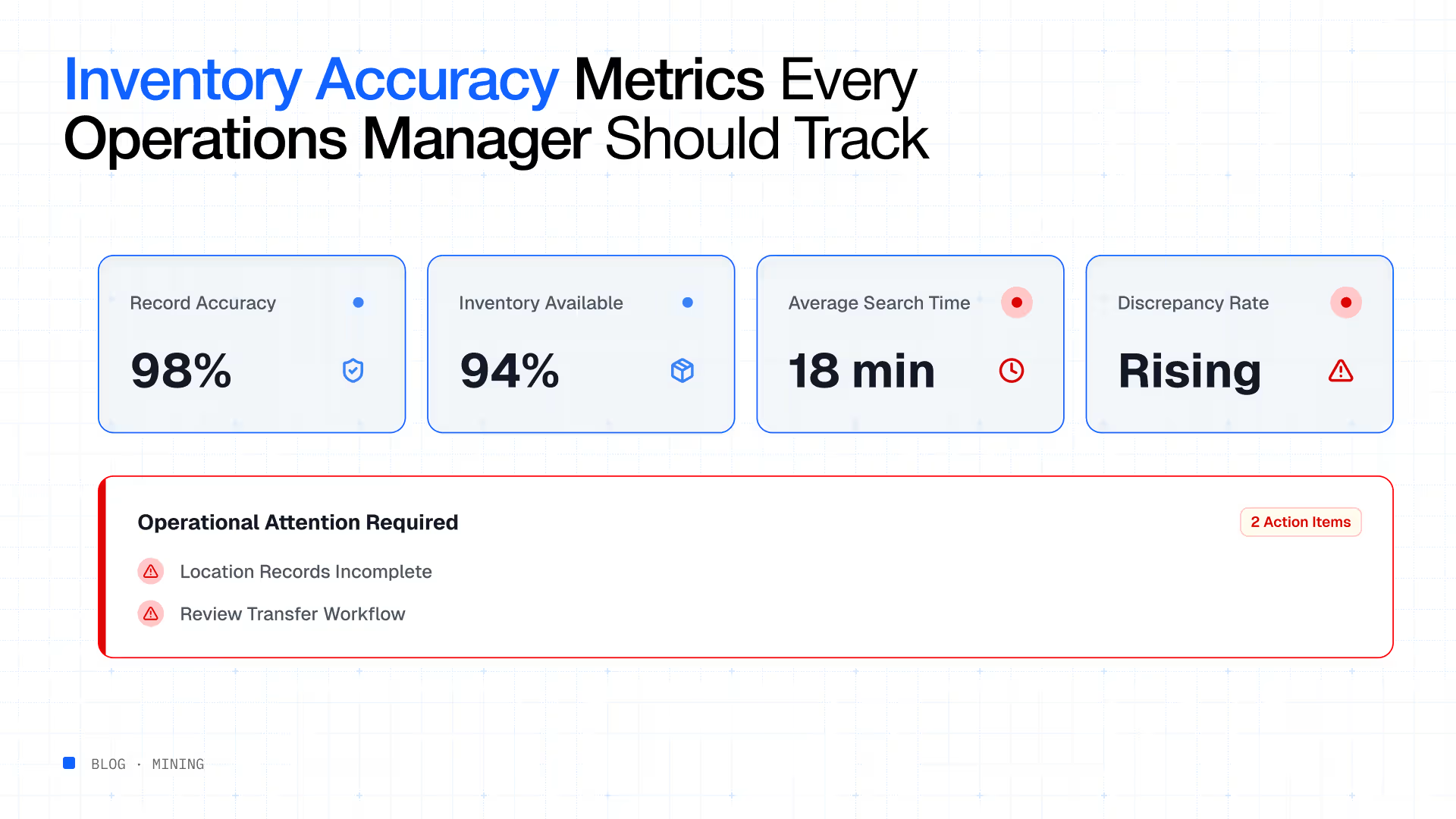
For example, an organization may report 98% inventory accuracy but still experience frequent emergency purchases because inventory visibility across multiple locations is poor. Another business may have excellent cycle count results while maintenance teams continue spending hours searching for spare parts.
This is why leading organizations monitor multiple inventory accuracy metrics through a centralized performance dashboard.
A comprehensive inventory dashboard should combine operational and financial indicators, including:
Together, these inventory accuracy metrics provide operations managers with a complete understanding of inventory performance rather than isolated statistics.
Instead of reacting to individual inventory issues, managers can identify trends, prioritize improvements, and measure the effectiveness of operational changes over time.
Organizations operating across several warehouses, mine sites, maintenance facilities, or project locations should not assume inventory performance is consistent everywhere.
One site may consistently achieve excellent inventory accuracy, while another experiences frequent discrepancies, delayed inventory updates, or excessive emergency purchases.
Monitoring inventory accuracy metrics at each location helps identify operational best practices that can be replicated across the business.
Benchmarking can answer questions such as:
These insights allow operations managers to focus improvement efforts where they will have the greatest impact instead of applying the same solution across every location.
Collecting inventory accuracy metrics is valuable. Knowing what to do with them is even more important.
For example, a rising inventory discrepancy rate may indicate inconsistent receiving procedures. Longer inventory search times may suggest poor location tracking. Increasing emergency purchases may reveal declining inventory visibility rather than inadequate stock levels.
Inventory intelligence connects these metrics and identifies the operational patterns behind them. Instead of presenting disconnected reports, inventory intelligence platforms help organizations understand why inventory performance is changing and where corrective action should begin.
This allows operations managers to move beyond reporting inventory performance and begin improving it.
The right metrics don't just measure inventory performance. They reveal where operational improvements should begin. Learn how Scatterlink transforms inventory data into actionable inventory intelligence.
Scatterlink's Inventory Intelligence Platform is designed to help organizations improve the inventory accuracy metrics that matter most to operational performance.
By combining RFID technology, barcode scanning, IoT devices, mobile inventory applications, GPS-enabled location tracking, offline-first functionality, and seamless ERP integration, Scatterlink captures inventory movements as they happen rather than after the fact.
This continuous flow of inventory data improves key performance indicators such as:
Because inventory information updates continuously across warehouses, stockyards, maintenance facilities, and remote operational sites, every department works from the same reliable inventory data.
The platform is designed around frontline workflows, requiring minimal training while simplifying day-to-day inventory management. Rather than creating additional administrative work, Scatterlink helps warehouse teams, maintenance personnel, procurement professionals, and operations managers improve inventory performance through accurate, intelligent, and actionable insights.
Want to improve your inventory accuracy metrics? Discover how Scatterlink helps industrial organizations increase inventory visibility, reduce discrepancies, and make better operational decisions with real-time inventory intelligence.
Inventory performance cannot be improved without measurement.
The most successful industrial organizations monitor inventory accuracy metrics not simply to report performance, but to understand how inventory supports maintenance, procurement, warehouse operations, and production.
Metrics such as inventory accuracy percentage, cycle count accuracy, inventory discrepancy rate, inventory search time, inventory availability, and real-time inventory visibility provide a clear picture of how effectively inventory is being managed.
However, the greatest value comes when these metrics are viewed together rather than independently. They reveal operational trends, highlight process weaknesses, and help organizations focus improvement efforts where they will have the greatest impact.
With the right technology, accurate inventory data becomes more than a record of stock levels. It becomes operational intelligence that supports faster decisions, higher productivity, and greater confidence across every stage of the inventory lifecycle.
Inventory accuracy metrics are key performance indicators (KPIs) that measure how accurately inventory records reflect physical inventory and how effectively inventory processes support operational performance.
The most important inventory accuracy metrics include inventory accuracy percentage, cycle count accuracy, inventory discrepancy rate, inventory search time, inventory availability, inventory turnover, stockout frequency, and real-time inventory visibility.
Inventory accuracy metrics help organizations identify inventory process issues before they lead to maintenance delays, duplicate purchases, inventory discrepancies, emergency procurement, or production interruptions.
Organizations can improve inventory accuracy metrics by implementing standardized inventory processes, increasing cycle counting frequency, adopting RFID and barcode technology, enabling mobile inventory management, improving real-time inventory visibility, and integrating inventory systems with ERP platforms.
Real-time inventory visibility ensures inventory movements are recorded as they occur, reducing delayed transactions, improving inventory accuracy, strengthening inventory availability, and giving every department access to current inventory information.
%20(1).avif)
.avif)
%20(1).avif)