
Inventory accuracy is one of the foundations of effective inventory management. When system records accurately reflect what is physically available, teams can make better decisions about purchasing, replenishment, maintenance and stock allocation. When those records are unreliable, even well-designed inventory processes can produce poor operational outcomes.
For industrial operations, inventory accuracy becomes particularly important because spare parts and MRO inventory can be distributed across warehouses, workshops, surface locations and underground operations. A system may show that a critical component is available, but if the part cannot be located when maintenance needs it, the recorded quantity has little operational value.
Measuring inventory accuracy therefore requires more than checking whether a physical count matches a system balance. Organisations need a set of inventory accuracy KPIs that reveal where discrepancies occur, how frequently they happen, how significant they are and whether inventory records are becoming more or less reliable over time.
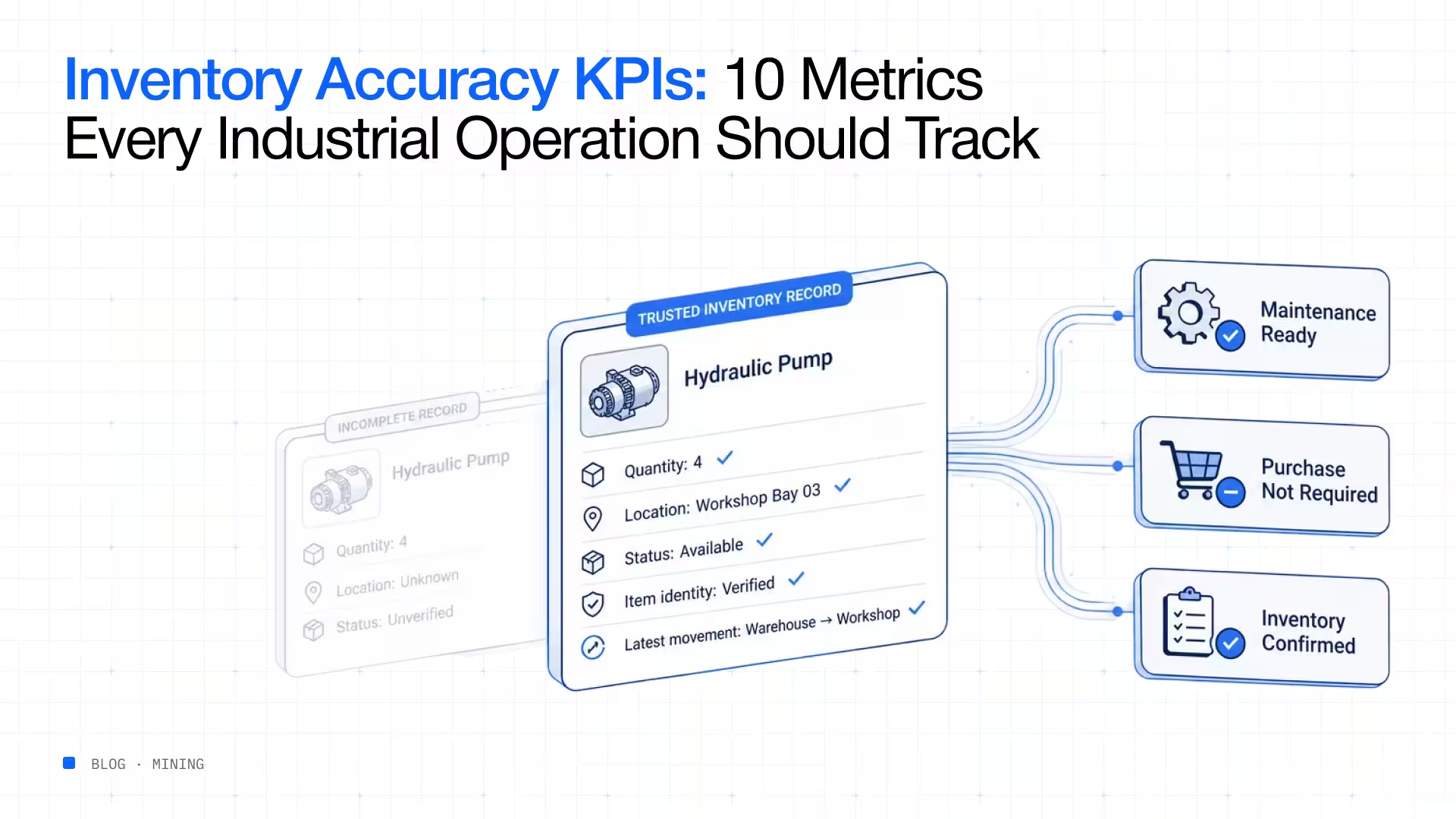
Inventory accuracy measures how closely recorded inventory information matches the actual physical inventory available within an organisation. This can include quantity, location, item identity, status and other information required to determine whether stock can actually be used.
A basic inventory accuracy calculation can be expressed as:
Inventory Accuracy = Correct Inventory Records ÷ Total Inventory Records × 100
For example, if 950 out of 1,000 inventory records accurately reflect the physical stock, the inventory accuracy rate would be 95%.
However, quantity accuracy alone does not provide a complete picture. An item may exist physically but be recorded against the wrong location, have an incorrect status or be associated with an inaccurate item description. For industrial operations, these discrepancies can affect whether teams can actually find and use the inventory when required.
Poor inventory accuracy creates uncertainty throughout the inventory lifecycle. Procurement teams may purchase parts that are already available, maintenance teams may waste time searching for components that the system says are in stock, and warehouses may carry excess quantities because no one can confidently determine what is actually available.
The consequences can extend beyond inventory carrying costs. When critical spare parts cannot be located, maintenance activities can be delayed and equipment downtime can increase. In operations where production continuity depends on timely access to specialised components, inaccurate inventory records can become an operational risk rather than simply an administrative issue.
Accurate inventory data helps organisations:
Inventory accuracy KPIs are measurable indicators used to assess the reliability of inventory records and identify where discrepancies or process failures are occurring. They provide a consistent way to monitor inventory performance instead of relying only on occasional physical stock counts.
The right KPIs should measure different aspects of inventory accuracy. Quantity accuracy is important, but organisations should also monitor location accuracy, adjustment frequency, cycle count performance and the financial impact of discrepancies.
A useful inventory accuracy framework should answer questions such as:
Inventory record accuracy is one of the most fundamental inventory accuracy metrics. It measures the percentage of inventory records that match the corresponding physical inventory within an organisation’s defined tolerance.
The calculation can be expressed as:
Inventory Record Accuracy = Accurate Records ÷ Total Records Checked × 100
For example, if 980 inventory records are accurate out of 1,000 records checked, the inventory record accuracy rate is 98%.
This KPI provides a useful overall measure, but organisations should define what qualifies as an accurate record. For some operations, the quantity must match exactly, while others may use an acceptable variance depending on the type and value of the inventory.
Quantity accuracy measures whether the number of units recorded in the inventory system matches the quantity physically available. This is particularly important for spare parts and MRO inventory because even a small discrepancy can affect whether a maintenance team believes a component is available.
For example, if the system shows 10 bearings but only eight can be physically located, the inventory record is inaccurate even though the difference may appear small. For a critical spare, those two missing units could determine whether maintenance can proceed without waiting for procurement.
Tracking quantity accuracy by location and inventory category can help identify where discrepancies are concentrated. A warehouse with consistently lower quantity accuracy may require process improvements, additional transaction controls or more frequent cycle counting.
Having the correct quantity is not enough if the inventory is recorded at the wrong location. Location accuracy measures whether inventory is physically stored where the inventory system indicates it should be.
This KPI is particularly relevant for organisations operating across multiple warehouses, workshops and operational areas. A component may technically exist within the organisation but remain operationally unavailable if the system directs a technician to the wrong storage location.
Location accuracy can be measured by comparing the recorded location with the verified physical location of inventory during cycle counts or inventory audits. Improving this metric can reduce inventory search time and help teams make better use of stock already available within the organisation.
Inventory adjustments occur when system records need to be changed to reflect physical inventory. A high number of adjustments can indicate recurring problems with receiving, issuing, transferring, consuming or counting inventory.
The adjustment rate can be measured by tracking the number of inventory adjustments over a defined period relative to the number of inventory transactions or inventory records reviewed.
An isolated adjustment does not necessarily indicate a serious problem. However, frequent adjustments can suggest that inventory transactions are not being captured consistently or that existing processes are allowing discrepancies to accumulate.
Inventory variance measures the difference between recorded inventory and physically verified inventory. Unlike a simple accuracy percentage, variance analysis can show the scale and direction of discrepancies.
A basic quantity variance calculation is:
Inventory Variance = Physical Quantity − Recorded Quantity
For example, if the system records 100 units and a physical count finds 95, the variance is negative five units. Repeated negative variances may indicate inventory shrinkage, transaction errors or unrecorded consumption.
Variance should also be analysed by inventory value. A five-unit discrepancy involving a low-cost consumable may have limited financial impact, while a small discrepancy involving an expensive specialised component could represent a significant loss.
Cycle count accuracy measures how accurately inventory records are maintained between scheduled full physical inventory counts. Instead of counting the entire warehouse at once, organisations conduct smaller, more frequent counts of selected inventory.
The KPI can track the percentage of cycle counts completed without a discrepancy or the percentage of counted inventory records that match the system.
Cycle counting is particularly useful for industrial operations because it allows teams to identify and correct discrepancies continuously. High-value or critical inventory can be counted more frequently, while lower-risk items can follow a different counting schedule.
Inventory value accuracy measures how closely the financial value recorded in the inventory system reflects the actual value of physical inventory held by the organisation. Quantity discrepancies can directly affect this KPI, but valuation issues can also arise from incorrect item costs, outdated records or inventory that has been incorrectly classified.
This metric is particularly important for industrial operations with high-value MRO and spare parts. A small quantity discrepancy involving an expensive component can have a much greater financial impact than a larger discrepancy involving low-cost consumables. Measuring inventory accuracy only by unit quantity can therefore underestimate the financial impact of poor inventory control.
Organisations should compare inventory records with physical counts and investigate significant valuation variances. Tracking inventory value accuracy alongside quantity accuracy provides finance and operations teams with a clearer picture of how reliable their inventory records actually are.
Stockout accuracy measures whether the inventory system correctly reflects items that are unavailable for use. An inventory record may show a positive quantity even when the physical stock is missing, damaged, reserved, quarantined or otherwise unavailable.
This creates a particularly serious problem for critical spare parts. A maintenance team may search the system, identify a component as available and plan a repair around it, only to discover that the part cannot actually be used. The resulting delay can create additional procurement activity and increase the risk of equipment downtime.
Tracking the accuracy of available-to-use inventory helps organisations distinguish between inventory that technically exists and inventory that is genuinely accessible for operational requirements.
Inventory shrinkage measures the difference between the quantity or value of inventory that should be available according to records and what can actually be accounted for physically. Shrinkage can result from unrecorded consumption, misplaced inventory, transaction errors, damage or other discrepancies.
A basic shrinkage calculation can be expressed as:
Inventory Shrinkage Rate = Inventory Shortage Value ÷ Recorded Inventory Value × 100
The causes of shrinkage should be investigated rather than simply adjusting the inventory record. Repeated discrepancies in the same location or inventory category may point to weaknesses in transaction processes, storage controls or inventory handling.
For industrial organisations, understanding the cause of shrinkage is particularly important because adjustments can hide recurring problems. Correcting the number without addressing the underlying process allows the same discrepancy to happen again.
Inventory transaction accuracy measures whether inventory movements are recorded correctly and at the appropriate time. This includes transactions such as receiving, issuing, transferring and consuming inventory.
A transaction can be inaccurate in several ways. The wrong quantity may be recorded, the wrong item may be selected, the transaction may be associated with the wrong location or the movement may not be recorded at all. Each of these errors can eventually create discrepancies between physical inventory and system inventory.
Tracking transaction accuracy helps organisations identify problems earlier in the inventory lifecycle. Instead of discovering discrepancies only during physical counts, teams can identify whether inaccurate transactions are contributing to inventory record errors.
Annual physical counts can identify discrepancies, but they may not reveal when or why the discrepancy occurred. If a part was received incorrectly six months earlier, the organisation may only discover the problem during the next full inventory count.
Cycle counting creates a shorter feedback loop. When discrepancies are identified closer to the time they occur, teams have a better opportunity to investigate the underlying transaction or process that caused them.
This makes cycle counting more than a counting exercise. When supported by accurate transaction records, it becomes a way to identify recurring inventory control problems before they affect a larger volume of stock.
An organisation-wide inventory accuracy percentage can hide significant differences between individual locations. A central warehouse may maintain highly accurate records while a remote workshop has recurring discrepancies, yet the combined figure may still appear acceptable.
Location-level inventory accuracy reporting helps identify where corrective action is required. Organisations can compare warehouses, workshops, surface locations and underground operations to determine where inventory discrepancies occur most frequently.
This is particularly important when the same spare parts are held across multiple sites. If teams cannot accurately determine what exists at each location, they may purchase additional stock unnecessarily while usable inventory remains elsewhere. Explore Scatterlink’s RFID inventory management solution to improve inventory visibility across locations and throughout the inventory lifecycle.
Every inventory transaction has the potential to affect inventory accuracy. Receiving, issuing, transferring and consuming stock all change the quantity or location recorded in the inventory system. If these transactions are delayed, missed or recorded incorrectly, discrepancies can accumulate.
For example, a spare part may be physically transferred from one warehouse to another but remain recorded at its original location. The organisation technically owns the inventory, but the system cannot accurately tell users where it is. This creates a location accuracy problem and can make available inventory effectively invisible.
Strong transaction control is therefore an essential part of inventory accuracy management. Learn more about Scatterlink and how connected inventory visibility can help organisations track inventory movements from receipt through consumption.
Inventory accuracy is often treated as a warehouse performance measure, but its impact extends across procurement, maintenance, finance and operations. Procurement relies on accurate inventory information to determine what needs to be purchased, while maintenance teams rely on it to know whether required parts are available.
Finance teams also depend on reliable inventory records because discrepancies can affect inventory valuation and working capital reporting. When physical inventory and system records consistently differ, the organisation may have less confidence in the financial value assigned to its inventory.
For industrial operations, improving inventory accuracy therefore requires coordination across the entire inventory lifecycle rather than focusing exclusively on warehouse counting.
Not every organisation needs to give every KPI equal weight. The most important metrics depend on the organisation’s inventory profile, operational environment and risk exposure.
For an industrial operation managing critical spare parts across multiple locations, inventory record accuracy, location accuracy, transaction accuracy, cycle count accuracy and stockout accuracy may deserve particular attention. For organisations carrying significant high-value inventory, inventory value accuracy and inventory variance by value may be equally important.
The objective should be to create a KPI framework that reflects the operational consequences of inaccurate inventory. A metric is useful when it helps teams identify a problem, understand its cause and take corrective action.
There is no single inventory accuracy target that works for every inventory category. Organisations should establish targets based on inventory criticality, value, transaction frequency and the consequences of inaccurate records.
Critical spare parts may require a higher accuracy threshold because even a small discrepancy can affect equipment availability. Lower-value consumables may be managed under different tolerances, particularly where minor quantity differences have limited operational impact.
Targets should also distinguish between quantity accuracy and location accuracy. Knowing that five units exist is not enough if the organisation cannot determine where those units are stored. For industrial operations, usable inventory accuracy is often more meaningful than a simple quantity percentage.
Improving inventory accuracy requires more than increasing the frequency of physical counts. Organisations need to identify why discrepancies occur and strengthen the processes that create inventory records in the first place.
Receiving, issuing, transferring and consuming inventory should follow consistent processes. Each transaction should capture the required information at the time the physical movement occurs.
Delaying transactions creates a gap between physical inventory and system inventory. The longer that gap remains open, the greater the opportunity for additional movements to occur without being reflected accurately in the system.
Every inventory item should have a clearly defined and consistently maintained location. When inventory moves, its recorded location should change at the same time as the physical movement.
This becomes more challenging across distributed operations. Inventory can move between warehouses, maintenance areas, workshops and operational sites, making manual location updates difficult to maintain consistently.
Inventory accuracy improves when organisations can capture inventory movements closer to the point where they occur. Mobile applications, barcode scanning and RFID can reduce manual data entry and help connect physical inventory activity with digital records.
For operations managing inventory across surface and underground locations, better movement visibility can make it easier to determine where inventory is located and whether it is actually available. Explore Scatterlink’s RFID inventory management solution to strengthen inventory visibility from receipt through consumption.
Cycle counting should be based on inventory risk rather than applied uniformly. High-value and critical spare parts can be counted more frequently, while lower-risk items can follow a less intensive schedule.
The results should also be analysed for patterns. If the same items repeatedly produce discrepancies, the organisation should investigate the underlying transaction or storage process instead of simply correcting the count.
An inventory adjustment corrects the record, but it does not necessarily correct the process that caused the error. Organisations should investigate recurring discrepancies to determine whether they originate from receiving, picking, issuing, transfers, consumption or location management.
Root-cause analysis can help prevent the same error from occurring repeatedly. Over time, this can improve inventory accuracy without relying solely on additional manual counting.
Inventory accuracy KPIs become more useful when they are reported with enough context to support action. A single organisation-wide accuracy percentage may look positive while individual locations or inventory categories experience significant problems.
A practical dashboard can report accuracy by:
Trend reporting is particularly valuable. If accuracy improves from 92% to 96% over several months, the organisation can assess whether process changes are working. If accuracy suddenly falls, teams can investigate what operational change may have contributed to the decline.
Poor inventory accuracy can directly affect procurement decisions. When system records cannot be trusted, procurement teams may order parts that are already available somewhere within the organisation.
This can create duplicate purchases and increase inventory carrying costs. At the same time, genuinely unavailable critical parts may remain unpurchased because the system incorrectly shows sufficient stock.
Improving inventory accuracy gives procurement teams greater confidence in on-hand quantities and reduces the need to purchase inventory simply because existing stock cannot be reliably located or verified.
Maintenance teams depend on accurate inventory information to plan repairs and access required spare parts. If a critical component is shown as available but cannot be found, maintenance work can be delayed while teams search for the part or arrange emergency procurement.
Accurate inventory records can reduce this uncertainty by providing a clearer view of available stock and its location. This is especially important for distributed industrial operations where a spare part may be held at another site but still be available for transfer.
The objective is not simply to improve the inventory accuracy percentage. It is to make inventory information reliable enough for maintenance teams to act on it with confidence.
Inventory accuracy can deteriorate at any stage of the inventory lifecycle. Errors can begin when materials are received, continue through storage and transfers, and ultimately affect the recorded quantity when inventory is issued or consumed.
For this reason, organisations should avoid treating inventory accuracy as a warehouse-only responsibility. The entire lifecycle should be considered, from the moment inventory enters the operation through every movement until it reaches its point of consumption.
A connected inventory management approach can help organisations maintain greater visibility across these stages. Learn more about Scatterlink and how inventory intelligence can help connect inventory movements and inventory data.
Accurate inventory data is the foundation for better inventory decisions, but accuracy alone is not the end goal. Organisations also need to understand what the data means, where risks are developing and what actions should be taken.
When inventory accuracy KPIs are combined with location, movement, consumption and criticality information, teams can identify patterns that would otherwise remain hidden. They can determine where inventory discrepancies are occurring, which parts are repeatedly unavailable and where excess stock may be accumulating.
This moves inventory management from simply correcting records to actively using inventory data to improve operational decisions. Learn more about Scatterlink’s inventory intelligence approach.
Inventory accuracy should be measured as an operational capability, not simply as a warehouse statistic. The most useful inventory accuracy KPIs reveal whether system records accurately represent the quantity, location, value, status and movement of physical inventory.
The 10 metrics provide a practical framework: inventory record accuracy, quantity accuracy, location accuracy, adjustment rate, variance rate, cycle count accuracy, inventory value accuracy, stockout accuracy, shrinkage rate and transaction accuracy. Together, they provide a much stronger view of inventory reliability than any single percentage can provide.
For industrial operations, accurate inventory information supports better purchasing, maintenance planning, inventory control and operational continuity. The ultimate goal is not to achieve a perfect number on a dashboard, but to create inventory records that teams can trust when they need to make critical decisions.
Inventory accuracy KPIs are measurable indicators used to determine how reliably inventory records reflect the physical inventory held by an organisation. They can measure quantity, location, value, transactions, discrepancies and other aspects of inventory accuracy.
Inventory record accuracy is one of the most fundamental metrics, but there is no single KPI that is most important for every organisation. Industrial operations should also consider location accuracy, transaction accuracy, cycle count accuracy and the accuracy of available-to-use inventory.
A basic calculation is Inventory Accuracy = Correct Inventory Records ÷ Total Inventory Records Checked × 100. Organisations should define what constitutes an accurate record and establish appropriate tolerances for different inventory categories.
The appropriate target depends on the type of inventory, its value, criticality and operational consequences. Critical spare parts may require very high accuracy because incorrect records can contribute directly to maintenance delays or stockouts.
Location accuracy ensures that inventory is physically stored where the system says it is. Poor location accuracy can make available inventory difficult to find, resulting in unnecessary purchases, longer search times and delays in maintenance activities.
Cycle counting identifies discrepancies throughout the year instead of waiting for a full annual physical inventory count. Strategic cycle counting can help organisations identify recurring discrepancies earlier and investigate their root causes.
Common causes include incorrect receiving, unrecorded consumption, inaccurate transfers, delayed transactions, incorrect quantities, misplaced inventory and inconsistent inventory processes. Poor item master data can also contribute to incorrect records and transaction errors.
RFID can automatically capture the movement and identification of tagged inventory, reducing reliance on manual data entry. This can improve visibility into inventory location and movement and support more accurate inventory records when integrated with inventory management processes.
%20(1).avif)
.avif)
%20(1).avif)