
Emergency purchases are often treated as a procurement problem, but the root cause can begin much earlier in the inventory process. A maintenance team may need a critical spare part immediately, only to discover that the local store does not have it. The organisation then places an urgent order, pays a premium for expedited supply and carries the additional cost because the required material was not available where it was needed.
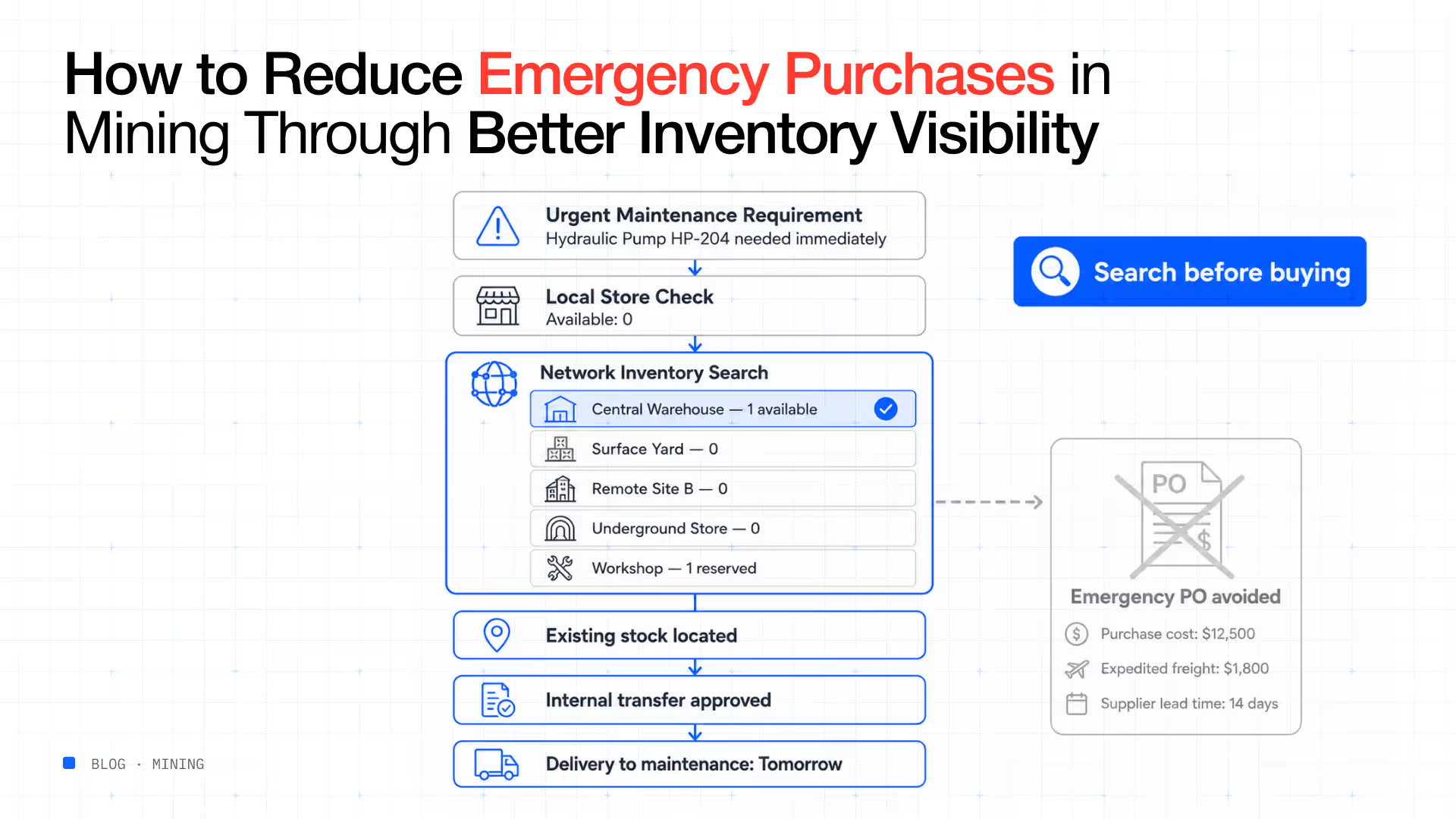
In some cases, however, the organisation already owns the part. It may be sitting in another warehouse, yard, remote store or sea can, but the team does not know it exists or cannot confidently determine where it is located. This is where inventory visibility becomes directly connected to procurement performance.
Better inventory visibility gives mining teams a broader view of available materials across the operation. Instead of automatically raising an emergency purchase request when local stock is unavailable, teams can determine whether the required item already exists elsewhere and whether it can be transferred or allocated before purchasing additional stock.
Emergency purchases in mining are unplanned procurement activities made to obtain materials, spare parts or other inventory needed urgently for an operational requirement. These purchases often occur when a required item is unavailable locally or cannot be sourced through the organisation’s normal procurement cycle.
Emergency parts purchasing can involve expedited freight, premium supplier pricing, urgent approvals and additional administrative effort. The financial cost can therefore be significantly higher than a planned purchase.
The problem becomes more complex when emergency procurement is caused by poor inventory information rather than genuine stock shortages. If an organisation already owns the required component but cannot locate it, the purchase creates additional inventory without solving the underlying visibility problem.
Reducing emergency purchases therefore requires mining companies to examine both procurement processes and the inventory information that influences those decisions.
Mining operations depend on the continuous availability of materials required for maintenance and production. When equipment requires an unexpected repair, maintenance teams may not have the time to wait for a standard procurement cycle.
If the required part is not immediately available, an urgent purchase may appear to be the fastest solution. The procurement team may then source the component from a supplier and arrange accelerated delivery.
This is sometimes unavoidable. However, repeated emergency parts purchasing can indicate that the organisation has weaknesses in forecasting, stock positioning, inventory visibility or spare parts management.
The key question is whether the emergency purchase was caused by genuine demand or by an inability to find and use inventory that was already available.
Poor inventory visibility creates uncertainty about what materials the organisation actually has. A system may show that a part exists somewhere, but if the location information is outdated or incomplete, employees may not be able to access it quickly.
This is particularly challenging in mining because inventory can be distributed across central warehouses, surface yards, workshops, remote sites and underground locations. Materials may also move frequently between these locations.
When a critical part is required, teams often search the most accessible location first. If they cannot find the item, they may assume that it is unavailable and begin the purchasing process.
Better visibility changes this decision. Instead of asking whether the local store has the item, employees can search across relevant inventory locations and determine whether the part exists elsewhere.
Procurement decisions depend heavily on the information available to the people making them. If employees cannot see existing stock, purchasing becomes the default response to a local shortage.
This can create a cycle of unnecessary purchasing. The organisation buys another unit because an existing unit cannot be located, increasing inventory while the original stock remains somewhere in the operation.
Inventory visibility provides procurement teams with a more complete picture. Before raising a purchase request, teams can check whether the required material already exists and whether it can be transferred.
This does not mean every purchase should be avoided. Instead, it allows procurement decisions to be based on a clearer understanding of actual inventory availability.
The first step is to improve visibility across inventory locations. Teams need to know what stock exists, where it is located and whether it is currently available.
The second step is to improve the accuracy of inventory transactions. Receipts, transfers, issues and consumption should be captured consistently so that the inventory record remains aligned with physical stock.
The third step is to establish a process for checking existing inventory before initiating an emergency purchase. This should include relevant warehouses, yards, remote stores and other locations where the required item may be held.
Finally, organisations should analyse the reasons behind emergency purchases. If the same parts repeatedly require urgent procurement, the issue may be related to stock positioning, demand planning, inaccurate records or poor visibility.
Real-time inventory visibility allows teams to make decisions using more current information about stock. This matters when materials move frequently between locations or are issued for maintenance activities.
If the system continues to show an item as available after it has already been issued, employees may waste time searching for it. Conversely, if a recently received item is not reflected in the system, teams may assume that additional stock needs to be purchased.
More timely information helps reduce these gaps. Employees can determine what inventory is currently recorded as available and where it is located.
For critical spare parts, this can make a significant difference. Instead of automatically initiating emergency procurement, teams can first determine whether an available item can meet the immediate requirement.
Spare parts are often at the centre of emergency procurement decisions. A mining operation may hold critical components across several locations because keeping every item at one central warehouse would create unacceptable response times.
The challenge is maintaining visibility over that distributed inventory. If the maintenance team does not know where a spare part is located, having it somewhere in the organisation may provide little practical benefit.
Mining spare parts management should therefore focus on both availability and accessibility. Teams need to know which parts exist, where they are located and whether they can be transferred or issued.
This can help convert existing inventory into a usable resource. Instead of purchasing another component, teams may be able to use or transfer a part already held within the operation.
Mining operations often have several inventory locations serving different operational requirements. A central warehouse may hold bulk stock, while remote stores and yards hold materials needed for faster local response.
Multi-location inventory management provides visibility across these different stock pools. If a part is unavailable at one location, teams can determine whether it exists elsewhere.
For example, a maintenance team at a remote site may need a specific component. The local store shows zero availability, but a central warehouse or another site may have the item in stock.
Without multi-location visibility, the immediate response may be to purchase the part. With better visibility, the organisation can evaluate an internal transfer and potentially avoid an emergency purchase.
An inventory tracking system can help teams understand the location and movement of materials across the operation. This is particularly useful when inventory moves frequently between warehouses, yards and remote locations.
Tracking provides more context than a simple stock balance. Teams can review where an item was received, whether it has been transferred and what its latest recorded transaction was.
This information can help determine whether a shortage is genuine. If the item was recently transferred to another location, the organisation may be able to retrieve it rather than placing a new purchase order.
The result is a more informed procurement process. Emergency purchasing becomes a decision based on actual inventory availability rather than a response to incomplete information.
RFID inventory tracking can improve the identification and visibility of suitable tagged materials. Instead of relying entirely on manual searches and identification, employees can use RFID-enabled processes to identify inventory more efficiently.
This can be particularly valuable in large yards or storage environments where locating individual items can be difficult. RFID can support inventory counts and identification workflows where the technology is appropriate.
However, RFID alone does not reduce emergency purchasing. Its value comes from connecting physical identification with a broader inventory management process.
When RFID information is linked to inventory records and location data, teams can build a more reliable picture of available stock. This can make it easier to determine whether an existing item can meet an urgent requirement.
Improve stock visibility across mining operations: Explore Scatterlink’s RFID inventory management solution to see how RFID and mobile workflows can support better inventory control.
Inventory transactions often happen outside the warehouse. A part can be moved to a yard, issued to a maintenance team or transferred to a remote location without immediate access to a desktop system.
Mobile inventory management allows employees to record these transactions closer to where the physical activity occurs. This reduces the delay between a material movement and its corresponding inventory update.
When transactions are captured promptly, teams have a more current view of stock availability. This helps prevent situations where the system shows inventory that has already been moved or consumed.
Mobile workflows can therefore support the broader objective of reducing emergency purchases. The more reliable the inventory information, the easier it becomes to determine whether existing stock can satisfy an urgent requirement.
Remote mining sites may not always have reliable network connectivity. If employees cannot update inventory information when materials move or are consumed, system records can quickly become outdated.
Offline inventory management allows employees to complete supported inventory transactions without an active connection. The information can synchronise when connectivity becomes available.
This helps maintain continuity in inventory tracking across remote locations. Teams can capture physical activity instead of relying on memory, paper records or delayed manual updates.
For procurement, this can be important because remote stock information remains more closely connected to actual activity. When teams need to determine whether a part is available, they are less dependent on outdated records.
Inventory accuracy is fundamental to reducing unnecessary procurement. If the system says an item exists but the item cannot be found, procurement teams cannot confidently rely on that information.
Conversely, if the system does not show stock that is physically available, employees may purchase additional inventory unnecessarily. Both situations can increase costs.
Improving inventory accuracy requires consistent receiving, transfer, issue and consumption processes. Physical inventory should be reflected in the system as close to the time of the transaction as practical.
Regular inventory counts can also help identify discrepancies. The objective is not simply to adjust quantities, but to understand why the discrepancy occurred and prevent the same issue from recurring.
Min-max inventory levels can help organisations maintain appropriate quantities of frequently required materials. The minimum level provides a trigger for replenishment, while the maximum level helps prevent unnecessary overstocking.
However, min-max settings are only useful when the underlying inventory information is reliable. If stock records are inaccurate or inventory is distributed across multiple locations without visibility, replenishment decisions can still be misleading.
Better inventory visibility therefore supports more effective min-max management. Teams can understand actual stock availability and make replenishment decisions using more reliable information.
Min-max controls should also be reviewed based on actual consumption patterns. Repeated emergency purchases may indicate that certain parts have inappropriate stock levels or are positioned in the wrong locations.
Reducing emergency procurement requires more than tracking how often urgent purchases occur. Organisations should examine why they happened.
Was the required part genuinely unavailable? Was it available at another location? Was the system showing an incorrect quantity? Had the item been transferred without updating its location? Was demand higher than expected?
These questions help distinguish between different causes of unplanned procurement in mining. A genuine demand spike may require a different response from a recurring inventory visibility problem.
By analysing emergency purchases against inventory records, organisations can identify patterns. If the same components repeatedly require urgent procurement, there may be an underlying issue with stock levels, location, forecasting or inventory accuracy.
Procurement planning becomes easier when teams have a reliable understanding of existing stock and historical consumption. Instead of responding primarily to urgent requests, procurement teams can identify patterns in inventory demand.
For example, repeated emergency purchases of the same component may indicate that the organisation needs to review its replenishment strategy. It may need a higher minimum stock level, a different stocking location or better visibility into existing inventory.
Inventory visibility provides the information required to make these decisions. It connects procurement activity with the physical inventory environment.
Over time, this can shift procurement from reactive purchasing towards more planned inventory management. Emergency purchases may still occur, but they become exceptions rather than a predictable part of the process.
The simplest way to avoid unnecessary purchases is to make existing inventory easier to find. Before ordering a new item, employees should be able to search across relevant inventory locations and determine whether the required material already exists.
This becomes particularly important for high-value or critical spare parts. The organisation may have the component, but it could be sitting in another warehouse, yard or remote store.
A connected inventory tracking system can provide this broader view. Teams can identify available stock and determine whether an internal transfer is possible.
This approach improves inventory utilisation. Rather than continuously adding new stock, the organisation makes better use of inventory it has already purchased.
Traditional inventory management focuses heavily on recording transactions and maintaining stock balances. Inventory intelligence takes this information further by helping teams understand patterns and relationships within the inventory data.
For emergency procurement, this could mean identifying which parts are frequently purchased urgently, which locations experience recurring shortages and where excess stock is held.
These insights can support more informed decisions about stock levels and inventory positioning. Procurement teams can investigate the underlying cause rather than simply processing another urgent purchase.
For mining operations, this creates an opportunity to move from reactive procurement to more intelligent inventory control.
Organisations should track the materials involved in emergency purchases, the location where the shortage occurred and whether the required inventory existed elsewhere.
They should also monitor the reason for the emergency purchase. Was the part genuinely unavailable, incorrectly recorded, misplaced or simply not stocked at the required location?
Lead times and supplier performance can provide additional context. If a particular supplier consistently requires long lead times, the organisation may need to adjust stocking strategies for critical components.
By combining procurement data with mining inventory management information, companies can identify whether emergency purchases are driven by demand, supply constraints or internal inventory visibility problems.
Reducing emergency purchases requires mining teams to have confidence in their inventory information. They need to know what materials exist, where they are located and how inventory has moved across the operation.
Scatterlink combines inventory intelligence with RFID, mobile and offline capabilities to help industrial teams maintain visibility across distributed inventory environments. This supports inventory activity across warehouses, yards, remote sites and surface and underground operations.
By connecting physical inventory movements with digital inventory information, Scatterlink helps create a clearer view of available materials. This can support faster decisions when teams need to determine whether an existing item can satisfy a maintenance or operational requirement.
The goal is not simply to eliminate emergency purchasing. It is to make emergency purchasing a more informed decision and reduce the situations where organisations purchase inventory simply because existing stock cannot be found or trusted.
Build accurate, actionable inventory visibility: Learn more about Scatterlink’s inventory intelligence platform.
Inventory visibility needs to extend across the entire material lifecycle. It begins when inventory is received and identified, but it should continue as the material moves between storage locations and is eventually issued or consumed.
If a part is received correctly but later transferred without being recorded, its visibility is lost. The same can happen when materials are issued to maintenance teams or moved into remote and underground locations without timely inventory updates.
A connected inventory process captures these movements as part of the material’s lifecycle. This gives procurement and maintenance teams a more reliable understanding of what inventory remains available.
Connect inventory from receipt to consumption: See how Scatterlink provides inventory visibility across warehouses, yards, surface and underground operations.
Reducing unnecessary emergency purchases can lower procurement costs and reduce the premium associated with urgent sourcing and expedited delivery. It can also help organisations make better use of inventory already held within the operation.
Better inventory visibility can reduce the time spent searching for parts and improve confidence in stock information. This can help maintenance teams make faster decisions when materials are required.
There is also a working capital benefit. If organisations can use existing inventory more effectively, they may reduce the need to purchase duplicate stock simply because existing materials are difficult to locate.
Most importantly, reducing avoidable emergency procurement addresses the underlying inventory problem. Instead of treating every urgent shortage as a supplier issue, mining companies can determine whether better inventory control could prevent the shortage from occurring in the first place.
Emergency purchasing will always have a place in mining operations. Unexpected equipment failures, demand changes and supply disruptions can create genuine situations where materials are needed faster than normal procurement processes allow.
The problem arises when emergency purchases are caused by poor inventory visibility rather than genuine shortages. If teams cannot determine what inventory exists or where it is located, they may purchase materials they already own.
Improving inventory tracking, spare parts visibility, multi-location management, RFID identification and mobile inventory processes can help close this gap. With better information, teams can check existing stock before initiating emergency procurement and make more informed decisions about transfers, replenishment and purchasing.
The objective is not simply to reduce the number of urgent purchase orders. It is to build an inventory environment where teams can confidently answer a critical question before they buy: Do we already have what we need, and if so, where is it?
Emergency purchases can result from unexpected equipment failures, supply disruptions, inaccurate inventory records, poor stock positioning, insufficient safety stock or an inability to locate existing inventory.
Mining companies can improve inventory visibility, maintain accurate stock records, track inventory across locations, improve spare parts management and check existing inventory before raising an emergency purchase request.
Inventory visibility allows teams to determine whether required materials already exist within the organisation. If stock is available at another location, it may be transferred instead of purchasing additional inventory.
Emergency parts purchasing is the urgent procurement of spare parts or other materials required to address an immediate operational or maintenance need. It can involve expedited ordering, premium pricing and urgent delivery.
Unplanned procurement in mining refers to purchases that occur outside normal purchasing plans because materials are unexpectedly required or unavailable. Poor inventory visibility can be one factor contributing to unplanned procurement.
It allows teams to see stock across warehouses, yards, remote sites and other locations. This helps them determine whether a required item exists elsewhere before purchasing a replacement.
RFID can improve the identification and visibility of suitable tagged inventory. When connected to inventory records and location information, it can help teams determine where existing stock is located.
Better spare parts management helps organisations maintain appropriate stock levels and visibility over critical components. It can also make it easier to locate existing parts before ordering replacements.
If inventory records are inaccurate, teams cannot confidently determine what is available. This can result in purchases being made for materials that are already physically present.
Yes. Offline inventory management can allow employees to record supported inventory transactions when connectivity is unavailable. This helps maintain more consistent inventory records across remote locations.
They can review emergency purchase records alongside inventory data, stock levels, locations, demand patterns and supplier lead times. This can reveal whether purchases are caused by genuine shortages or internal inventory visibility problems.
Appropriate min-max levels can help ensure frequently required materials are replenished before they reach critical shortages. However, the effectiveness of min-max controls depends on accurate inventory records and appropriate stock positioning.
Inventory intelligence can help organisations identify patterns in stock availability, emergency purchases, shortages and inventory distribution. These insights can support more informed procurement and replenishment decisions.
Scatterlink provides inventory intelligence supported by RFID, mobile and offline capabilities. By improving visibility across distributed inventory environments, it can help teams identify available materials and make better-informed procurement decisions.