
Managing inventory at a central warehouse is one thing. Managing it across remote mining locations, surface facilities and underground operations is an entirely different challenge. Materials can be transferred between sites, stored in temporary locations, issued to maintenance teams and consumed far from the central warehouse, often while employees are working with limited or unreliable connectivity. This is where remote inventory management becomes critical.
When inventory transactions cannot be captured at the point where they happen, the central system can quickly fall behind physical reality. A part may have already been transferred, issued or consumed while the system continues to show it as available at its previous location. For mining operations, this can increase search time, encourage duplicate purchasing, create inaccurate stock records and make it harder to ensure critical materials are available when maintenance and production teams need them.
A practical offline inventory management approach helps close this gap by allowing teams to continue capturing inventory activity even when connectivity is unavailable. Instead of treating remote locations as disconnected pockets of stock, mining companies can create a more connected inventory environment that provides visibility across warehouses, yards, surface facilities and underground operations.
Remote inventory management is the process of tracking, controlling and maintaining visibility over inventory located away from a central warehouse or connected facility. In mining, this can include materials stored at remote camps, satellite warehouses, surface facilities, yards, workshops and underground locations. The challenge is that these locations may operate under very different physical and technological conditions.
A remote inventory management system provides a connected way to record inventory receipts, transfers, issues, adjustments and consumption across these locations. It helps organisations understand what materials are available, where they are stored and how inventory has moved between locations. For mining companies, this provides a more reliable alternative to relying on spreadsheets, paper records or employee knowledge.
The most effective approach combines inventory visibility with practical field workflows. Employees should be able to capture transactions where the physical work happens rather than waiting until they return to a connected workstation. This becomes especially important when inventory is being moved between remote and underground locations.
Remote mining locations often operate under conditions that are very different from conventional warehouses. Connectivity may be intermittent, employees may work across large areas and inventory may be stored in temporary or decentralised locations. Materials can also move frequently between storage areas and points of use.
This makes traditional inventory processes difficult to maintain. If employees need a continuous network connection to access the inventory system or record every transaction, even a short connectivity problem can interrupt the process. Materials may continue moving while the digital record remains unchanged.
Once connectivity returns, employees may need to reconstruct several transactions from memory, paperwork or spreadsheets. This increases the possibility of incorrect locations, missed transactions and inaccurate stock quantities. Over time, these small discrepancies can create a significant gap between physical inventory and the information held in the system.
Offline inventory management allows employees to perform inventory transactions without an active internet or network connection. Inventory information and relevant workflows are made available on a mobile device, allowing employees to continue working even when connectivity is unavailable.
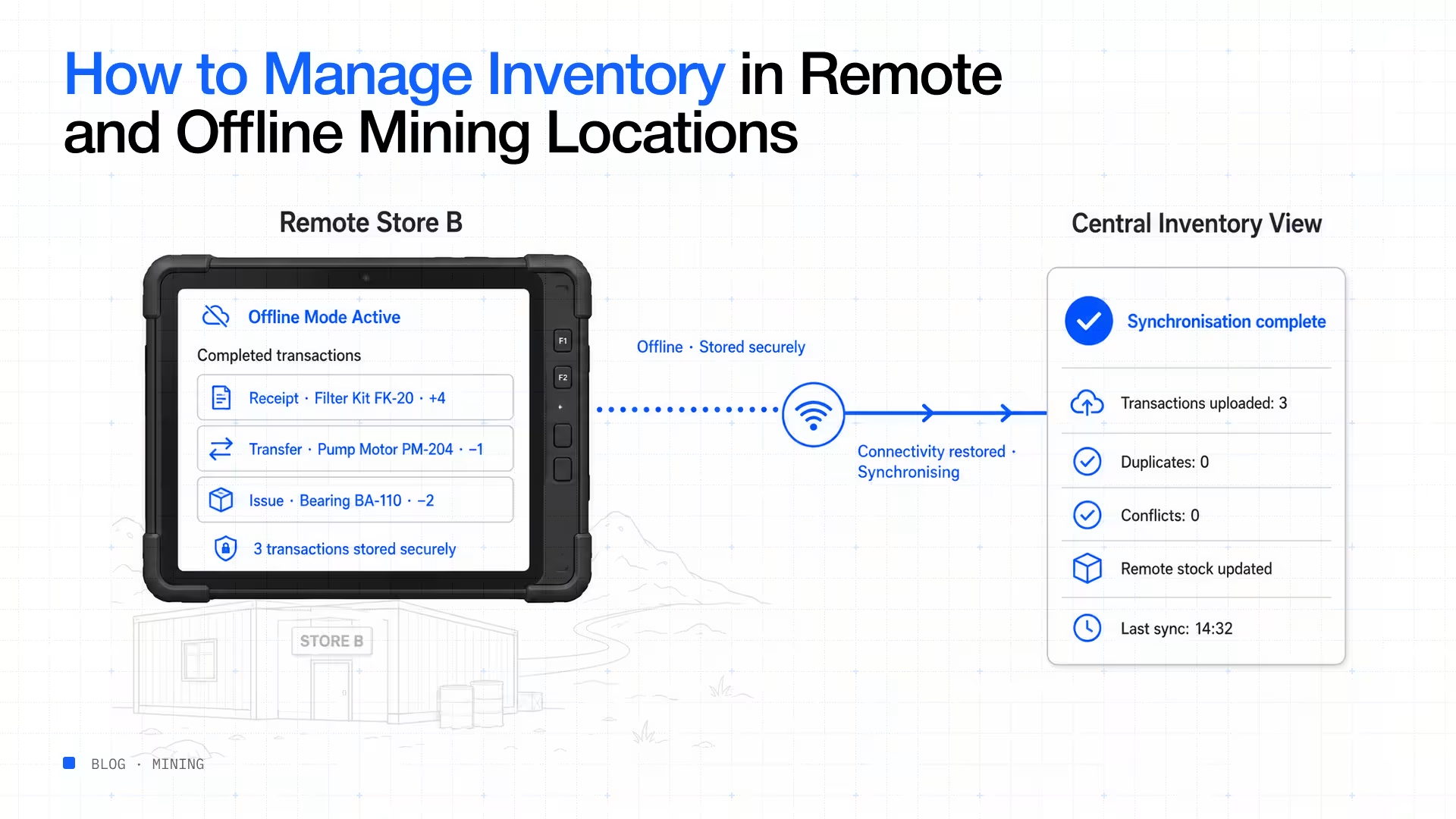
For example, an employee working at a remote mining location may need to issue a spare part to a maintenance team. Instead of waiting for network access, the employee can record the transaction directly through the offline inventory application. The transaction can then synchronise with the central inventory system when connectivity becomes available.
For mining operations, this capability is particularly valuable because remote and underground locations cannot always guarantee continuous connectivity. Offline inventory management allows the physical operation to continue while maintaining a structured record of what happened. It removes connectivity as a barrier to completing essential inventory transactions.
Mining operations can continue around the clock, regardless of whether the network is available at a particular location. Maintenance teams may need to issue a spare part, transfer materials or record consumption during a period when the system cannot connect.
If the inventory process depends entirely on live connectivity, these transactions may be delayed. Employees may resort to handwritten notes, spreadsheets or informal communication to keep operations moving. When these records are eventually entered into the central system, there may be missing information or inconsistencies.
Offline inventory tracking provides a more reliable alternative. Employees can record the transaction when it happens and allow the system to synchronise the information later. This helps maintain continuity between physical inventory activity and the central inventory record.
An offline inventory system typically stores the necessary inventory information and workflows locally on an authorised mobile device. Employees can access the relevant information and complete supported transactions even when the device cannot communicate with the central system.
For example, an employee can receive, transfer or issue a material while offline. The transaction is recorded locally and remains available until connectivity is restored. Once the device reconnects, the recorded information can synchronise with the central inventory system.
This allows the physical inventory process and the digital inventory record to remain connected despite temporary network limitations. The exact synchronisation process depends on the software architecture and controls used by the inventory platform, but the objective remains the same: capture the transaction when it occurs rather than reconstruct it later.
Offline functionality should support the transactions that mining employees actually need to perform in remote environments. Simply providing offline access to inventory information is not enough if critical transactions still require a live connection.
Common offline inventory transactions can include receiving materials, transferring stock, issuing parts, recording consumption and completing inventory counts. Location changes and relevant adjustments may also need to be captured depending on the operational workflow.
The objective is to allow employees to complete inventory activity without creating a separate paper-based process. This makes remote inventory management more consistent across connected and disconnected environments.
The system should also provide appropriate controls around synchronisation. When several users perform transactions offline, the platform needs to manage the resulting information correctly when those transactions are brought back into the central system.
Remote employees cannot always return to a workstation every time they need to complete an inventory transaction. Materials may be received at a remote yard, transferred underground or issued directly at a maintenance location.
Mobile inventory management allows employees to bring the inventory workflow to the point of activity. Using a supported mobile device, employees can identify materials, check relevant information and record transactions without relying on a fixed workstation.
This reduces the gap between physical activity and digital recording. Instead of remembering what happened and updating the system later, employees can capture the transaction closer to the moment it occurs. When mobile functionality is combined with offline capability, it becomes particularly useful for remote mining environments.
RFID can provide an additional layer of automation and identification for inventory located across remote mining environments. RFID tags can give individual materials, containers or other inventory items a unique digital identity that can be captured using compatible readers.
In a remote location, this can make certain inventory activities faster and more consistent. Instead of manually identifying every item, employees can use RFID-enabled workflows to capture relevant inventory information.
RFID inventory tracking can also support inventory counts and material movement tracking where the operating environment is suitable for RFID. This can be particularly valuable for critical spare parts and materials distributed across multiple storage areas.
However, RFID and offline functionality solve different parts of the problem. RFID helps identify physical inventory, while offline inventory software allows employees to continue recording inventory activity when network connectivity is unavailable. Together, they can provide a more resilient approach to remote inventory management.
Improve tracking across remote mining environments: Explore Scatterlink’s RFID inventory management solution to see how RFID and mobile inventory workflows work together.
The most practical way to track inventory without internet access is to use an inventory application with offline functionality. The application should allow employees to access the required inventory workflows and record transactions locally on their mobile device.
For example, an employee can issue a spare part even when there is no network connection. The system records the transaction and stores it until connectivity is restored. Once the device reconnects, the transaction can synchronise with the central inventory system.
The important consideration is that offline inventory tracking should be designed as part of the overall inventory process. It should not require employees to maintain a separate offline spreadsheet that someone later has to reconcile manually. The goal is to keep the inventory workflow connected even when the network is not.
Inventory visibility becomes more difficult as the distance between inventory and the central team increases. A warehouse manager may know what is recorded at the central facility but have limited information about materials sitting at remote locations.
A connected remote inventory management system can bring these locations into the same inventory environment. Teams can see what stock has been recorded at each location and understand relevant movements between them.
Offline transactions can then be synchronised when connectivity becomes available. This helps ensure that remote activity eventually becomes visible to central teams rather than remaining in disconnected records.
The result is a more complete view of inventory across the operation. Instead of asking individual employees what materials are available at a remote site, teams can use the inventory system as a more reliable source of operational information.
Searching for materials at a remote location can be particularly frustrating. Employees may know that a required part was sent to the site but have no reliable information about whether it is still there or where it was stored.
This can result in employees checking multiple storage areas, contacting other teams or travelling between locations to find the required material. The time lost can be significant when the material is needed for urgent maintenance.
A remote inventory tracking system can provide information about the recorded location and movement history of inventory. This gives employees a clearer starting point when looking for a required component.
Better visibility can also help central teams determine whether the material exists at another location. Rather than purchasing a replacement immediately, they can assess whether existing stock can be transferred.
Poor visibility across remote locations can lead to unnecessary purchasing. When employees cannot confidently determine whether a required component exists elsewhere, ordering another unit may seem like the safest option.
This can result in duplicate stock being held across multiple locations. For critical spare parts, this can tie up significant working capital while increasing the overall complexity of inventory management.
Mining inventory software with multi-location visibility can help teams identify available stock across the wider operation. If the required material already exists at another location, the organisation can consider transferring it rather than purchasing another item.
This approach can help balance inventory across locations while maintaining the stock levels required to support maintenance and production.
Remote and underground locations should be treated as connected parts of the same inventory environment. Materials may move between a central warehouse, a surface yard, a remote facility and underground storage before reaching their final point of use.
Each movement should be captured consistently. If the system records only the initial receipt and final consumption, the organisation has limited visibility into where the material was during the period in between.
Underground inventory management therefore needs to support location transfers, issues and other transactions even when connectivity is unreliable. Mobile and offline workflows can help maintain this continuity.
The same inventory identity should follow the material throughout the process. This makes it easier for teams to understand where stock is located and how it has moved through the operation.
Mining materials often move between surface and underground locations as part of normal maintenance and production activities. A spare part may be received at a surface warehouse, transferred to a yard and later transported underground for use.
If these movements are recorded manually or after a delay, inventory visibility can quickly deteriorate. The central system may continue showing the material at its previous location even though it has already moved.
A connected inventory tracking system can capture each relevant transfer. Mobile devices can be used at the point of movement, while offline capability allows the transaction to be recorded even without connectivity.
This creates a more consistent record of material movement between surface and underground environments. It also makes it easier for teams to determine where a critical item is expected to be located.
Remote inventory management software needs to be designed around the realities of distributed operations. The ability to work offline should be considered essential for locations where network availability cannot be guaranteed.
Mobile functionality is equally important. Employees should be able to complete inventory transactions without returning to a desktop workstation.
The system should also support multi-location inventory visibility, location transfers, inventory counts and material issue processes. Where appropriate, RFID and barcode capabilities can provide additional ways to identify inventory.
Integration with existing ERP systems is another important consideration. The inventory platform should complement existing enterprise records while providing the operational visibility and field-level functionality that may be missing from the core ERP workflow.
Finally, the software should be simple enough for employees to use in the field. If completing an inventory transaction requires extensive training or multiple administrative steps, adoption can become difficult.
Inventory accuracy depends on how consistently physical transactions are captured. When employees cannot access the inventory system, the likelihood of delayed or incomplete transactions increases.
Offline inventory software reduces this dependency on connectivity. Employees can capture transactions when they happen, even when the network is temporarily unavailable.
This helps reduce the need for manual reconstruction later. Instead of relying on memory or paper notes, the transaction is recorded directly within the inventory workflow.
Offline capability does not automatically guarantee inventory accuracy. The system still needs proper item records, transaction controls, synchronisation processes and user workflows. However, it removes one major obstacle to timely inventory recording in remote environments.
There is no single technology that solves every remote inventory challenge. A successful approach usually combines inventory processes, mobile technology, offline functionality and appropriate identification methods.
The first step is to identify where inventory visibility currently breaks down. Organisations should look at remote warehouses, yards, underground storage areas and other locations where transactions are frequently delayed.
The next step is to determine which inventory needs the highest level of control. Critical spare parts, frequently moved materials and stock with high replacement costs may be logical priorities.
Technology should then be implemented around these workflows. Mobile applications can support field transactions, offline capability can maintain continuity and RFID can improve identification where it is appropriate.
The result should be a system that makes inventory easier to manage rather than simply adding another layer of technology.
Remote mining operations need inventory technology that works in the same conditions as the people using it. A system that provides excellent visibility at a connected office but becomes unusable when employees move into remote or underground areas does not solve the complete inventory problem.
Scatterlink combines inventory intelligence with mobile and offline capabilities to support inventory visibility across distributed industrial operations. Employees can capture inventory activity closer to where physical transactions occur, while offline workflows help maintain continuity when connectivity is unavailable.
The platform also supports RFID-based inventory management, allowing organisations to connect physical inventory identification with digital inventory records where RFID provides operational value. This creates a more connected approach to tracking materials across warehouses, yards, remote locations and underground environments.
For mining companies focused on remote inventory management, the objective is to maintain accurate, actionable inventory information regardless of where the material is stored or where the transaction takes place.
Connect inventory across distributed operations: Learn more about Scatterlink and its inventory intelligence approach.
The ultimate goal of remote inventory management should be to maintain visibility throughout the material lifecycle. This starts when inventory arrives and continues through storage, transfer, issue and consumption.
At receipt, materials should be correctly identified and assigned to the appropriate location. When they move to a remote site, surface facility or underground area, the transfer should be recorded.
When the material is issued to maintenance or another operational team, the inventory record should reflect that transaction. At consumption, the final movement should be captured so that available inventory remains accurate.
This creates a continuous inventory trail. Even when transactions take place in remote or offline locations, the information can eventually flow back into the central inventory environment.
Maintain visibility throughout the inventory lifecycle: See how Scatterlink provides inventory visibility from receipt to consumption across warehouses, yards, remote sites and underground operations.
A well-designed remote inventory management process can deliver several operational benefits. The most immediate is improved visibility into inventory distributed across multiple locations.
Better visibility can help maintenance teams find critical materials faster. It can also reduce duplicate purchasing by showing whether existing inventory is available elsewhere in the operation.
Offline capabilities can reduce delays in transaction recording, while mobile workflows allow employees to capture inventory activity where it happens. RFID can further improve identification and movement tracking for suitable inventory.
Over time, these improvements can contribute to stronger stock control and more reliable inventory data. Instead of treating remote inventory as a separate problem, mining organisations can bring it into a connected inventory management process.
Managing inventory in remote and offline mining locations requires more than simply extending a warehouse inventory system into the field. Mining operations need a process that accounts for unreliable connectivity, distributed storage, frequent material movement and the physical realities of surface and underground environments.
Offline inventory management can help maintain continuity when connectivity is unavailable, while mobile inventory management allows employees to capture transactions where the work actually happens. RFID and other identification technologies can add further visibility where automated or faster inventory identification is valuable.
The real objective is to keep physical inventory and digital inventory records aligned. When teams can see what materials are available, where they are located and how they have moved, they can spend less time searching, avoid unnecessary purchases and respond more effectively to operational requirements.
For remote mining operations, better inventory visibility is ultimately about making the right material available at the right location when it is needed, regardless of how far that location is from the central warehouse.
Remote inventory management is the process of tracking and controlling inventory stored or used away from a central warehouse or connected facility. In mining, this can include remote sites, yards, surface facilities and underground locations.
Offline inventory management allows employees to record and manage inventory transactions without an active internet or network connection. Transactions can synchronise with the central system when connectivity becomes available.
Mining operations frequently operate in locations where connectivity can be unreliable. Offline inventory tracking allows employees to continue recording receipts, transfers, issues and other transactions without waiting for a network connection.
An inventory application with offline functionality can store relevant information and allow employees to complete supported transactions locally. The recorded information can synchronise with the central system once connectivity is restored.
Yes. RFID can be used to identify tagged inventory and support movement tracking in suitable remote environments. It can be combined with mobile and offline inventory workflows.
It connects inventory information from remote locations to the broader inventory system. This can help teams understand what stock is available, where it is recorded and how it has moved.
It allows transactions to be captured when they occur rather than waiting for connectivity. This can reduce delayed entries, manual reconstruction and discrepancies caused by missed inventory transactions.
Underground inventory management involves tracking and controlling materials stored and consumed in underground mining environments. It needs to account for limited connectivity, physical accessibility and frequent material movement.
Remote inventory tracking is the process of monitoring inventory located at remote or distributed operating locations. It can involve mobile applications, RFID, barcodes and inventory management software.
Yes. Better visibility across locations can help teams identify existing stock before purchasing additional materials. This can reduce unnecessary inventory accumulation and improve stock utilisation.
Important capabilities include offline functionality, mobile inventory management, multi-location visibility, inventory transfers, stock counts, RFID or barcode support, ERP integration and controlled synchronisation.
Mining companies can use a central inventory management platform with mobile and offline functionality to connect warehouses, yards, remote sites and underground locations within a common inventory environment.
Yes. Offline inventory applications can capture transactions locally and synchronise relevant information with an ERP or central inventory system when connectivity becomes available, depending on the integration architecture.
Mobile inventory management allows employees to perform inventory transactions at the location where materials are received, moved, issued or consumed. This reduces reliance on fixed workstations and delayed data entry.
Scatterlink combines inventory intelligence with mobile and offline capabilities to support inventory visibility across distributed industrial environments. Its RFID inventory management capabilities can also help organisations identify and track materials where RFID is appropriate.