
Industrial organisations often maintain inventory across multiple warehouses, maintenance stores, workshops and operational sites. When each location manages stock independently, teams can begin holding more inventory than they actually need. Over time, this can create a hidden inventory problem where the same parts are accumulated across multiple locations even though the organisation already has sufficient stock elsewhere.
This behaviour is commonly described as inventory hoarding. It occurs when teams retain inventory as a precaution against uncertainty, supply delays or future requirements rather than relying on shared visibility of stock across the wider organisation. While holding additional inventory can feel like protection, excessive stock at one site can coexist with stockouts at another, creating an inefficient inventory network.
Identifying inventory hoarding requires more than looking for large quantities of stock. Organisations need to understand consumption, inventory age, criticality, location, replenishment lead times and the availability of the same item elsewhere. With the right inventory visibility, teams can distinguish genuinely necessary inventory from stock that is being held simply because no one has confidence in what is available across the network.
Inventory hoarding occurs when a location, department or team holds more inventory than it reasonably requires because of concerns about future availability. The behaviour can develop when teams do not trust inventory records, have experienced previous stockouts or lack visibility into stock held at other locations.
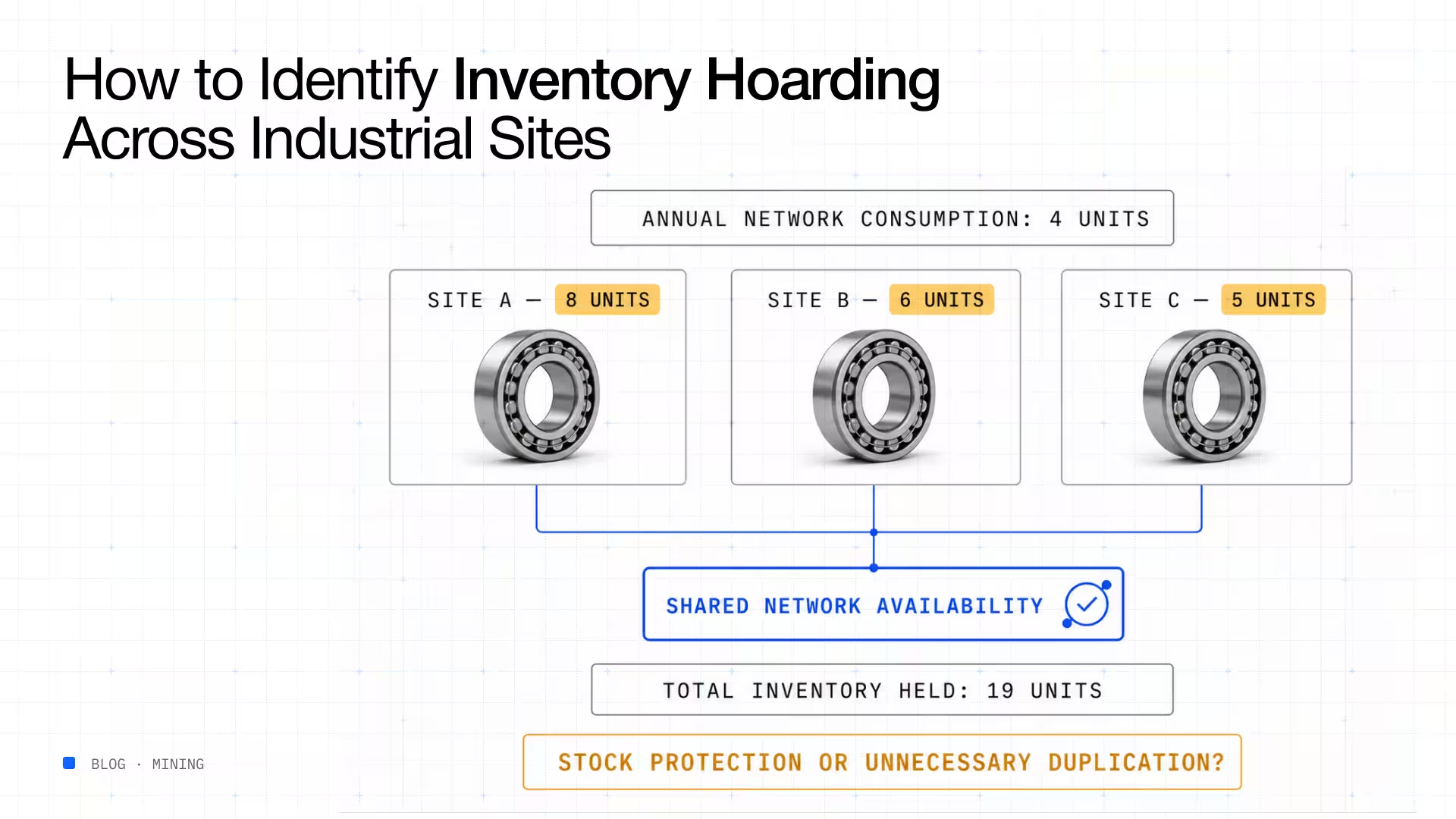
For example, a maintenance team may keep ten units of a spare part because it does not know whether another site has the same component available. A second site may make the same decision, resulting in excess inventory across the organisation even though the combined quantity is far greater than actual demand requires.
Inventory hoarding is therefore not always intentional overstocking. It can be a response to uncertainty. When teams cannot confidently see, locate or access inventory elsewhere, maintaining additional local stock can appear to be the safer operational choice.
Inventory hoarding can develop for several reasons, but poor inventory visibility is one of the most significant. When teams cannot reliably determine what inventory exists, where it is located or whether it is available for use, they are more likely to protect themselves by holding additional stock.
Other common causes include:
The underlying issue is often not simply that teams want to hold excess stock. It is that the organisation has not provided a reliable alternative to local stock accumulation.
Inventory hoarding can be difficult to identify because excess stock may appear reasonable when viewed from a single location. A site may have a legitimate reason for maintaining inventory based on its own demand and operational requirements.
The problem becomes clearer when inventory is analysed across the entire network. Several locations may hold the same part, while actual consumption is concentrated at only one or two sites. Other indicators include high quantities of slow-moving inventory, repeated purchases despite existing stock elsewhere and large differences between inventory levels at comparable locations.
Common signs include:
If several locations maintain significant quantities of the same low-demand spare part, the organisation should determine whether each location genuinely requires its own stock. Multiple local buffers can create unnecessary duplication.
This does not mean all shared inventory should be centralised. Some locations may require dedicated stock because of response times, operational isolation or equipment criticality. The key is to determine whether the duplication is intentional and justified.
Long periods without consumption can indicate that a site is holding more inventory than it needs. However, low movement alone does not prove that stock is unnecessary.
Critical spare parts may remain unused for years and still be operationally important. Inventory age should therefore be considered alongside criticality, future demand, supplier lead time and equipment requirements.
One of the strongest signs of inventory hoarding is repeated purchasing when the organisation already has usable inventory at another location. This often indicates that teams either cannot see the existing stock or cannot easily access it.
The result is duplicated inventory rather than improved availability. One site may accumulate excess stock while another continues to purchase the same item because the existing inventory is effectively invisible to its procurement team.
Comparable industrial sites often have similar equipment, maintenance requirements and inventory categories. If one site holds substantially more of a particular part than another without a clear operational reason, the difference deserves investigation.
Large variations can reveal local inventory policies, inconsistent replenishment settings or historical purchasing behaviour that has created unnecessary stock accumulation.
Inventory visibility is central to understanding inventory hoarding. When teams can see inventory across the organisation, they have more options before placing a new purchase order. They can determine whether the required item already exists elsewhere, whether it is available for transfer and how quickly it can reach the requesting location.
Without this visibility, purchasing additional inventory may appear to be the lowest-risk option. A maintenance planner facing an urgent requirement is unlikely to spend time searching through multiple sites if there is no reliable way to determine whether the part exists or whether the recorded quantity is accurate.
This creates a cycle: poor visibility leads to uncertainty, uncertainty leads to local stock buffers, local stock buffers create excess inventory, and excess inventory makes the overall network more difficult to manage.
Identifying inventory hoarding requires analysis across locations rather than reviewing each site independently. Organisations should begin by identifying items that are held at multiple locations and comparing their quantities against actual consumption.
The analysis should consider:
This information helps determine whether the organisation is holding deliberate strategic stock or simply accumulating inventory because of fragmented visibility and local decision-making.
One useful indicator of potential inventory hoarding is the relationship between stock held and historical consumption. If a site consistently holds a large quantity of an item but consumes very little, the inventory level should be reviewed.
For example, if a site holds 50 units of a component but has consumed only two units in the past three years, the quantity may require investigation. However, the decision should not be based solely on the consumption ratio. The organisation should also determine whether the component is critical, difficult to source or required for specific equipment.
This distinction is important because low consumption does not automatically mean excess inventory. The purpose of the analysis is to identify inventory that appears disproportionate to the site’s actual requirements and then understand why it is being held.
Duplicate inventory is one of the clearest opportunities to identify potential hoarding. Organisations should compare inventory records across locations to determine how many sites hold the same item and how much total stock is available.
A part that appears scarce when viewed from one site may be abundant across the wider network. Without consolidated inventory visibility, each location may continue replenishing its own quantity independently.
A network-wide view changes the question from “Do we have this part at this site?” to “Do we already have this part anywhere in the organisation, and can it be made available?” That shift can significantly reduce unnecessary purchasing.
Critical spare parts require particular care because their low consumption can make them appear to be hoarded even when the inventory is justified. A critical component with a long supplier lead time may need to be held at multiple locations if transferring it would take too long to protect operations.
The right question is therefore not whether multiple locations hold the same critical spare. The question is whether the quantity and distribution of that inventory are aligned with operational risk.
Factors such as equipment criticality, failure consequences, response time, geographic distance and supplier lead time should all be considered. This allows organisations to reduce unnecessary duplication without compromising the availability of parts that protect critical operations.
Holding excess inventory across multiple locations increases the amount of working capital tied up in stock. It also increases storage, handling, counting and management requirements.
The financial impact can become more significant when duplicated inventory consists of high-value spare parts. Even if each individual location considers its stock level reasonable, the combined inventory value across the organisation may be substantially higher than necessary.
Inventory hoarding can also increase the risk of obsolescence. When equipment changes or is retired, duplicated spare parts may no longer have a useful application. The longer excess inventory remains untouched, the greater the possibility that its value will decline.
One of the most important signs of an inefficient inventory network is the simultaneous presence of excess inventory and stockouts. An organisation may have a large quantity of a particular part overall while a site that needs the part cannot access it.
This usually indicates that inventory is not being managed as a connected network. Stock exists, but it is trapped in the wrong location or not visible to the teams that need it.
Improving visibility can help organisations identify these situations before placing new orders. Explore Scatterlink’s RFID inventory management solution to improve visibility into inventory locations, movements and availability across industrial operations.
Inventory hoarding cannot be identified reliably when inventory records are inaccurate. If the system shows ten units at a location but only six can actually be found, the organisation may incorrectly assume that sufficient stock exists.
Poor accuracy can therefore create both false confidence and unnecessary purchasing. Teams may either avoid ordering because the system says stock is available or purchase additional inventory because they cannot locate the recorded stock.
Accurate inventory transactions and location information provide the foundation for identifying where inventory is actually held. Learn more about Scatterlink and how connected inventory visibility can support more reliable inventory decisions.
Inventory hoarding should be measured across the entire inventory network rather than at individual sites in isolation. The objective is to identify where inventory quantities are significantly higher than actual requirements and whether the same items are being unnecessarily duplicated across locations.
Several indicators can help identify potential inventory hoarding:
No single metric proves that a site is hoarding inventory. These indicators should be evaluated together with criticality, lead time and operational requirements to determine whether the inventory is genuinely necessary.
Excess inventory and inventory hoarding are closely related, but they describe different aspects of an inventory problem. Excess inventory refers to stock that exceeds what is reasonably required, while inventory hoarding describes the behaviour or conditions that cause teams to retain more stock than necessary.
A site may have excess inventory because its demand forecast was inaccurate, replenishment parameters were never updated or equipment requirements changed. Inventory hoarding can occur when teams deliberately retain additional stock because they do not trust supply availability or cannot see inventory elsewhere.
Understanding this distinction matters because reducing quantities without addressing the reason behind the behaviour may not solve the problem. If teams continue to lack visibility, they may simply accumulate replacement stock after the reduction.
The first step is to create a consolidated view of inventory across all relevant locations. Organisations should identify how much of each item is held at each site and compare those quantities against historical and expected demand.
The analysis should then identify inventory that exceeds established maximum levels, has remained unused for extended periods or is duplicated across locations. Items should be prioritised based on value, criticality and the potential financial benefit of redistribution or reduction.
For example, if three sites collectively hold 100 units of a spare part but annual network consumption is only 10 units, the organisation should investigate why the quantity is so high. The answer may be justified strategic stock, outdated replenishment settings or simply years of local purchasing decisions accumulating without network-level review.
One of the simplest ways to reduce inventory hoarding is to check existing network inventory before placing a new purchase order. If the required part already exists at another location, transferring it may be a better option than purchasing another unit.
This requires more than knowing that the organisation owns the item. Teams need to know its current location, quantity, condition, availability and transfer requirements. Without reliable information, a procurement team may still choose to purchase because an existing part cannot be confidently located or accessed.
A connected inventory management approach can help make existing stock more visible before new purchasing decisions are made. Explore Scatterlink’s RFID inventory management solution to improve visibility across distributed industrial inventory.
Cross-site inventory transfers can help redistribute existing stock to locations where it is more likely to be consumed. Instead of allowing every site to maintain its own independent buffer, organisations can use network-wide inventory information to make better allocation decisions.
For example, if Site A has eight units of a slow-moving spare and Site B has an immediate requirement for the same part, transferring available stock can prevent a new purchase. This reduces unnecessary inventory growth while making better use of stock already owned by the organisation.
Transfers should still account for transport time, operational risk and the cost of moving inventory. The objective is not to transfer everything between locations, but to make informed decisions about where inventory provides the greatest operational value.
Inventory hoarding often develops when each location follows its own purchasing and replenishment rules. One site may maintain three months of stock while another maintains twelve months, even though both support similar equipment and demand patterns.
Creating common inventory policies can reduce these inconsistencies. Organisations can establish standard approaches for minimum and maximum stock levels, criticality classification, replenishment reviews and excess inventory management.
Local requirements should still be recognised. Remote or isolated operations may require higher stock levels than sites located close to suppliers or central warehouses. The goal is to create a consistent framework while allowing inventory policies to reflect genuine operational differences.
Outdated min-max inventory levels can contribute significantly to inventory hoarding. If a site once consumed 20 units of a component each month but now consumes only two, an unchanged maximum stock level can result in significant excess inventory.
Inventory parameters should therefore be reviewed against current consumption, equipment requirements and supply conditions. Historical demand can provide a useful starting point, but teams should also consider planned maintenance, equipment changes and future operational requirements.
Regular reviews prevent old assumptions from becoming permanent inventory requirements. They can also identify locations where replenishment settings are significantly different from comparable sites.
Purchasing behaviour can provide another useful signal. If teams repeatedly purchase an item despite the organisation already holding substantial quantities elsewhere, there may be a visibility or inventory-sharing problem.
Purchase orders should therefore be analysed alongside inventory availability. Organisations can identify cases where new purchases occurred even though usable stock existed elsewhere at the time of purchase.
This does not mean every purchase made while network inventory exists is unnecessary. A part may be reserved for another operation, have an unsuitable specification or be located too far away to meet the required response time. The purpose of the analysis is to identify patterns that warrant further investigation.
Inventory age can reveal where stock has accumulated without being consumed. Comparing inventory age across locations can help identify sites that consistently retain older inventory than comparable operations.
Older inventory should be reviewed according to its criticality and future requirement. A ten-year-old critical spare may still be necessary if the equipment remains active and the part is difficult to procure. In contrast, an old component associated with retired equipment may represent clear excess or obsolete stock.
Location-level ageing analysis can therefore help organisations identify where inventory is becoming trapped and why.
Organisations looking to monitor inventory hoarding can establish a dedicated set of KPIs. These metrics should focus on duplication, excess quantities, inventory age and purchasing behaviour across the network.
Useful inventory hoarding KPIs include:
Measures the financial value of identical inventory held across multiple locations beyond defined requirements. This helps quantify how much working capital may be tied up in duplicated stock.
Measures the proportion of inventory held above established requirements. This can be calculated by location, item category, value or criticality.
Shows how much inventory has experienced limited or no movement at each location. Comparing sites can reveal where stock is accumulating disproportionately.
Measures how much usable inventory is available across the organisation rather than only at the requesting site. This provides greater context when assessing purchasing and stockout decisions.
Tracks purchases made when equivalent usable inventory was already available elsewhere. A high rate can indicate poor visibility or weak inventory-sharing processes.
The goal of reducing inventory hoarding should never be simply to remove stock. The organisation needs to improve confidence in inventory availability so that teams do not feel they need to maintain excessive local buffers.
Start by identifying duplicated inventory and separating it into critical and non-critical categories. Review high-value and low-movement items first, then determine whether stock can be transferred, consolidated or reduced without affecting operational requirements.
At the same time, strengthen visibility into inventory held at other locations. When teams can confidently see what is available and where it is located, they have less reason to protect themselves through unnecessary local stock accumulation.
Inventory hoarding is often a symptom of uncertainty. When teams lack reliable information about inventory availability, they compensate by holding more stock.
Inventory intelligence can help replace that uncertainty with actionable information. Instead of simply showing an inventory quantity, a connected inventory environment can provide greater visibility into location, movement, consumption and availability.
This allows teams to make better decisions about whether to purchase, transfer, retain or reduce inventory. Learn more about Scatterlink and its approach to improving inventory visibility for industrial operations.
Inventory hoarding should be reviewed as an ongoing network-level process rather than a one-time stock reduction exercise. Organisations can establish regular reviews that identify duplicate inventory, excess quantities, ageing stock and purchasing patterns across locations.
A practical review can begin with the highest-value duplicated inventory and then move into lower-value categories. Each item should be assessed against consumption, criticality, lead time and operational requirements before a decision is made.
This approach helps organisations reduce unnecessary inventory while preserving the stock required to maintain operational continuity.
Ultimately, inventory hoarding is difficult to manage when organisations cannot see their inventory as a connected network. Site-level information can tell a team what it has, but network-level visibility shows what the organisation has and where it can be used.
That distinction is critical for industrial operations. A part sitting unused at one site may be exactly what another site needs, but without accurate location and availability information, the organisation may purchase another unit instead.
Improving inventory visibility creates the foundation for better inventory sharing, more informed purchasing and more controlled stock levels. It allows organisations to move from protecting every site with excess inventory to managing inventory as a connected operational resource.
Inventory hoarding rarely happens without a reason. It often develops because teams have experienced stockouts, face uncertain supply conditions or simply do not have enough confidence in inventory information outside their own location.
The solution is not to force every site to hold less inventory. Instead, organisations need to understand where stock is duplicated, why it is being held and whether it can be shared or redistributed without increasing operational risk.
By analysing inventory across locations, monitoring duplicate and excess stock, reviewing purchasing behaviour and improving inventory visibility, industrial organisations can reduce unnecessary inventory while protecting critical parts. The objective is a network where teams know what inventory exists, where it is located and when it should be used, rather than accumulating stock simply because they cannot see what is already available.
Inventory hoarding occurs when a site, team or department holds more inventory than it reasonably needs, often because of concerns about stock availability, supplier lead times or a lack of visibility into inventory held elsewhere.
Common reasons include previous stockouts, unreliable inventory records, long supplier lead times, decentralised purchasing, poor visibility across locations and a lack of confidence in inventory availability at other sites.
Inventory hoarding can be identified by analysing duplicate inventory, inventory held versus consumption, inventory age, excess stock, purchasing behaviour and inventory quantities across multiple locations.
No. Excess inventory refers to stock that exceeds actual requirements, while inventory hoarding describes the behaviour or conditions that can cause teams to retain unnecessary stock. Hoarding can be one reason an organisation accumulates excess inventory.
Better inventory visibility allows teams to see what inventory exists across the organisation, where it is located and whether it is available for use. This reduces the uncertainty that often causes sites to maintain unnecessary local stock buffers.
Yes. An organisation can have excess inventory overall while experiencing stockouts at individual locations. This can happen when usable inventory is concentrated at the wrong site and teams cannot see or access it when required.
Organisations can reduce inventory hoarding by improving cross-site inventory visibility, reviewing duplicate stock, establishing shared inventory policies, updating min-max levels, analysing purchasing behaviour and transferring usable inventory between locations where appropriate.
Not automatically. Critical spares may need to be held at multiple sites because of response requirements, long lead times or operational isolation. Their distribution should be evaluated based on operational risk rather than inventory value or quantity alone.
%20(1).avif)
.avif)
%20(1).avif)