
Inventory that does not move quickly can be difficult to manage, particularly in industrial operations carrying large quantities of MRO, spare parts and maintenance inventory. A part may sit on a warehouse shelf for months because demand is low, while another item may have had no consumption for several years. Both may appear inactive, but they do not necessarily represent the same inventory problem.
The distinction between dead stock and slow-moving inventory matters because each requires a different management response. Slow-moving inventory may still have legitimate operational value and could be required for future maintenance, while dead stock may have little realistic prospect of being consumed. Understanding the difference allows inventory teams to reduce excess stock without prematurely disposing of parts that the operation may still need.
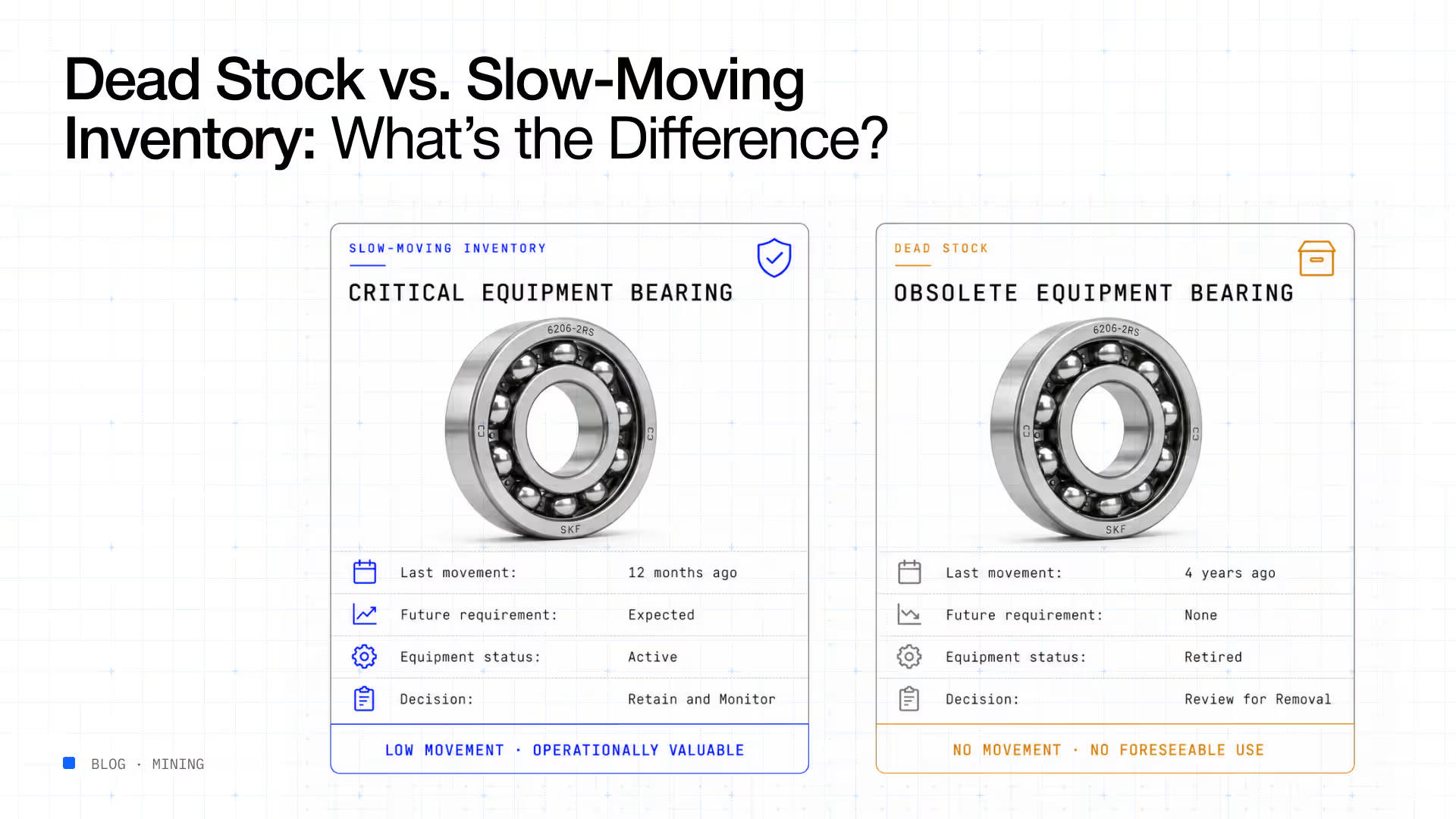
The simplest difference is whether the inventory still has meaningful demand or usage potential. Slow-moving inventory continues to move, but at a lower rate than expected, while dead stock has experienced little or no movement for an extended period and has limited foreseeable demand. The exact timeframe used to classify inventory will vary by organisation, industry and item type.
For example, a mining operation may hold a specialised bearing that is issued once every 12 months because the associated equipment rarely requires replacement. That part could be considered slow-moving, but it may still be operationally important. Another component that has not been issued for several years, is associated with retired equipment and has no planned future use may be better classified as dead stock.
The important point is that low movement does not automatically mean unnecessary inventory. Inventory managers need to consider consumption history alongside equipment dependency, future requirements, criticality, obsolescence risk and the availability of alternative uses before deciding what should happen to a slow-moving or inactive item.
Slow-moving inventory is stock that continues to experience some level of demand or consumption but moves less frequently than expected. The item may still be required for maintenance, repairs, production or future operational requirements, but its rate of consumption is relatively low. In industrial environments, this is common for specialised spare parts and components associated with equipment that has long maintenance cycles.
There is no universal definition of slow-moving inventory because acceptable movement rates depend on the type of inventory being managed. A consumable that moves once a month may be considered slow if it normally moves every week, while a critical spare that is only used once every two years may be perfectly reasonable to hold. Classification therefore needs to reflect the role and expected demand of each inventory category.
Slow-moving stock should not automatically be treated as excess inventory. Some low-demand parts have high operational value because they are difficult to source, have long supplier lead times or are required to support critical equipment. Removing these items simply because they have low turnover can create a much greater operational risk later.
Dead stock is inventory that has remained unused for an extended period and has little or no expected future demand. It may have been purchased for equipment that is no longer operating, accumulated because of changes in maintenance requirements or become unnecessary because a replacement component has been introduced. Unlike slow-moving inventory, dead stock generally has little evidence of continued operational demand.
Dead stock can remain hidden within large inventory networks for years. Because the items are already owned and stored, they may not attract the same attention as new procurement requirements, even though they continue to consume storage space and tie up working capital. In some cases, organisations may not recognise the scale of dead inventory until a detailed inventory review is conducted.
The risk is particularly significant for industrial spare parts. A component can remain physically usable but still have little practical value if the equipment it supports has been retired or replaced. This makes inventory obsolescence, equipment lifecycle information and future maintenance requirements important considerations when identifying dead stock.
This distinction is particularly important when managing MRO and spare parts inventory. A slow-moving critical spare may be worth retaining because the cost of not having it could be far greater than the cost of holding it. Dead stock associated with obsolete equipment, on the other hand, may provide little operational benefit while continuing to occupy valuable storage capacity.
Dead stock can accumulate when organisations purchase inventory based on forecasts or assumptions that do not match actual consumption. A part may have been expected to support future maintenance activity, but if equipment usage, production requirements or maintenance strategies change, the inventory may never be consumed. Once the expected demand disappears, the stock can remain in storage without a clear purpose.
This can happen particularly easily when purchasing decisions are made independently across multiple locations. One site may purchase a large quantity to protect against a potential requirement, while another site later changes its equipment or maintenance plan. Without a mechanism to review the original purchasing rationale, the remaining stock can quietly become obsolete or irrelevant.
Industrial equipment does not remain unchanged throughout its operational life. Equipment may be upgraded, replaced, retired or modified, which can change the spare parts required to maintain it. Inventory that was previously essential can therefore become unnecessary even though the physical parts remain in good condition.
This is why inventory management should be connected to equipment and maintenance information where possible. When an item is no longer required by the equipment it supports, continuing to hold large quantities can create unnecessary carrying costs and increase the likelihood of eventual obsolescence.
Dead stock can also be the result of purchasing more inventory than the organisation actually needs. If several locations independently purchase the same spare part, total inventory may exceed actual network demand. Some of those units may eventually be consumed, while others remain unused for years.
Improving inventory visibility across locations can help organisations identify existing stock before purchasing additional quantities. Explore Scatterlink's RFID inventory management solution to improve visibility into inventory across complex industrial environments.
Slow-moving inventory may not represent an immediate problem, but it can become one when organisations fail to understand why the stock is moving slowly. Low consumption could indicate that demand has genuinely decreased, or it could simply reflect the nature of a critical spare that is rarely needed but essential when equipment fails. Treating both situations in the same way can result in either excessive inventory or unacceptable operational risk.
Slow-moving inventory also ties up capital for longer periods. The longer an item remains in storage, the greater the opportunity cost of the capital invested in it and the greater the possibility that the item will become obsolete before it is consumed. Organisations therefore need to monitor slow-moving stock and determine whether it should be retained, reduced, transferred or reviewed.
The first step is to analyse inventory movement over an appropriate period. This should include issues, consumption, transfers and other relevant transactions rather than relying only on the current quantity on hand. A part with no recorded movement for 24 months requires a different review from one that has been issued twice during the same period.
However, movement history alone is not enough. Inventory teams should also consider the item's criticality, equipment dependency, future maintenance plans, supplier lead time, replacement availability and whether equivalent parts are already held elsewhere. A complete review combines inventory data with operational context so that low movement is not automatically interpreted as low value.
Identifying dead stock and slow-moving inventory requires more than looking at how long an item has been sitting on a warehouse shelf. Inventory teams need to analyse historical issues, consumption, transfers, current demand, equipment requirements and future maintenance plans to understand why an item is not moving. This creates a more accurate picture of whether an item is genuinely inactive or simply has a naturally low rate of consumption.
A useful starting point is to review inventory movement over defined periods such as 12, 24 or 36 months, depending on the type of inventory being assessed. Items with no movement over a prolonged period can then be investigated for their operational relevance, while items with limited but recurring movement can be assessed as slow-moving inventory. These thresholds should vary by inventory category because a critical spare may naturally move far less frequently than a high-use consumable.
The last movement date is another useful indicator. It shows when an item was last received, issued, transferred or otherwise moved within the inventory system, providing a starting point for identifying stock that may require further review. However, a long period without movement does not automatically mean the item should be classified as dead stock, because some specialised spare parts are intentionally held for infrequent but potentially critical requirements.
Several inventory metrics can help organisations identify items that may require closer review. Inventory turnover, days of inventory on hand, consumption frequency, stock age and time since last movement can all provide useful indicators of how quickly inventory is being used. However, these metrics should be interpreted alongside the operational purpose of the inventory rather than treated as automatic rules for disposal.
Inventory turnover is particularly useful because it shows how frequently stock is consumed or replaced over a defined period. Low turnover can indicate that an organisation is carrying more inventory than current demand requires, but this does not necessarily mean the inventory is unnecessary. MRO and spare parts inventory behaves differently from fast-moving production materials, so turnover targets should reflect the type, criticality and expected demand of each item.
Days of inventory on hand can provide another perspective by estimating how long current stock could support expected consumption. A high number of days may indicate excess inventory, but it could also reflect a deliberate decision to protect against long supplier lead times or unpredictable equipment failures. The metric becomes more useful when combined with demand patterns, criticality and replenishment lead times.
Not all slow-moving inventory creates the same financial or operational risk. A low-value component that moves slowly may have little effect on working capital, while a high-value specialised spare that remains unused for several years can represent a significant amount of capital tied up in inventory. At the same time, the operational importance of that high-value spare may justify retaining it if replacing the component quickly would be difficult.
This is why industrial inventory reviews should consider both financial value and operational criticality. High-value, low-movement inventory can be prioritised for detailed review, while critical parts can be protected even when their turnover is low. This approach helps organisations reduce unnecessary inventory without creating new stockout risks.
An item that appears slow-moving at one location may not actually be slow-moving across the organisation. Another site may be consuming the same part regularly, while the original location continues to hold excess quantities. Without visibility across locations, organisations can miss opportunities to transfer existing inventory instead of purchasing additional stock.
This is particularly relevant for mining and industrial operations with multiple warehouses, workshops, surface locations and underground operations. Inventory demand can vary significantly between sites, creating situations where one location holds excess stock while another raises a purchase request for the same component. A network-wide inventory view allows teams to compare stock levels and consumption before making procurement or disposal decisions.
Reducing slow-moving inventory starts with understanding why the item is moving slowly. If demand has genuinely decreased, organisations may be able to reduce replenishment quantities, adjust minimum and maximum stock levels or consolidate inventory across locations. If the item remains operationally important, the better approach may be to retain an appropriate quantity while preventing additional unnecessary purchases.
Inventory transfers can also improve stock utilisation. A slow-moving item at one location may be in demand at another, allowing the organisation to use inventory it already owns instead of purchasing new stock. This can reduce excess inventory while improving availability at locations where actual consumption is occurring.
Organisations should also review purchasing and replenishment rules for items that consistently move below expected rates. Continuing to purchase the same quantity based on outdated demand assumptions can cause slow-moving inventory to become excess inventory over time. Adjusting replenishment parameters based on actual consumption helps prevent the problem from continuing.
Dead stock requires a more deliberate review because it may no longer have a clear operational purpose. Organisations should determine whether the inventory can be reused at another site, returned to a supplier, repurposed, sold, recycled or formally written off. The appropriate action will depend on the condition of the inventory, contractual arrangements, operational requirements and potential future use.
Before disposing of dead stock, teams should verify that the associated equipment is no longer dependent on the item. Equipment may still be operating, a maintenance project may be planned or another site may have a legitimate requirement for the same component. A structured review reduces the risk of disposing of inventory that later needs to be purchased again.
A dead stock review should also investigate why the inventory became inactive in the first place. If the cause was duplicate purchasing, inaccurate demand forecasting, equipment changes or fragmented inventory visibility, simply disposing of the stock does not solve the underlying problem. Addressing the cause helps prevent the same pattern from creating another pool of inactive inventory.
Dead stock and slow-moving inventory are difficult to manage when organisations cannot see inventory movement across their entire network. A part may appear inactive at one site while being consumed regularly at another location, or multiple sites may independently hold quantities of the same low-demand component. Without a network-wide view, inventory teams cannot accurately assess total demand and utilisation.
Real-time inventory visibility provides a clearer picture of where inventory is located, how it moves and where consumption is occurring. It allows teams to identify inventory that could be transferred before new stock is purchased and provides better information for deciding whether inactive inventory should be retained or removed. Explore Scatterlink's RFID inventory management solution to improve visibility across inventory locations.
Dead stock and slow-moving inventory should not only be reviewed when warehouse capacity becomes a problem. A regular inventory review can identify changes in demand, equipment requirements and inventory utilisation before inactive stock accumulates. This allows inventory teams to take action while there is still an opportunity to consume, transfer or redeploy the inventory.
A practical review process can include:
Review consumption history, inventory turnover, stock age and last movement dates to identify items requiring further investigation.
Determine whether the item supports active equipment, planned maintenance or future operational requirements.
Check whether the same item is being consumed elsewhere or whether excess quantities exist at another site.
Determine whether the item should be retained despite low consumption because its absence could create operational risk.
Consider maintenance schedules, equipment lifecycle plans, production requirements and known operational changes.
Reduce unnecessary future purchases where demand has permanently declined.
Transfer stock to locations where it has a higher probability of being consumed.
Where inventory has no realistic operational use, follow an appropriate disposal, return, resale or write-off process.
This approach ensures that inventory optimisation does not become a simple exercise in removing stock. The objective is to maintain the right inventory for operational requirements while reducing capital tied up in stock that no longer provides value.
Traditional inventory management can tell organisations how much stock they have, but effective inventory optimisation requires a clearer understanding of what that stock means operationally. Teams need to connect inventory quantities with movement history, location, consumption patterns and future requirements. Without that context, it is difficult to determine whether an item should be retained, transferred, replenished or removed.
Inventory intelligence brings these signals together to support faster and more informed decisions. Scatterlink provides inventory visibility from receipt through to consumption, helping industrial operations understand inventory movements across complex environments. Learn more about Scatterlink and how its inventory intelligence approach supports better inventory control.
Dead stock and slow-moving inventory may look similar on an inventory report, but they represent different management challenges. Slow-moving inventory can still provide legitimate operational value, particularly when it supports critical equipment, has unpredictable demand or requires long lead times to replace. Dead stock, by contrast, has little realistic future demand and can continue consuming storage space and working capital without providing meaningful operational value.
The right approach is not to remove every item that has low inventory turnover. Organisations should combine movement history with equipment requirements, inventory criticality, future maintenance plans, supplier lead times and demand across locations before deciding whether inventory should be retained, reduced, transferred or disposed of. This prevents inventory optimisation efforts from creating new stockout risks.
For industrial organisations, better inventory visibility provides the foundation for making these decisions. When teams can see what inventory exists, where it is located, how frequently it moves and where demand is occurring, they can identify excess and inactive stock more accurately. Discover how Scatterlink supports real-time inventory visibility across the inventory lifecycle.
Dead stock is inventory that has experienced little or no movement for an extended period and has limited expected future demand. Slow-moving inventory continues to experience some level of consumption but moves less frequently than expected. The distinction matters because slow-moving inventory may still be operationally necessary, while genuinely dead stock may be suitable for redeployment, return, resale or disposal.
Dead stock can be identified by analysing inventory movement history, consumption records and the last transaction date over an appropriate period. Organisations should also check equipment lifecycle information, future maintenance requirements, inventory criticality and potential demand at other locations before making a final classification.
No. Slow-moving inventory is not necessarily excess or unnecessary inventory. Some critical spare parts may have very low consumption because equipment failures are infrequent, but keeping the part available may still be justified because replacing it could take weeks or months. The decision should therefore consider operational criticality and replacement risk alongside inventory turnover.
Dead stock can accumulate because of inaccurate demand forecasts, duplicate purchasing, changes in equipment, equipment retirement, discontinued parts, excessive stock levels and poor visibility across inventory locations. When inventory requirements change but existing stock is not reviewed, items can remain in storage long after their original operational purpose has disappeared.
Companies can reduce slow-moving inventory by improving demand planning, reviewing minimum and maximum stock levels, consolidating inventory across locations and transferring suitable stock to locations where demand exists. Organisations should also review replenishment settings so that declining demand does not continue generating unnecessary purchases.
Reducing dead stock begins with determining whether the inventory has any remaining operational value. Suitable stock may be transferred to another location, returned to a supplier, reused for another application or sold, while genuinely obsolete inventory may need to be disposed of or written off. Organisations should also investigate why the stock became inactive so that the same issue does not continue creating dead inventory.
Useful metrics include inventory turnover, consumption frequency, days of inventory on hand, stock age and time since the last inventory movement. These metrics can identify items requiring further review, but they should be evaluated alongside criticality, equipment requirements and future demand. A low-turnover critical spare should not automatically be treated in the same way as obsolete inventory.
Inventory visibility provides a clearer view of what stock exists, where it is located and how it is being consumed across the organisation. This helps teams identify duplicate quantities, locate slow-moving inventory that may be needed elsewhere and distinguish genuinely inactive stock from inventory that simply has low demand at one particular location.
%20(1).avif)
.avif)
%20(1).avif)