
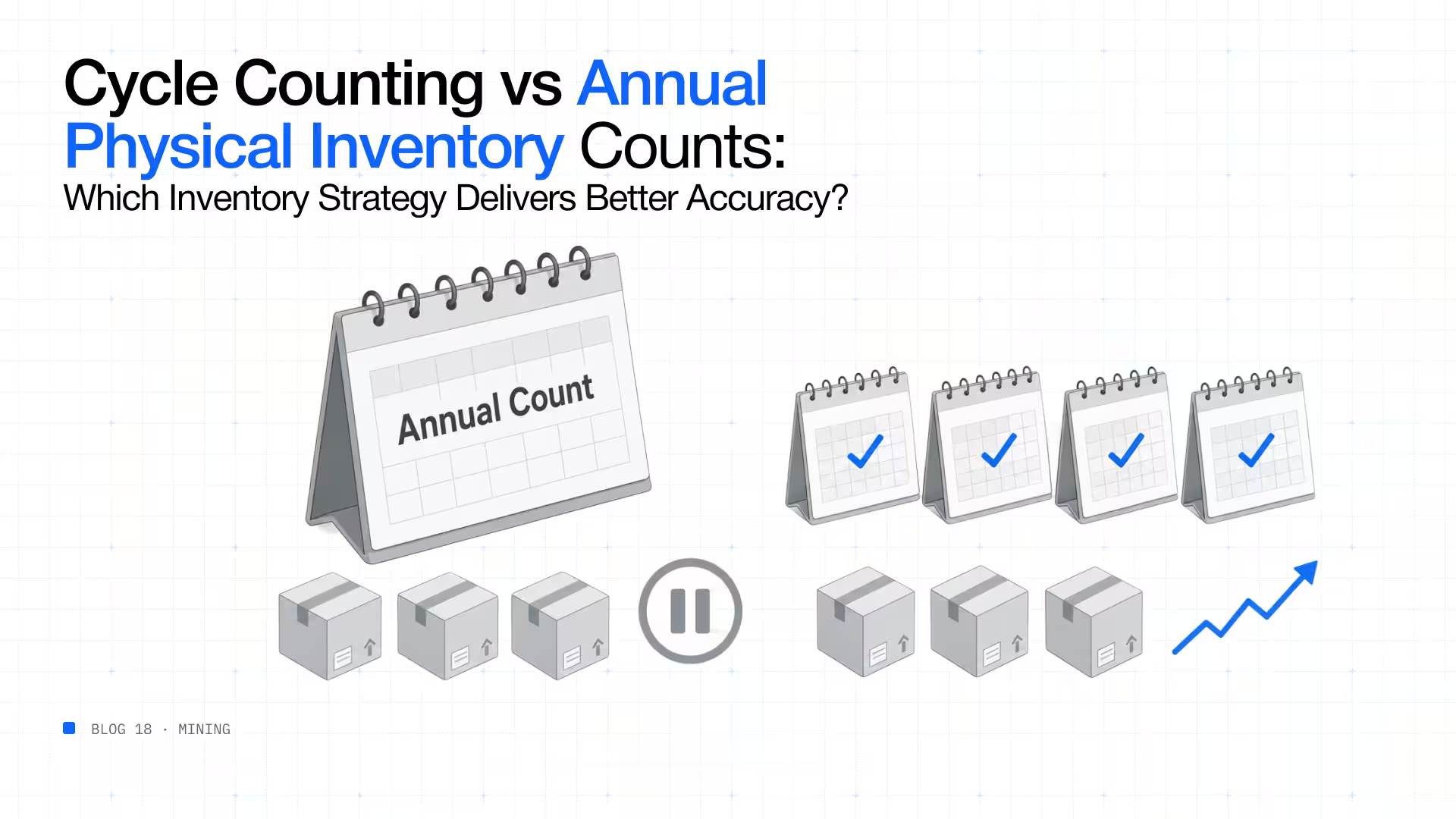
Inventory accuracy directly drives operational efficiency. When system records match physical stock, maintenance teams execute jobs without material delays, procurement teams avoid panic buying, and warehouse crews eliminate wasted search time. Achieving high inventory confidence requires a continuous validation strategy rather than periodic post-mortems.
For decades, industrial operations relied exclusively on annual physical inventory counts. Once or twice a year, facility operations halted so teams could manually count every line item, reconcile discrepancies, and post adjustments. While this satisfies tax and compliance audits, it identifies stock variance months after operational impact has already occurred.
Modern industrial operations increasingly adopt cycle counting. By shifting from periodic shutdowns to targeted, incremental counts, organizations catch discrepancies immediately, maintain continuous accuracy, and protect daily output.
Cycle counting is an inventory auditing strategy where staff count targeted subsets of inventory on a continuous, daily, or weekly schedule. Instead of attempting a full facility audit at once, high-priority, high-velocity, or high-value SKUs undergo ongoing physical verification.
This proactive process ensures data integrity across the entire operational year. Because variances are flagged near the time of occurrence, managers can trace root causes like picking errors, unrecorded scrap, or vendor short-shipments before systemic failures cascade.
Industrial organizations with high SKU density, rapid inventory turn, or critical MRO spare parts gain the highest return from cycle counting programs. The continuous feedback loop prevents stockouts of high-priority operational items.
Traditional annual physical counts remain necessary primarily for smaller operations with low inventory velocity, minimal SKU counts, or strict external regulatory requirements mandating a single comprehensive audit. Many enterprise facilities use a hybrid approach, using cycle counting for ongoing operational control while performing a streamlined year-end count for financial validation.
An annual physical inventory count is a comprehensive inventory audit where every inventory item is counted over a short period, typically once every financial year. During this process, warehouse operations are often paused or significantly slowed while employees verify physical stock against inventory records.
Annual inventory counts remain an important requirement for financial reporting, external audits, and regulatory compliance. They provide organizations with a complete snapshot of inventory at a specific point in time and help identify discrepancies that have accumulated throughout the year.
However, annual counts are reactive by nature. If an inventory discrepancy occurred six months earlier, the organization may only discover it during the annual count. By then, maintenance delays, duplicate purchases, emergency procurement, and operational inefficiencies may have already occurred.
For organizations operating in asset-intensive industries, relying solely on annual counts often leaves significant gaps in inventory visibility.
Both methods aim to improve inventory accuracy, but they differ significantly in how they support daily operations.
For organizations where inventory availability directly affects production, cycle counting inventory provides far greater operational value because inventory accuracy is maintained continuously rather than corrected periodically.
Industrial operations have changed significantly over the past decade. Inventory now moves faster, operations span multiple facilities, and maintenance activities occur around the clock. Waiting until the end of the year to verify inventory is increasingly difficult to justify.
Consider a mining operation where a critical bearing is issued for emergency maintenance but never recorded correctly. If the organization relies solely on an annual inventory count, that discrepancy may remain hidden for months. During that time, planners continue believing the bearing is available, procurement delays replenishment, and future maintenance activities face unnecessary delays.
The issue is not the annual inventory count itself. The issue is the length of time between inventory verification activities.
Cycle counting inventory reduces this delay dramatically, allowing organizations to identify discrepancies before they become operational problems.
Improving inventory accuracy starts with more frequent inventory validation. Discover how Scatterlink helps organizations simplify cycle counting with mobile technology, RFID, and real-time inventory visibility.
Organizations implementing cycle counting inventory often experience improvements that extend well beyond inventory accuracy. Because inventory is validated continuously, employees spend less time investigating discrepancies, while operational teams gain greater confidence in inventory information.
Some of the biggest benefits include:
These benefits make cycle counting inventory one of the most effective inventory management practices for industrial organizations that depend on accurate inventory information every day rather than once a year.
Implementing cycle counting inventory requires more than assigning employees to count inventory every week. The process should be structured, repeatable, and aligned with operational priorities so that inventory accuracy improves consistently over time.
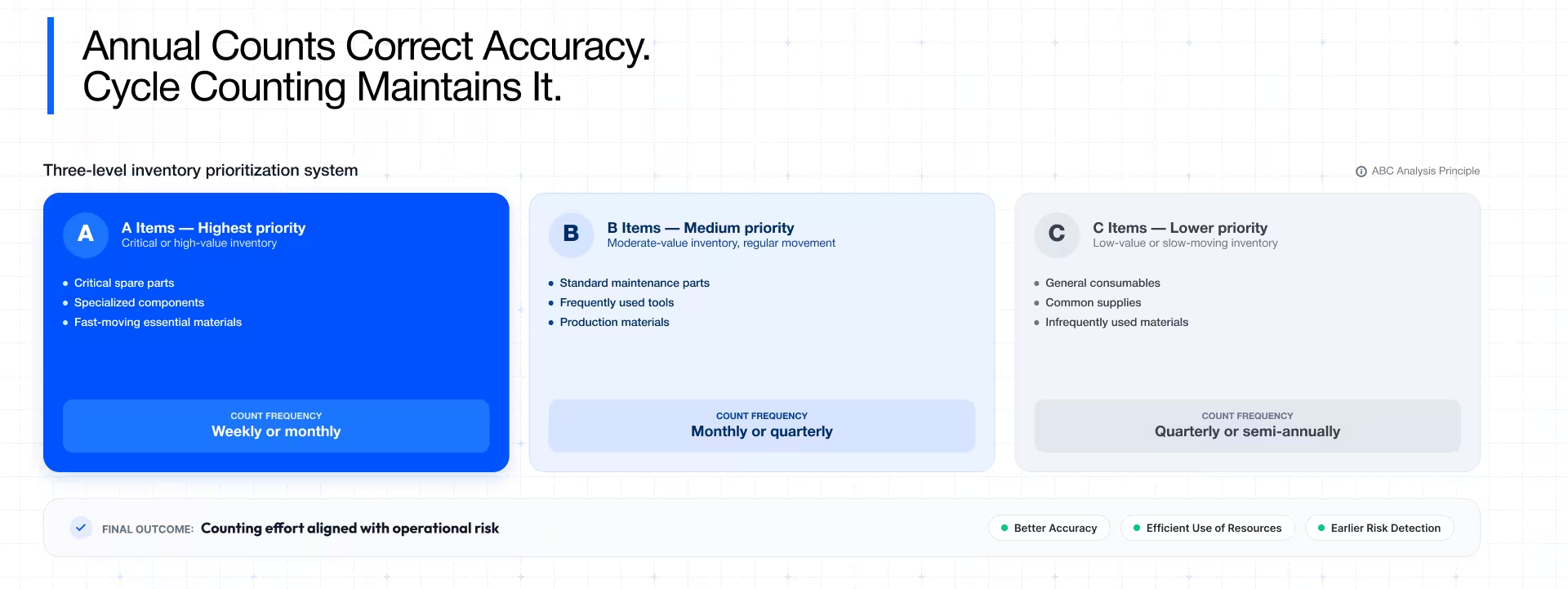
The first step is to classify inventory according to its importance. Not every inventory item needs to be counted with the same frequency. Critical spare parts, high-value equipment components, and fast-moving inventory should be counted more often than low-value or infrequently used materials.
A common approach is ABC classification:
This approach allows organizations to focus resources where inventory accuracy has the greatest operational impact.
Just as importantly, every discrepancy identified during cycle counting inventory should trigger an investigation. Simply adjusting inventory records addresses the symptom, not the cause. Organizations should determine whether discrepancies resulted from missed transactions, incorrect receiving procedures, inventory transfers, damaged materials, or process failures so they can prevent similar issues in the future.
Traditional cycle counting inventory often relies on printed count sheets, handwritten notes, and manual data entry. Besides being time-consuming, this approach increases the likelihood of transcription errors and delays inventory updates.
Mobile inventory technology transforms this process by allowing warehouse personnel and field teams to perform counts directly from handheld devices. Instead of recording inventory on paper, employees can scan RFID tags or barcodes, verify quantities, and submit inventory counts immediately.
This creates several operational advantages:
For organizations managing inventory across multiple warehouses, stockyards, maintenance workshops, or remote facilities, mobile-enabled cycle counting inventory significantly improves productivity while reducing counting errors.
Modern cycle counting doesn't require clipboards and spreadsheets. Learn how Scatterlink simplifies cycle counting with mobile inventory applications, RFID, barcode scanning, and real-time inventory visibility.
Although cycle counting inventory is one of the most effective methods for maintaining inventory accuracy, its success depends on consistent execution. Several common mistakes prevent organizations from realizing its full value.
One of the most frequent issues is treating cycle counting as an isolated warehouse activity rather than an organization-wide inventory management process. Inventory accuracy depends on every inventory movement being recorded correctly, not just periodic counting activities.
Another common mistake is counting inventory without investigating recurring discrepancies. If the same inventory items repeatedly require adjustments, organizations should focus on identifying the operational process causing the errors rather than simply correcting quantities.
Some organizations also attempt to count too much inventory too frequently. Effective cycle counting inventory prioritizes business-critical inventory rather than applying the same counting schedule to every item. This ensures counting resources are used efficiently while maintaining high inventory accuracy where it matters most.
Finally, relying entirely on manual counting methods limits the long-term effectiveness of cycle counting. Technologies such as RFID, barcode scanning, and mobile inventory applications reduce manual effort while improving both speed and accuracy.
Successful cycle counting inventory depends on timely, accurate, and easy-to-complete inventory transactions. Scatterlink's Inventory Intelligence Platform is designed to make this process part of everyday operations rather than an additional administrative task.
Using mobile applications, RFID technology, barcode scanning, and seamless ERP integration, Scatterlink enables employees to complete inventory counts directly from the warehouse floor, stockyard, maintenance workshop, or remote operational site. Inventory updates are captured immediately, reducing manual paperwork while improving inventory accuracy across the organization.
For organizations operating in environments where connectivity cannot always be guaranteed, Scatterlink's offline-first mobile capability allows cycle counts to continue without interruption. Inventory data synchronizes automatically once connectivity returns, ensuring inventory records remain accurate regardless of location.
Beyond counting inventory, Scatterlink provides real-time visibility into inventory movement, location, and usage. This allows warehouse teams, maintenance planners, procurement professionals, and operational leaders to work from the same accurate, intelligent, and actionable inventory information.
The result is a cycle counting inventory process that is faster, more accurate, and significantly easier to manage across multiple operational sites.
Looking to improve inventory accuracy without disrupting operations? Discover how Scatterlink helps industrial organizations modernize cycle counting inventory with mobile technology, RFID, and real-time inventory intelligence.
Maintaining accurate inventory records is no longer something organizations can achieve through a single annual inventory count. Industrial operations move too quickly, inventory changes too frequently, and operational decisions depend on information that reflects current conditions rather than historical records.
Cycle counting inventory provides a more effective approach by continuously validating inventory throughout the year. Instead of waiting months to identify discrepancies, organizations detect issues early, investigate root causes, and maintain confidence in inventory records every day. This not only improves inventory accuracy but also strengthens maintenance planning, procurement, warehouse operations, and overall operational performance.
When supported by mobile technology, RFID, barcode scanning, and real-time inventory visibility, cycle counting inventory becomes far more than a counting exercise. It becomes a continuous improvement process that helps organizations reduce inventory discrepancies, improve decision-making, and build greater operational resilience.
For asset-intensive industries where inventory availability directly affects productivity, adopting cycle counting inventory is one of the most practical steps toward achieving long-term inventory accuracy and operational efficiency.
Cycle counting inventory is an inventory management process where selected inventory items are counted regularly throughout the year instead of conducting one complete annual inventory count. This helps organizations maintain continuous inventory accuracy.
Cycle counting inventory verifies smaller groups of inventory on an ongoing schedule, while annual physical inventory counts verify all inventory at one time. Cycle counting improves day-to-day inventory accuracy, whereas annual counts primarily support financial reporting and compliance.
The main benefits of cycle counting inventory include improved inventory accuracy, reduced operational disruption, earlier identification of discrepancies, better maintenance planning, improved purchasing decisions, and reduced emergency procurement.
The frequency depends on inventory criticality. High-value and fast-moving inventory is often counted weekly or monthly, while lower-value inventory may only require quarterly or semi-annual counts.
Mining, oil and gas, manufacturing, utilities, construction, transportation, and other asset-intensive industries benefit significantly because accurate inventory records directly support maintenance, production, and operational efficiency.
RFID inventory management uses radio frequency identification (RFID) technology to automatically identify, locate, and track inventory throughout its lifecycle. Compared to manual inventory processes and barcode-only systems, RFID provides faster inventory counts, improved inventory accuracy, and real-time visibility across warehouses, stockyards, field locations, and industrial operations.
RFID asset tracking software helps organizations monitor inventory and equipment in real time by combining RFID tags, readers, mobile applications, and centralized inventory intelligence. It reduces manual data entry, shortens inventory search time, improves inventory accuracy, and provides complete visibility across multiple operational locations.
Mining operations manage inventory across warehouses, stockyards, sea cans, laydown yards, workshops, field locations, and underground environments. Purpose-built asset tracking software for mining, mining asset tracking platforms, and mining equipment tracking systems provide real-time visibility, offline mobile capability, and RFID-based tracking that traditional warehouse management systems are not designed to support.
%20(1).avif)
.avif)
%20(1).avif)