
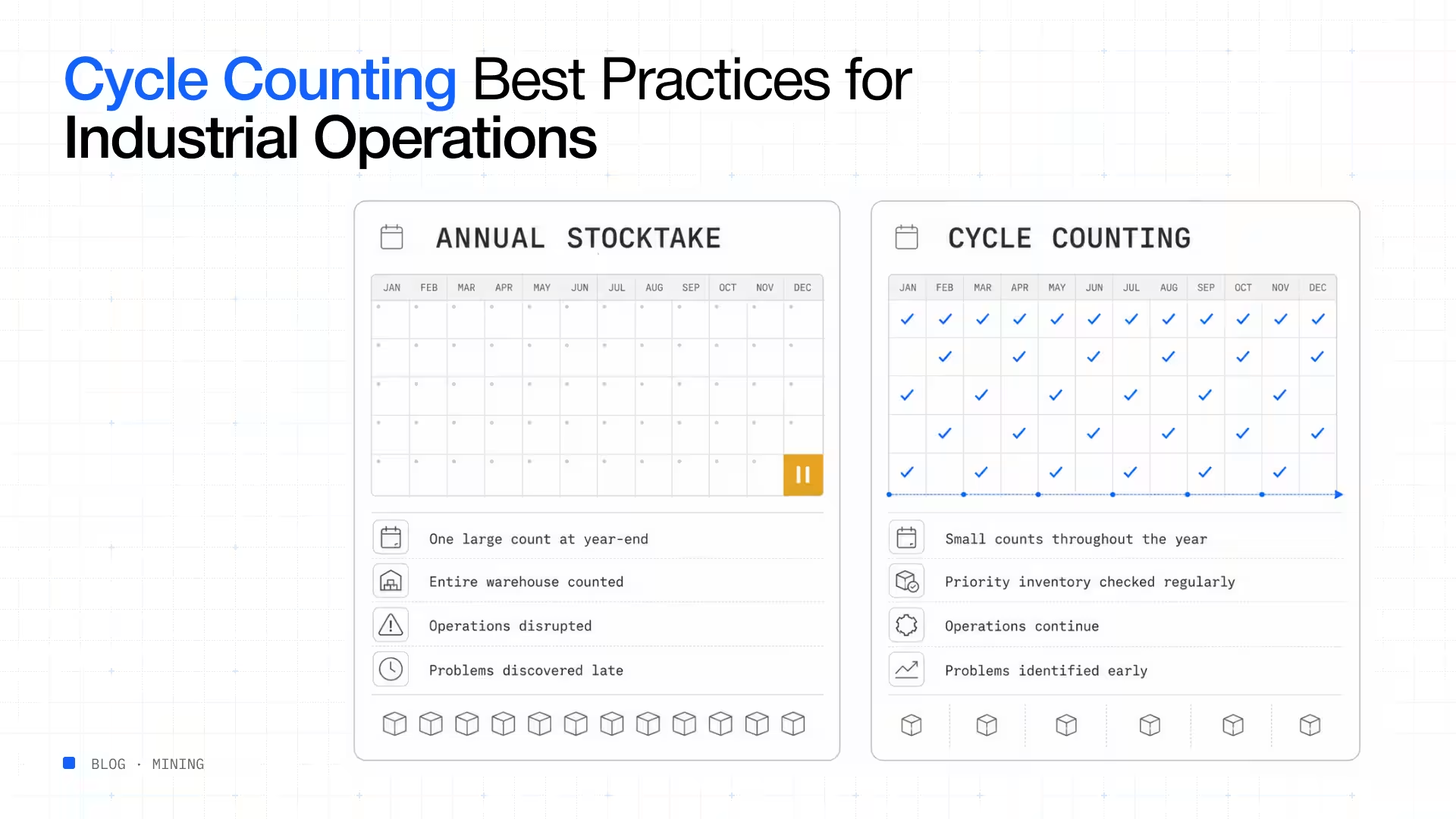
For decades, annual physical inventory counts have been the standard approach to verifying inventory accuracy. Warehouses shut down operations, maintenance teams wait for inventory to be counted, and hundreds of employees work overtime to reconcile inventory records with physical stock. While this process provides a snapshot of inventory accuracy, it does little to prevent inventory problems from occurring throughout the rest of the year. By the time discrepancies are discovered, the root causes have often existed for months. This is why more industrial organizations are adopting cycle counting as a continuous inventory management strategy rather than relying solely on annual stocktakes.
Cycle counting replaces one large inventory event with smaller, scheduled inventory counts performed throughout the year. Instead of counting every inventory item at once, organizations count selected inventory categories on a regular basis based on criticality, movement, or inventory value. This approach identifies inventory discrepancies earlier, reduces operational disruption, and creates continuous confidence in inventory records.
For mining and industrial operations where inventory supports critical maintenance activities, accurate inventory information is essential. Cycle counting helps ensure warehouse records remain reliable while allowing production and maintenance to continue without interruption.
Cycle counting is a structured inventory verification process where small groups of inventory items are counted regularly instead of performing one complete physical inventory each year.
Rather than shutting down warehouse operations to count every item simultaneously, organizations schedule recurring counts throughout the year. High-value or fast-moving inventory may be counted monthly, while slower-moving inventory is verified less frequently depending on operational requirements.
The objective is not simply to count inventory more often.
Cycle counting is designed to identify inventory discrepancies while they are still manageable. Because inventory is reviewed continuously, organizations can investigate the cause of discrepancies immediately instead of trying to reconstruct inventory movements that occurred several months earlier.
This makes cycle counting both an inventory verification process and a continuous improvement tool.
Warehouse teams identify process weaknesses, procurement gains greater confidence in inventory records, maintenance experiences fewer inventory-related delays, and leadership receives more reliable inventory reporting throughout the year.
Organizations that implement cycle counting effectively often achieve higher inventory accuracy while reducing the operational disruption associated with traditional annual stocktakes.
Annual physical inventory counts remain an important financial requirement for many organizations. However, relying on a single inventory count each year creates significant operational limitations.
Inventory moves continuously.
Spare parts are issued to maintenance teams, inventory is transferred between warehouses, emergency purchases arrive unexpectedly, shutdown materials are temporarily relocated, and contractors handle inventory throughout ongoing projects. Every day creates hundreds or thousands of inventory transactions.
Waiting until year-end to verify inventory means discrepancies continue affecting operations for months before anyone notices.
By the time an annual stocktake identifies missing inventory, duplicate records, or incorrect quantities, the individuals involved may no longer remember what occurred. Documentation may be incomplete, temporary storage areas may have changed, and inventory may have been transferred multiple times since the original error occurred.
This delay creates several challenges:
Annual stocktakes answer one question: How accurate is inventory today?
Cycle counting answers a far more valuable question:
What caused inventory accuracy to change, and how do we prevent it from happening again?
This shift from reactive verification to continuous improvement is what makes cycle counting increasingly valuable for industrial organizations.
Simply introducing cycle counting does not guarantee better inventory accuracy. Many organizations continue experiencing inventory discrepancies because they focus on counting inventory instead of improving the processes that create inventory accuracy. Effective cycle counting is less about the number of counts performed and more about how organizations respond to what those counts reveal.
One of the most effective practices is prioritizing inventory based on business criticality rather than counting every item equally.
Critical spare parts that can shut down production if unavailable should be counted far more frequently than low-value consumables or slow-moving inventory. Fast-moving inventory is also more susceptible to transaction errors because it is issued and replenished regularly. By concentrating counting efforts on these high-impact categories, organizations maximize the operational value of every inventory count.
Consistency is equally important.
Cycle counts should follow standardized procedures with clearly defined responsibilities. Warehouse personnel need documented processes for selecting inventory, performing physical counts, investigating discrepancies, and updating inventory records. This consistency ensures results remain reliable regardless of who performs the count.
Another best practice is investigating discrepancies immediately rather than simply correcting inventory quantities.
If a count reveals missing inventory, the objective should not be to update the ERP and move on. Organizations should determine why the discrepancy occurred. Was inventory transferred without being recorded? Was an item issued directly to maintenance? Was the wrong stock code selected during receiving? Understanding the cause prevents the same issue from recurring during future inventory counts.
Organizations that treat cycle counting as a continuous improvement process achieve significantly better long-term inventory accuracy than those using it only as an auditing exercise.
Traditional cycle counting often depends on printed inventory lists, manual counting sheets, and handwritten quantity adjustments. Although this approach is familiar, it introduces unnecessary delays and increases the risk of human error.
Modern inventory technologies significantly improve both the speed and accuracy of cycle counting.
Barcode scanning allows warehouse personnel to verify inventory quickly while reducing manual data entry. RFID technology goes even further by enabling multiple inventory items to be identified simultaneously without requiring direct line-of-sight scanning. Mobile inventory applications eliminate paper-based processes and update inventory records immediately after counts are completed.
The greatest advantage of digital inventory technologies is that they shorten the time between identifying discrepancies and correcting them.
Instead of spending days entering inventory adjustments after a cycle count, organizations update inventory records in real time. Supervisors can investigate discrepancies while inventory movements are still recent, making it easier to identify the underlying operational issue.
Technology also supports more frequent counting because the process requires fewer resources.
Rather than allocating large teams for periodic inventory reviews, organizations can perform smaller cycle counts continuously without disrupting normal warehouse operations. Inventory accuracy improves because verification becomes part of daily operations instead of an annual event.
Ultimately, technology does not replace cycle counting. It makes cycle counting practical at the scale required by modern industrial organizations.
Move beyond manual stock checks. Discover how Scatterlink combines RFID, mobile inventory applications, and Inventory Intelligence to simplify cycle counting and improve inventory accuracy across every operational location.
Scatterlink's Inventory Intelligence Platform helps organizations transform cycle counting from a reactive inventory exercise into a continuous inventory management process. Rather than relying solely on periodic physical verification, Scatterlink continuously captures inventory movement throughout the inventory lifecycle, reducing the number of discrepancies that cycle counts uncover.
Using RFID technology, barcode scanning, offline mobile inventory applications, IoT devices, GPS-enabled location tracking, and seamless ERP integration, Scatterlink ensures inventory transactions are recorded as they happen. This creates more reliable inventory records while making cycle counts faster and easier to perform.
Warehouse teams can verify inventory across warehouses, workshops, laydown yards, sea cans, contractor facilities, and both surface and underground operations without interrupting daily activities. Maintenance planners gain greater confidence in inventory availability, procurement reduces duplicate purchasing, and finance benefits from consistently accurate inventory reporting.
Instead of discovering inventory problems once a year, organizations gain continuous inventory intelligence that supports better operational decisions every day.
Cycle counting has become one of the most effective strategies for maintaining inventory accuracy in industrial operations. Unlike annual physical inventory counts, which provide only a single snapshot each year, cycle counting creates continuous visibility into inventory performance while allowing organizations to identify discrepancies before they become larger operational problems.
When supported by standardized inventory processes, clean inventory data, and modern inventory technologies, cycle counting delivers benefits far beyond inventory verification. Procurement gains confidence in inventory records, maintenance experiences fewer stock-related delays, warehouse teams improve operational efficiency, and leadership receives more reliable inventory information for strategic decision-making.
For mining and other asset-intensive industries, inventory accuracy is not achieved by counting more inventory. It is achieved by creating processes that keep inventory accurate every day of the year.
Cycle counting is a continuous inventory verification process where selected inventory items are counted regularly throughout the year instead of performing one large annual physical inventory count.
The frequency depends on inventory criticality and movement. High-value, fast-moving, or operationally critical inventory is typically counted more frequently than slower-moving or lower-value items.
Cycle counting identifies inventory discrepancies earlier, reduces operational disruption, improves inventory accuracy throughout the year, and helps organizations identify the root causes of inventory errors instead of discovering them months later.
%20(1).avif)
.avif)
%20(1).avif)