

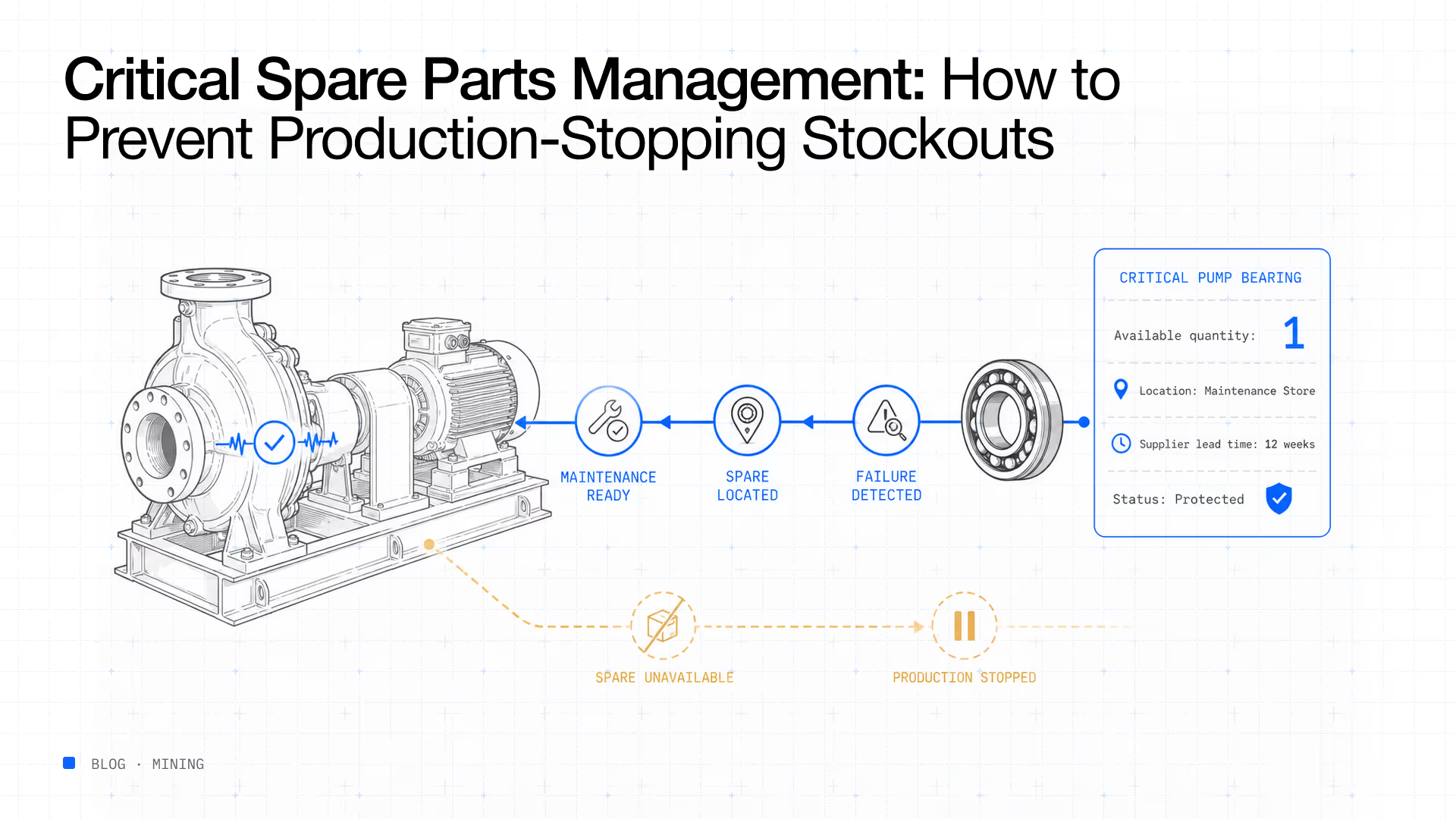
A production line can stop because of a part that costs a fraction of the equipment it supports. A failed pump, bearing, motor component, valve or specialised replacement part may be relatively inexpensive, but if the right spare is unavailable when it is needed, the operational impact can be significant. For mining and other asset-intensive industries, critical spare parts management is therefore not simply an inventory control exercise. It is a direct part of maintaining operational continuity.
The challenge is that critical spare parts do not always behave like conventional inventory. Some parts may be consumed frequently and require constant replenishment, while others may sit unused for months or years but remain essential because their failure could stop production. Managing these items effectively requires organisations to look beyond consumption rates and consider equipment criticality, supplier lead times, failure risk, inventory accuracy and the actual availability of stock across locations.
Critical spare parts management is the process of identifying, stocking, monitoring and replenishing spare parts that are essential to maintaining equipment and operational continuity. It involves determining which components require protection against stockouts and establishing appropriate inventory levels based on operational risk. The objective is to ensure that the right spare part is available at the right location when maintenance or production requires it.
Unlike general inventory management, critical spare parts management focuses heavily on the consequences of non-availability. A component that is rarely used may still require a high level of inventory control if obtaining a replacement takes several weeks and its absence could stop a critical process. This makes criticality, lead time and operational impact just as important as historical demand.
Critical spare parts protect operations against equipment failure and unexpected maintenance requirements. When a critical component fails, maintenance teams need to identify and access the replacement quickly, particularly when the equipment supports a production-critical process. If the spare cannot be found or is not available, the organisation may face extended downtime while waiting for procurement and delivery.
The cost of the stockout can also extend beyond lost production. Equipment downtime can create additional labour requirements, emergency freight costs, maintenance delays, production scheduling disruptions and pressure on other operational resources. For this reason, the value of a critical spare part should be considered in relation to the operational consequence of not having it, rather than only its purchase price.
A spare part is generally considered critical when its unavailability can have a significant operational, financial, safety or maintenance impact. However, criticality is not determined by one factor alone. Organisations should assess how important the associated equipment is, how likely the component is to fail, how quickly it can be replaced and whether another suitable part is available.
Key factors in spare parts criticality analysis include:
A low-use component with a long supplier lead time may therefore be more critical than a frequently consumed item that can be replenished quickly. The right inventory strategy should reflect this difference.
One of the most common causes of spare parts stockouts is the gap between inventory records and physical stock. A system may show that several units are available, but maintenance teams may be unable to locate them when required. The inventory technically exists in the system, but it is not operationally available.
This can happen because of unrecorded issues, delayed transactions, incorrect quantities, misplaced items or stock movements that were never captured. When inventory records cannot be trusted, teams may discover a stockout only when a critical part is urgently required. Maintaining high inventory accuracy is therefore essential to critical spare parts management.
Critical spares are often distributed across warehouses, workshops, stores and operational sites. A component that is unavailable at one location may already exist at another, but without a reliable multi-location inventory view, maintenance teams may not know that the part can be accessed or transferred.
This can create two problems at the same time. One location experiences a stockout and raises an urgent purchase, while another location continues to hold unused inventory. The organisation therefore carries the stock but cannot use it effectively when demand occurs.
Critical spare parts are sometimes managed using standard minimum and maximum inventory rules that do not reflect their operational importance. A part may have low historical consumption, causing the system to recommend a low stock level even though a single failure could create significant downtime.
Historical demand alone is not enough to determine the appropriate quantity for critical spares. Inventory levels should also consider lead time, failure risk, equipment criticality and the consequences of non-availability.
Some industrial spare parts cannot be replenished quickly. Specialised components, imported parts and manufacturer-specific items may have long or variable lead times, meaning that an organisation cannot simply wait until the stock reaches zero before placing a replenishment order.
When lead times are long, replenishment decisions need to anticipate future requirements. If procurement begins only after a critical spare has been consumed, the replacement may arrive long after the equipment needs to return to operation.
Critical spare parts are often required because something unexpected has happened. A component fails earlier than expected, operating conditions change or a piece of equipment experiences an unplanned breakdown. This creates demand that may not be reflected in historical consumption data.
A spare parts strategy must therefore account for uncertainty. The goal is not to predict every failure accurately, but to identify which failures have consequences serious enough to justify additional inventory protection.
The first step is to establish a clear spare parts criticality framework. Instead of managing every part in the same way, organisations can classify inventory according to the operational consequences of non-availability. This allows inventory teams to apply stronger controls and monitoring to parts that present the greatest production risk.
A practical classification might separate parts into critical, essential and non-critical categories, although the exact framework should reflect the organisation's equipment, processes and risk profile. Critical parts can then receive more frequent monitoring, tighter replenishment controls and stronger inventory accuracy requirements.
Once critical spare parts have been identified, their criticality should influence how inventory levels are established. Replenishment rules should consider equipment dependency, supplier lead time, failure probability and the consequences of a stockout. This creates a more risk-based approach to spare parts inventory management.
For example, a critical pump component with a 12-week lead time may require greater protection than a frequently consumed consumable that can be sourced locally within a day. Treating both items according to the same minimum stock formula can result in either unnecessary inventory or unacceptable stockout risk.
Having the right quantity of a critical spare is only useful if the organisation can locate and access it. Inventory teams should be able to identify the physical location of critical components across warehouses, workshops, surface operations and underground locations. They should also be able to distinguish between available stock, reserved stock and stock already allocated to another requirement.
This is where real-time inventory visibility becomes particularly valuable. Explore Scatterlink's RFID inventory management solution to improve visibility into inventory movements and availability from receipt through to consumption.
Inventory accuracy is one of the most important controls in critical spare parts management because maintenance decisions depend on the information available at the point of need. If the inventory system reports five units but only two can be physically located, the organisation may believe it is protected when it is actually exposed to a stockout. The problem may remain hidden until the component is urgently required.
Improving accuracy requires more than periodic stock counts. Receiving, issuing, transferring and consuming inventory should be captured consistently so that the inventory record reflects operational reality. For critical spare parts, the closer inventory information is to real time, the more confidently maintenance, procurement and inventory teams can make decisions.
For mining operations, critical spare parts management becomes more complex when inventory is distributed across surface and underground environments. Physical access, transportation time, operating conditions and location-specific stock requirements can make it difficult to determine whether a spare is genuinely available to the team that needs it. A part may exist somewhere within the operation but still be operationally inaccessible within the required timeframe.
This makes location visibility an important part of spare parts availability. Teams need to know not only how much inventory exists, but where it is, how it is moving and whether it can reach the point of consumption when required. A connected inventory management approach can help organisations move from simply knowing that a spare exists to understanding whether that spare is actually available for the operation.
There is no universal stock level that works for every critical spare part. The right quantity depends on factors such as equipment criticality, demand variability, supplier lead time, failure probability, replacement availability and the operational consequences of a stockout. An effective critical spare parts strategy therefore balances the cost of holding inventory against the much greater cost of being unable to restore equipment when a critical component fails.
For some parts, holding a single replacement may provide sufficient protection if the supplier can replenish it quickly. For other components, particularly those with long lead times or limited supplier availability, additional stock may be justified even when historical consumption is very low. The important point is that inventory levels should be based on operational risk rather than simply applying the same minimum quantity to every spare.
Safety stock can provide an additional buffer when demand or replenishment lead times are unpredictable. For critical spare parts, this buffer can be particularly important because demand is often driven by unexpected equipment failure rather than predictable consumption. The amount of safety stock required should therefore reflect the consequences of the part becoming unavailable as well as the variability surrounding demand and supply.
However, maintaining more safety stock is not automatically the answer. Excessive safety stock can tie up capital, consume valuable storage capacity and increase the risk of inventory becoming obsolete. The objective should be to establish a risk-based safety stock level that provides appropriate protection without unnecessarily increasing the overall spare parts inventory holding.
Historical consumption remains useful for understanding how inventory behaves, but it should not be the only source of information used to manage critical spares. Changes in equipment age, maintenance schedules, operating conditions and failure frequency can alter future requirements. A part that historically moved once every two years may suddenly become a high-demand item if a particular equipment model begins experiencing repeated failures.
Monitoring consumption and maintenance trends allows inventory teams to identify these changes earlier. When a critical component begins moving more frequently, replenishment settings can be reviewed before inventory reaches a level that exposes the operation to a stockout. This connects spare parts inventory management with maintenance and operational data rather than treating inventory as a separate function.
Knowing that a spare was received is not enough. Organisations also need visibility into where it was stored, whether it was transferred, when it was issued and whether it was ultimately consumed. Without this end-to-end transaction history, inventory teams can lose confidence in the status of critical components.
Tracking inventory from receipt to consumption creates a clearer chain of accountability around each movement. It also helps organisations identify where inventory visibility breaks down, whether during receiving, storage, transfer, issue or final consumption. See how Scatterlink provides inventory visibility from receipt to consumption.
Critical spare parts should have clearly defined replenishment triggers that reflect their importance and supply risk. These triggers may incorporate minimum stock levels, lead time, current demand, open purchase orders and the criticality of the equipment supported. A replenishment decision should occur before the organisation reaches a point where a new order cannot arrive in time to protect operations.
Replenishment rules should also be reviewed periodically rather than treated as permanent settings. Changes in production requirements, equipment reliability, supplier performance or maintenance strategies can alter the level of inventory protection required. Regular review ensures that critical spare parts inventory remains aligned with actual operational risk.
Emergency purchasing is often a symptom of a deeper inventory management problem. When a critical spare cannot be located or the available quantity cannot be trusted, procurement teams may be forced to place urgent orders, arrange expedited freight or source parts from unfamiliar suppliers. These decisions can significantly increase the cost of maintaining equipment.
Better inventory visibility gives teams another option. If a suitable component exists elsewhere in the organisation, it may be possible to transfer the part before committing to an emergency purchase. This is particularly valuable for organisations with multiple operational locations where inventory can become distributed across warehouses, workshops and sites.
Traditional inventory management often focuses on recording quantities and transactions. Critical spare parts management requires a broader understanding of what those inventory records mean operationally. Teams need to know which parts are critical, where they are located, how quickly they are being consumed, whether they are available and when replenishment is likely to become necessary.
An inventory intelligence approach brings these signals together to support faster operational decisions. Scatterlink combines inventory data, RFID and mobile capabilities to provide greater visibility into inventory movements and availability across complex operating environments. Learn more about Scatterlink's inventory intelligence platform.
A Practical Critical Spare Parts Management Process
A structured process can help organisations move from reactive spare parts purchasing to proactive inventory control. The first step is to identify the parts that have the greatest operational consequences if unavailable. From there, inventory teams can establish appropriate stock levels, monitor availability and connect replenishment decisions with equipment and maintenance requirements.
A practical process can include:
Determine which equipment and spare parts have the greatest impact on production, safety or operational continuity.
Consider failure impact, demand, lead time, supplier availability and the availability of alternatives.
Set minimum, maximum and safety stock levels based on operational risk rather than consumption alone.
Regularly confirm that system quantities match the inventory physically available at each location.
Maintain visibility into critical spares held across warehouses, workshops, surface and underground operations.
Monitor inventory movements and identify changes in demand before they create a stockout risk.
Adjust inventory parameters when lead times, equipment reliability, production requirements or consumption patterns change.
Check whether suitable inventory is available elsewhere before placing an urgent external order.
This approach makes critical spare parts management a continuous operational process rather than an activity that only receives attention after a stockout occurs.
Critical spare parts management is ultimately about protecting operational continuity without creating unnecessary inventory. The right strategy does not simply ask how often a part is consumed. It asks what happens if the part is unavailable, how quickly it can be replaced, where existing stock is located and whether the organisation can confidently access it when required.
A strong approach combines spare parts criticality analysis, accurate inventory records, risk-based stock levels, safety stock, replenishment controls and real-time visibility across locations. For mining and industrial operations, this becomes particularly important when inventory is distributed across warehouses, workshops, surface and underground environments.
The goal is not to hold every possible spare in large quantities. It is to ensure that the parts capable of stopping production are visible, accurately tracked and available when the operation needs them. Explore Scatterlink's approach to real-time inventory management to see how connected inventory visibility can support better spare parts control.
Critical spare parts management is the process of identifying, stocking, monitoring and replenishing spare parts that are essential to maintaining equipment and operational continuity. It focuses on ensuring that high-risk components are available when required while avoiding unnecessary inventory accumulation.
Preventing stockouts requires accurate inventory records, appropriate stock levels, reliable replenishment rules, visibility across locations and an understanding of supplier lead times. Organisations should also classify spare parts according to operational criticality so that the highest-risk components receive appropriate inventory protection.
Critical spare inventory levels can depend on equipment criticality, demand variability, supplier lead time, failure probability, replacement availability, safety stock requirements and the consequences of non-availability. Historical consumption should be considered, but it should not be the only factor.
Inventory accuracy ensures that maintenance and procurement teams can trust the quantities and locations shown in the inventory system. If system records do not reflect physical inventory, an organisation can appear to have critical spare parts available when those parts cannot actually be located or used.
Safety stock can be appropriate for critical spare parts where demand or supplier lead times are uncertain. The required level should reflect the operational consequences of a stockout and the variability of demand and supply rather than simply increasing inventory across the board.
RFID can help organisations capture the identification and movement of tagged inventory with less dependence on manual data entry. When incorporated into an inventory management process, RFID can improve visibility into where critical spare parts are located and how they move through the operation.
%20(1).avif)
.avif)
%20(1).avif)