
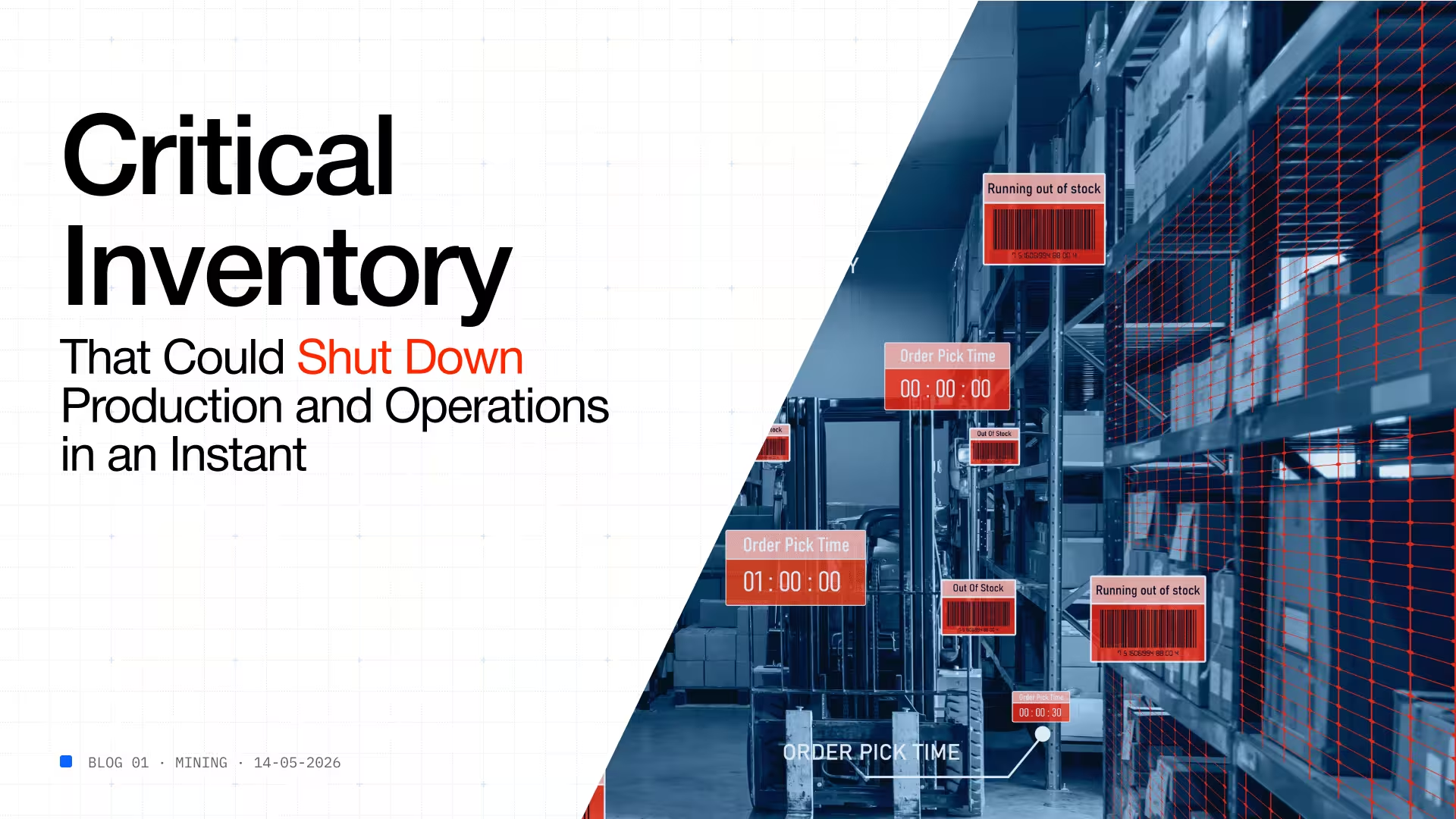
A single missing inventory item can stop production, delay maintenance, and disrupt operations within minutes. Not because it is expensive, but because it is essential.
Every industrial operation relies on a small group of critical inventory items to keep equipment running and work moving forward. When one of those items is unavailable, teams are forced into reactive mode, searching storage locations, reviewing inventory records, and scrambling to source replacements while downtime continues to accumulate.
The challenge is that many organizations don't discover they have a critical inventory problem until the moment they need the item most. By then, the cost is no longer the part itself. It's the operational disruption that follows.
Do you know which inventory items could immediately impact production or maintenance activities if they became unavailable?
Many organizations can identify their highest-value inventory. Far fewer can confidently identify their highest-risk inventory.
Critical inventory refers to the minimum stock level of essential spare parts, raw materials, and machinery required to maintain daily operations and prevent costly shutdowns. Managing it effectively relies on core operational metrics like safety stock, lead time, and inventory turnover.
Not all inventory impacts your bottom line in the same way. Treating a high-value, fast-depreciating item the same as a low-cost staple is one of the quickest ways to lock up working capital or trigger costly stockouts. Effective inventory risk management starts with proper stock categorization.
By grouping items based on demand volatility, shelf life, and financial impact, businesses can apply targeted control strategies to mitigate risk across three core categories:
To systematically control these risk levels, implement an ABC Inventory Analysis:
Take control of your high-risk stock. Eliminate manual spreadsheets and automate your stock categorization with Scatterlink’s inventory risk management tools.
The true cost of missing critical inventory is rarely reflected in the inventory value itself. Instead, the cost appears throughout the operation. Maintenance teams may be unable to complete repairs. Production schedules may be interrupted. Equipment may remain offline while replacement inventory is sourced. Procurement teams may be forced to place urgent orders. Additional labor may be required to investigate discrepancies or search multiple storage locations.
Over time, these disruptions create significant operational and financial consequences. What makes this issue particularly challenging is that organizations often discover the problem only when the inventory is needed. Inventory records may indicate that an item is available. The part may technically exist somewhere within the organization. Yet if employees cannot locate it quickly, the operational outcome is often the same as a stockout.
The inventory exists. The visibility does not.
If a maintenance technician needed a critical component right now, could they locate it in minutes rather than hours? Inventory visibility becomes most important when operations cannot afford delays.

Managing critical inventory is uniquely complex because these high-stakes items often move infrequently, span multiple facilities, and are reserved for emergency maintenance or scheduled shutdowns. Unlike standard stock driven by predictable customer demand, critical spare parts and operational supplies are difficult to track; leading to misplaced items, phantom inventory, and unplanned downtime.
As organizations expand across multiple warehouses, stockyards, and remote maintenance facilities, three main operational breakdown points typically emerge:
Stock transfers between facilities, temporary storage during major projects, and urgent off-hours call-outs frequently happen without real-time inventory updates. Over time, untracked relocations cause audit discrepancies to accumulate.
When digital systems fall behind, teams default to manual workarounds: spreadsheets, emails, direct phone calls, and relying on team members' memories to locate critical parts. While this tribal knowledge keeps work moving short term, it creates severe single-point-of-failure risks when employees leave or shift teams.
Traditional inventory tools rely on ABC analysis (ranking by sales volume or unit cost). However, critical spares often fall into low-volume, low-cost brackets while carrying massive downtime costs if missing; requiring dedicated VED (Vital, Essential, Desirable) analysis to maintain true operational readiness.
Stop letting invisible stock hold back your operations. Explore how Scatterlink brings complete data accuracy and real-time control to complex, multi-site supply chains.
To eliminate single-point-of-failure risks and eliminate reliance on institutional knowledge, organizations must transition from reactive searches to proactive, system-driven inventory control. Managing critical inventory across warehouses, remote stockyards, and job sites requires a blend of centralized technology and standardized field processes.
Here are five proven best practices for maintaining 100% visibility over multi-location critical inventory:
Traditional ABC analysis ranks items by monetary value or transaction volume; often misclassifying low-cost, low-turnover critical spare parts as low priority. Implement VED (Vital, Essential, Desirable) analysis to categorize stock based on functional criticality:
Untracked inter-site transfers are a primary cause of inventory drift. Require digital sign-offs for every stock transfer, temporary staging area move, or technician check-out. Using mobile handheld scanners or mobile asset management apps ensures that item locations update in real time; not hours or days after the move occurs.
Spreadsheets and site-specific silos obscure total inventory levels. Deploy a centralized Computerized Maintenance Management System (CMMS) or enterprise Inventory Management System (IMS) that aggregates data across all facilities. This allows one site experiencing an emergency part shortage to instantly locate and request surplus stock from a nearby sister facility before placing an expedited purchase order.
Digital accuracy depends on physical discipline. Standardize naming conventions for aisle, shelf, bin, and yard locations across every facility in your network. When a field technician enters a remote stockyard at 2:00 AM, standardized visual cues and barcode labels ensure they locate the exact critical component without relying on memory or phone calls.
Instead of relying solely on disruptive annual physical audits, conduct continuous cycle counting prioritized by criticality. Count "Vital" items monthly or quarterly, ensuring high-risk parts are verified frequently while reducing manual labor spent auditing low-risk consumables.
Many organizations continue to rely on periodic inventory counts, spreadsheets, and manual processes to manage critical inventory. While these approaches provide useful information, they often answer the wrong question.
Inventory counts tell organizations how much inventory they have, and operational teams need to know where inventory is right now. When a critical component is needed urgently, historical inventory reports offer limited value if location information is inaccurate or outdated. This is where many organizations encounter a visibility gap.
Inventory may be recorded correctly from a financial perspective while remaining difficult to locate operationally. The challenge is not simply tracking quantities, it is maintaining visibility into inventory locations, movements, and availability throughout the organization.
Critical inventory should never become a hunt- let’s see how to solve your problem!
Organizations that maintain accurate inventory locations and movement records are better positioned to respond when operational needs arise unexpectedly.

Leading industrial organizations reduce critical inventory risk by implementing automated critical spare parts management systems. By moving away from static spreadsheets and adopting real-time RFID tracking, predictive reorder thresholds, and digital laydown yard mapping, operations teams eliminate unplanned downtime, optimize safety stock levels, and ensure essential machinery spares are accessible instantly.
Proactive supply chain and reliability teams mitigate inventory risks by replacing manual tracking with digital asset intelligence. Enterprise leaders execute this transition across four key pillars:
Relying on human memory or periodic manual audits leads to unexpected stockouts. Modern critical spare parts management leverages automated inventory software to track usage rates, calculate lead times, and automatically trigger reorder alerts before high-wear components drop below minimum safety thresholds.
Misplacing essential machinery components in large, outdoor laydown yards creates costly production delays. Industry leaders apply ruggedized, weather-resistant RFID tags to outdoor spares, allowing technicians to locate critical equipment within seconds using handheld mobile scanners, even when tags are obscured by mud, frost, or snow.
Unrecorded material transfers across job sites create "phantom stockouts"; where enterprise ERP records show a part is available, but field teams cannot find it. Streamlining critical spare parts management ensures every stock issue, transfer, and consumption event is captured live on mobile devices, keeping central databases 100% accurate.
Remote mining and industrial sites frequently experience cellular network drops. Advanced critical spare parts management platforms feature native offline sync capabilities, enabling field crews to update inventory records in zero-connectivity zones without creating data gaps or unrecorded stock transfers.
Ready to bridge the gap across your remote sites and warehouses? See how Scatterlink's multi-location tracking solution digitizes chain-of-custody and prevents costly downtime.
The inventory items most capable of disrupting operations are not always the ones with the highest price tags. More often, they are the components that quietly support maintenance activities, production processes, and day-to-day operations. When these items cannot be found, the consequences are immediate. Work slows. Maintenance is delayed. Production schedules are affected. Organizations that understand the difference between inventory value and inventory criticality are better equipped to reduce operational risk and improve resilience. Because when critical inventory is needed, there is rarely time to start searching for it.
Want greater visibility into the inventory that matters most?
Discover how organizations improve inventory tracking, maintain accurate location information, and reduce the risk of production and maintenance disruptions through better inventory visibility.
Critical inventory refers to items that are essential for maintaining production, maintenance activities, operational continuity, or safety requirements. Their absence can create significant disruptions regardless of their purchase cost.
Critical inventory helps ensure equipment remains operational, maintenance activities can be completed on schedule, and production processes continue without interruption.
No. Many critical inventory items are relatively inexpensive. Their importance comes from their operational impact rather than their monetary value.
Organizations may experience downtime, delayed maintenance, emergency procurement costs, productivity losses, and operational disruptions.
Improving inventory location accuracy, tracking inventory movements consistently, and maintaining visibility across all storage locations can help reduce risk and improve responsiveness.
%20(1).avif)
.avif)
%20(1).avif)