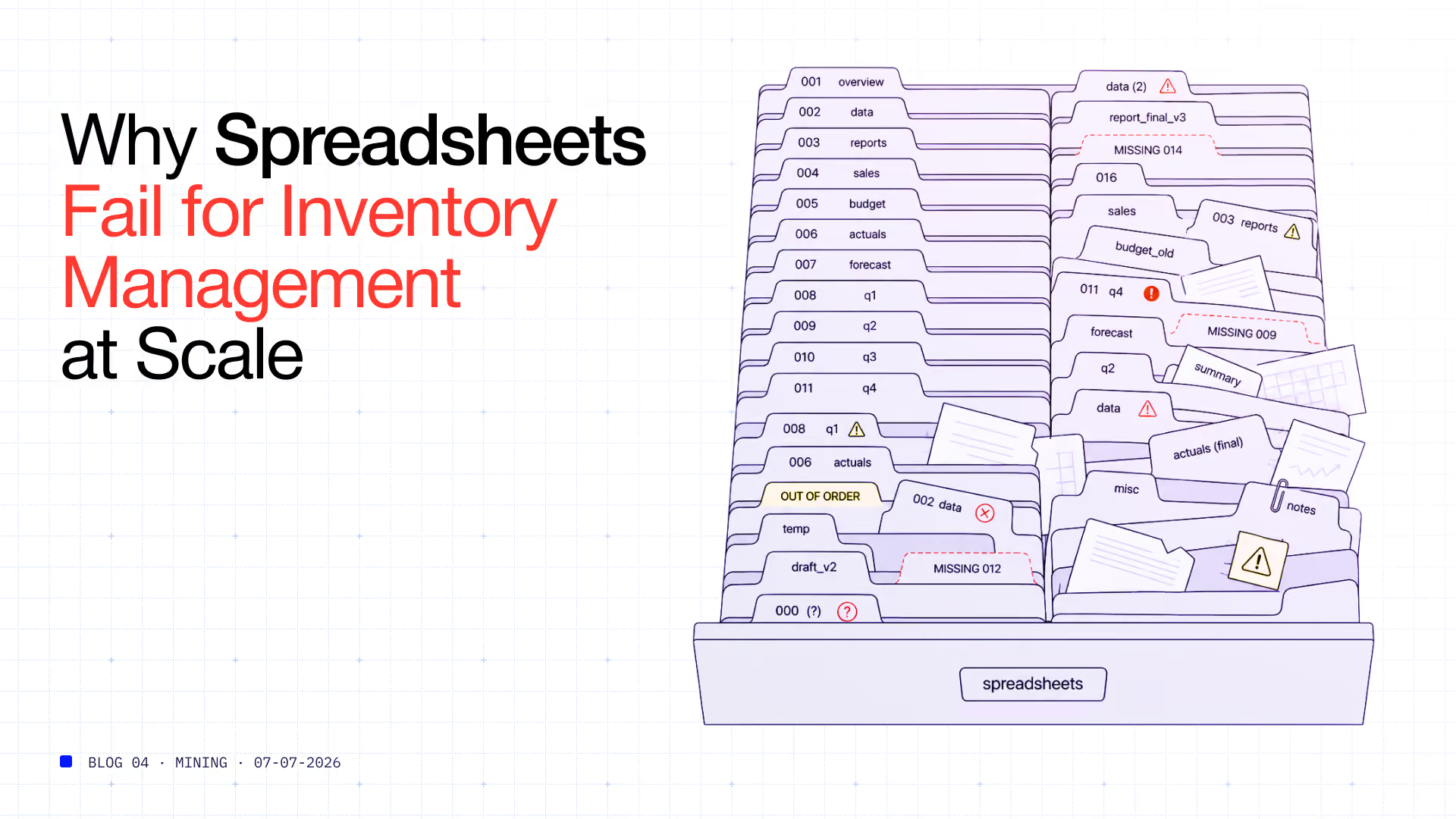


Every year, mining operations globally, order materials they already have. They run short on supplies that their records say are fully stocked. They pay for emergency procurement because a stockyard count that was done twelve months ago no longer reflects what is actually on the ground.
This is the phantom inventory problem. It is quiet, it is expensive, and for most operations relying on manual processes, it is completely invisible until something goes wrong.
Phantom inventory is stock that exists in your system but not in your stockyard. Your records say you have 200 units of a material. Your team goes to pull it and finds 60. The gap between those two numbers is phantom inventory, and it is costing your operation more than most managers realize.
It goes by a few names depending on who you ask: ghost stock, paper inventory, unverified materials. The problem is always the same. Your inventory data has drifted away from physical reality, and every decision made from that data is built on a shaky foundation.
This is not a problem that happens because of one bad process. It accumulates through dozens of small, ordinary failures that are almost impossible to catch without the right system in place.
A field worker pulls materials from a stockyard bin and does not log the transaction because the logging process is slow or the connectivity is poor. A delivery comes in and gets sorted into the wrong location, so the system counts it in one place while it physically sits in another. A batch of materials gets damaged and set aside, but the status is never updated. A contractor uses stock from your yard and nobody reconciles it afterward.
None of these things are unusual. They happen every day on large mining sites, and each one creates a small discrepancy between your records and reality. Over weeks and months, those small discrepancies compound into a gap that meaningfully distorts every operational and procurement decision that flows from your inventory data.
In industries with high material throughput, such as mining and other asset-intensive sectors, inventory discrepancies are a common operational challenge. Phantom inventory rates of 15 to 25 percent are not unusual, and some organizations discover even larger gaps when conducting their first comprehensive physical count.
The financial consequences of phantom inventory tend to show up in a few predictable places.
Emergency procurement
When your system says stock is available but the physical count says otherwise, the gap gets filled with urgent orders at premium prices. Rush procurement is almost always more expensive than planned procurement, and it creates unpredictable cash flow in operations that need cost predictability.
Overstocking and carrying costs
The flip side is equally damaging. When teams do not trust inventory records, they order buffer stock to protect themselves from surprises. You end up holding excess materials that tie up working capital, take up physical space, and in some cases expire or degrade before they are used.

Unplanned downtime
In a mining environment, inventory shortages do not just create procurement headaches. They stop work. A missing component or consumable can idle a crew for hours while someone figures out whether the item is actually missing or just miscounted somewhere in the yard.
Procurement decisions made on bad data
Operations and procurement managers making purchasing decisions based on inaccurate stock counts are, in effect, flying blind. The decision might be right by luck, but it is not right by design. Over time, that gap between data and reality drives up costs in ways that are hard to trace back to a single root cause.
Audit and compliance exposure
Mining companies operating worldwide, particularly those with reporting obligations to provincial regulators in Alberta, British Columbia, and Saskatchewan, are expected to maintain accurate inventory records. Significant discrepancies between reported and physical stock can create compliance risk and complicate both internal and external audits.

The damage from phantom inventory is not only financial. The operational consequences ripple through the entire site.
When field teams know that the inventory system cannot be trusted, they stop using it as a source of truth. They develop workarounds. Personal spreadsheets. Informal check-in processes. Verbal confirmations. These shadow systems are inefficient, inconsistent, and impossible to audit.
Management loses visibility into what is actually happening in the stockyard. Decisions that should be data-driven get made on instinct. Additionally, the longer the problem runs, the harder it becomes to close the gap between the system and reality, because no one is quite sure where the discrepancies started or how deep they go.
There is also a safety dimension that often gets overlooked. When materials used in safety-critical processes are miscounted or mislocated, the risk of using expired, degraded, or incorrect materials goes up. In a mining environment, that is not a minor concern.
The reason phantom inventory persists is that manual processes cannot keep pace with the speed and scale of material movement on an active mining site. RFID-based inventory management changes that by making real-time visibility achievable without adding significant burden to field teams.
Here is how it works in practice with Scatterlink:

Materials and stock are tagged with RFID labels that are linked to digital records in the system. Each tag carries identity, location, and status information that updates as items move through the stockyard.
Field teams use mobile RFID readers to scan zones of the stockyard regularly, confirming what is physically present. Discrepancies surface in real time rather than building up for months between manual audits.
When a tag cannot be read during a cycle count, Scatterlink flags it as a missing item. That flag triggers a review, not a silent gap in the record that compounds over time.
When materials are pulled, transferred, or received, the update happens in the field, on the spot, from a mobile device. The system reflects what actually happened, not what someone remembered to enter later.
When procurement managers, site supervisors, and finance teams are all working from the same real-time picture of what is in the stockyard, the decisions they make are grounded in reality. Overstocking drops. Emergency procurement drops. Downtime from stock shortages drops.
Consider a mining operation in Saskatchewan managing materials across a large outdoor stockyard. Inventory counts were done manually once per quarter, requiring two to three days of field staff time and producing records that were already partially outdated by the time they were entered.
Before implementing RFID, a physical reconciliation found an 18 percent discrepancy between system records and physical stock. Materials that the system showed as available were not in the yard. Other items that were present had no corresponding record. Procurement had been running on assumptions, and the cost of buffer stock and emergency orders had been climbing for two years without a clear explanation.
After deploying RFID tags and going live with Scatterlink, the operation ran its first digital cycle count in under five hours. Discrepancies were identified and reconciled. Within three months, the gap between system records and physical stock had dropped below 3 percent and stayed there.
Procurement decisions became more accurate. Buffer stock levels were reduced. The quarterly manual count was replaced by an ongoing verification process that field teams managed as part of their normal workflow, without pulling anyone off productive work for days at a time.
Phantom inventory is stock that your system shows as available but that does not physically exist in your stockyard. A stock shortage is when you genuinely do not have enough of something. Phantom inventory is a data accuracy problem. A stock shortage is a supply problem. The two are easy to confuse because phantom inventory often masquerades as a supply issue until you investigate the root cause.
It is more common than most operations managers expect. In heavy industry environments relying on manual inventory processes, discrepancy rates between system records and physical stock frequently fall in the 15 to 25 percent range. The rate tends to be higher on sites with large outdoor stockyards, high material throughput, or significant contractor involvement.
RFID allows inventory records to be updated in real time at the point of transaction, rather than retrospectively through manual data entry. Cycle counts happen continuously rather than quarterly. Missing or mislocated stock is flagged immediately rather than discovered months later. The cumulative effect is that the gap between system records and physical reality stops growing.
The initial reconciliation, where existing stock is tagged and a baseline count is established, typically takes one to three weeks depending on stockyard size. After that, ongoing accuracy improves continuously as every transaction and cycle count feeds real data back into the system.
Industrial RFID tags and readers are built for outdoor environments and perform consistently across the temperature ranges found in Canadian mining operations, including the harsh winters common in the northern regions of the world. Passive RFID tags require no batteries and have no moving parts, which makes them durable in conditions that would compromise other tracking methods.
Field teams need a mobile device running the Scatterlink app and a compatible RFID reader. The core functions, including cycle counting, locating stock, and flagging missing items, are designed to be learned in a short session. The system is built for field workers, not for people sitting at a desk.
When procurement decisions are based on accurate, real-time inventory data rather than outdated manual counts, the need for buffer stock and emergency procurement drops significantly. Most operations that move from manual to RFID-based inventory management see measurable reductions in carrying costs and rush order spend within the first six months.
Scatterlink gives mining and field operations teams real-time visibility into what is actually in their stockyards, so the decisions being made in procurement, operations, and finance are based on data that reflects the ground truth. If your last inventory count left you with more questions than answers, that gap is worth closing.
%20(1).avif)
.avif)
%20(1).avif)